
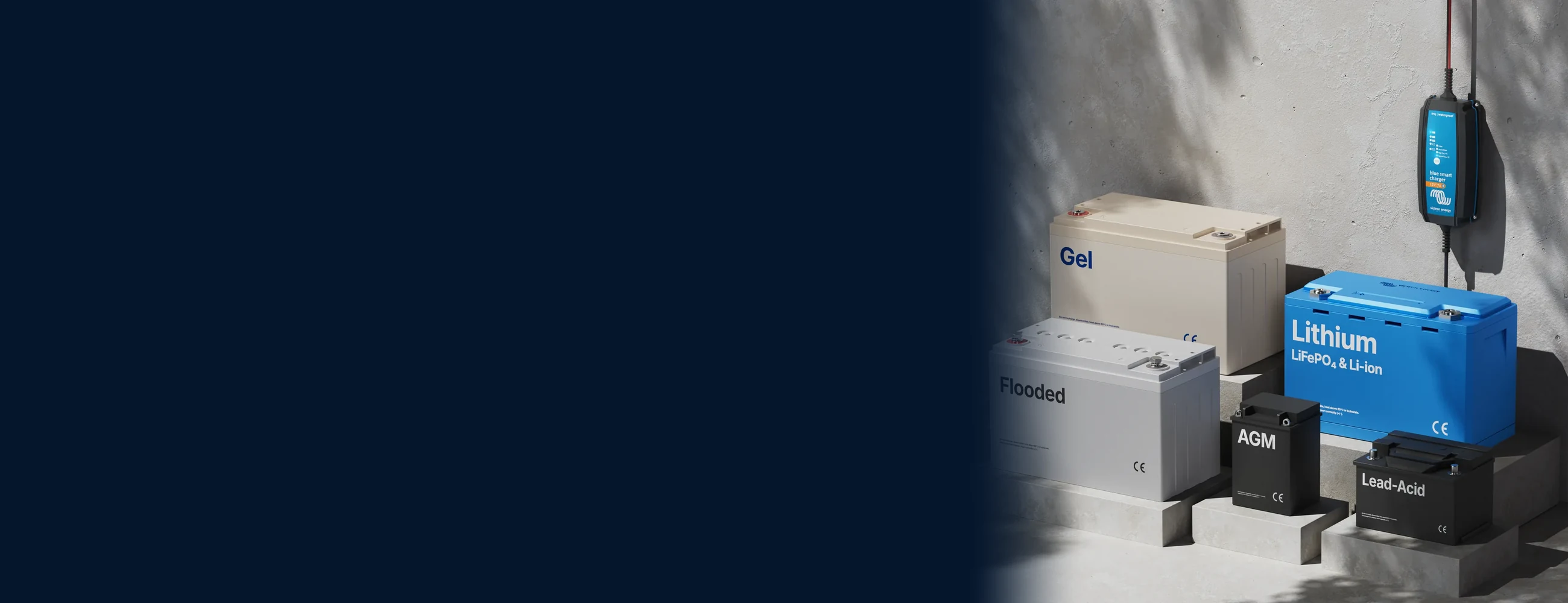
Battery charging time
Enter the battery type and capacity, state of charge and charger current. We will calculate how long the bulk phase and full charge will take — using the formula from Victron Blue Smart charger manuals.
Victron manual formula
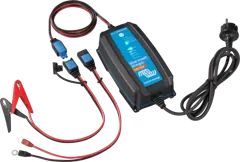 Blue Smart IP65its manual gives this formula
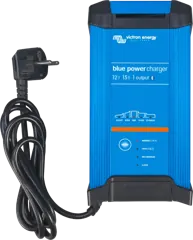 Blue Smart IP22indoor charger
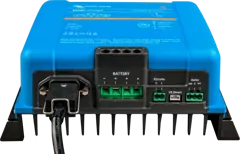 Smart IP43higher charging currents
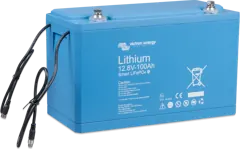 LiFePO4 Smartcharging only above +5 °C
The Blue Smart IP65 charger manual (section “Estimating charge time”) splits charging into two parts:
- Bulk phase — the charger delivers full current until the voltage reaches absorption voltage. Time: Tbulk = Ah ÷ I, where Ah is the missing capacity to around 80% (lead-acid battery) or around 95% (lithium battery), and I is the charging current excluding the current drawn by loads.
- Absorption phase — constant voltage, current slowly falls. In lead-acid batteries, the time is adaptive: from 30 minutes to 8 hours, depending on how deeply the battery was discharged (the charger estimates this from the length of the bulk phase). In lithium batteries, absorption usually lasts less than 30 minutes.
Examples from the manual — a 100 Ah battery discharged to zero and a 10 A charger: lead-acid 100 × 80% ÷ 10 = 8 h bulk + 8 h absorption = 16 h; lithium 100 × 95% ÷ 10 = 9.5 h bulk + 0.5 h = 10 h. The calculator gives the same results.
What charging current: according to the same manual, the maximum charging current should usually not exceed around 0.3C for lead-acid batteries (30% of capacity in Ah, e.g. 30 A for 100 Ah) and around 0.5C for LiFePO4. With a small battery and a powerful charger, low current mode helps. The values in the datasheet of the specific battery take priority.
What the calculator does not include: charging losses, temperature (Victron Smart LiFePO4 batteries charge only above +5 °C), the reconditioning phase (recondition, up to 1 h) or current limits imposed by the BMS. Treat the result as an estimate.
We describe charging phases and charger settings on the Blue Smart IP65, Blue Smart IP22 and Smart IP43 pages. If charging takes clearly longer, see Blue Smart does not charge.
Sources
Content checked against Victron Energy documentation (datasheets and manuals) — status as of 23 September 2026. Report an error in the content · Correction log