
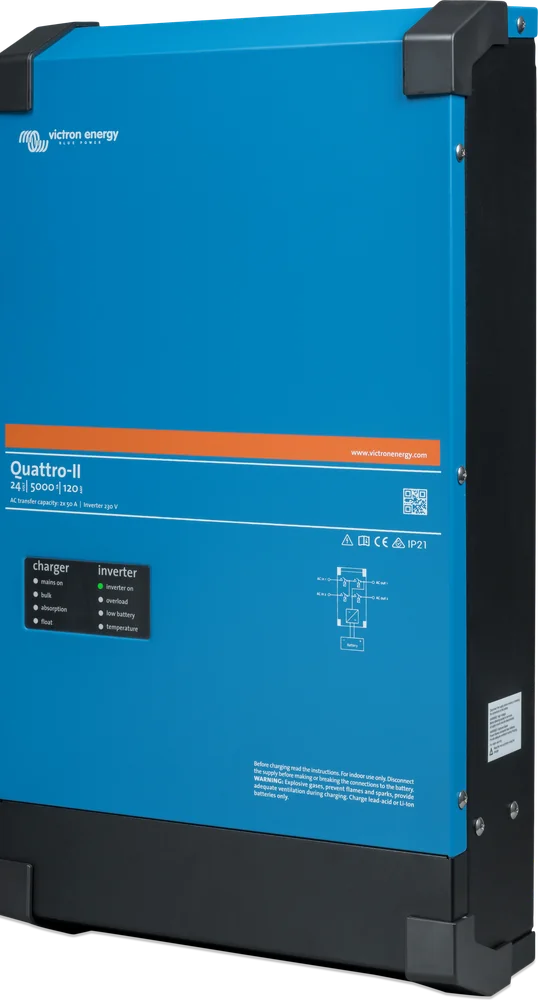
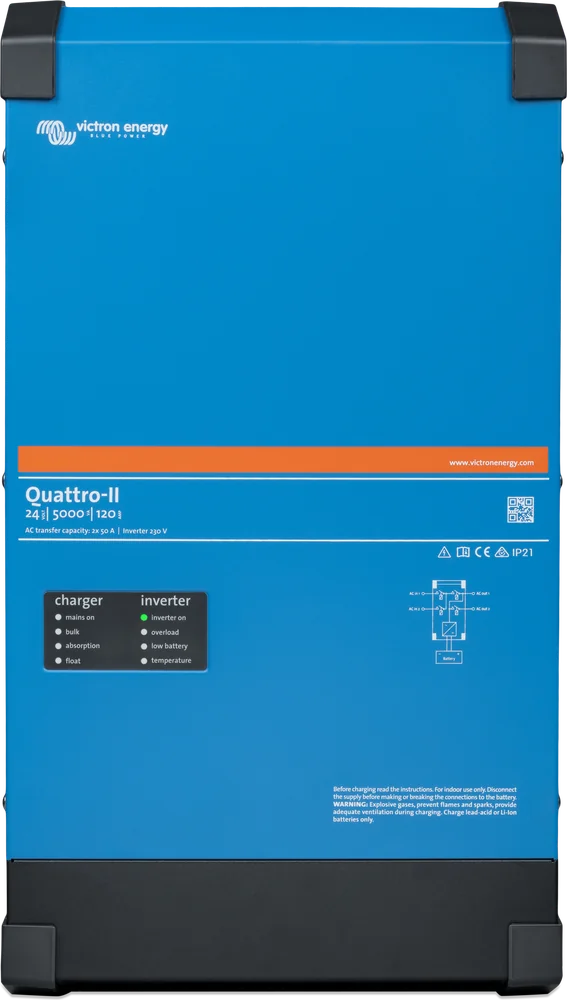
Quattro-II 24/5000 230 V — side view
Quattro-II
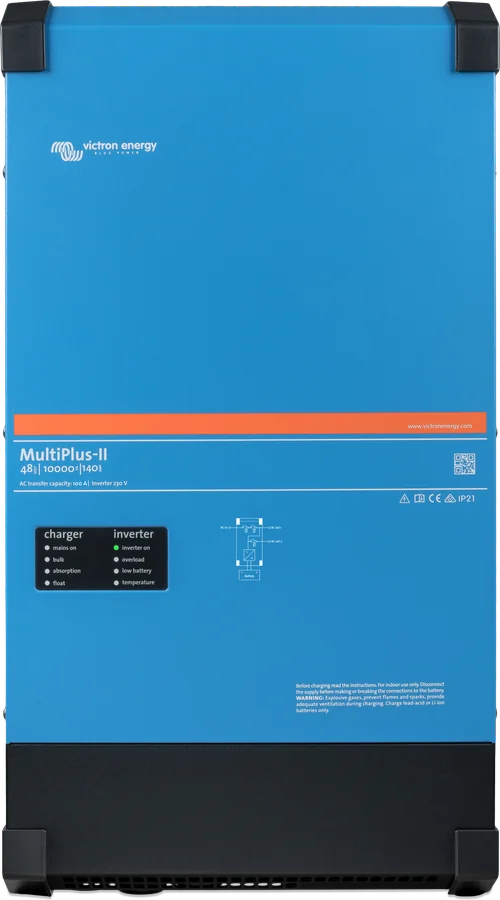
Everything the MultiPlus-II can do, plus a second AC input. You connect grid and generator (or shore power and generator), and the Quattro-II automatically switches to whichever source is available.
- 24 / 48 V DC
- 5000 VA
- 2 × 50 A AC input
- 230 V · 50 Hz
- switch-over < 20 ms
Two power sources without an extra switch
Many installations have two 230 V sources: grid and generator in an off-grid or backup-power home, shore power and generator on a yacht, or two generators. With a MultiPlus-II you need an external transfer switch. The Quattro-II has two AC inputs and automatically switches to the source that is active.
Otherwise, it has the same feature set as the MultiPlus-II: pure sine wave inverter, adaptive charger, UPS function with changeover in less than 20 ms, PowerControl and PowerAssist, parallel and three-phase operation, ESS.
- yachts: shore power in harbour + generator on board,
- homes and cabins: grid + backup generator,
- off-grid and technical sites: two generators.


What the Quattro-II can do
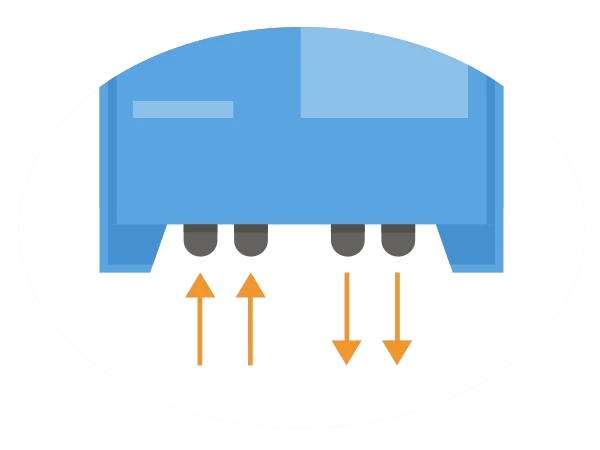
Two AC inputs
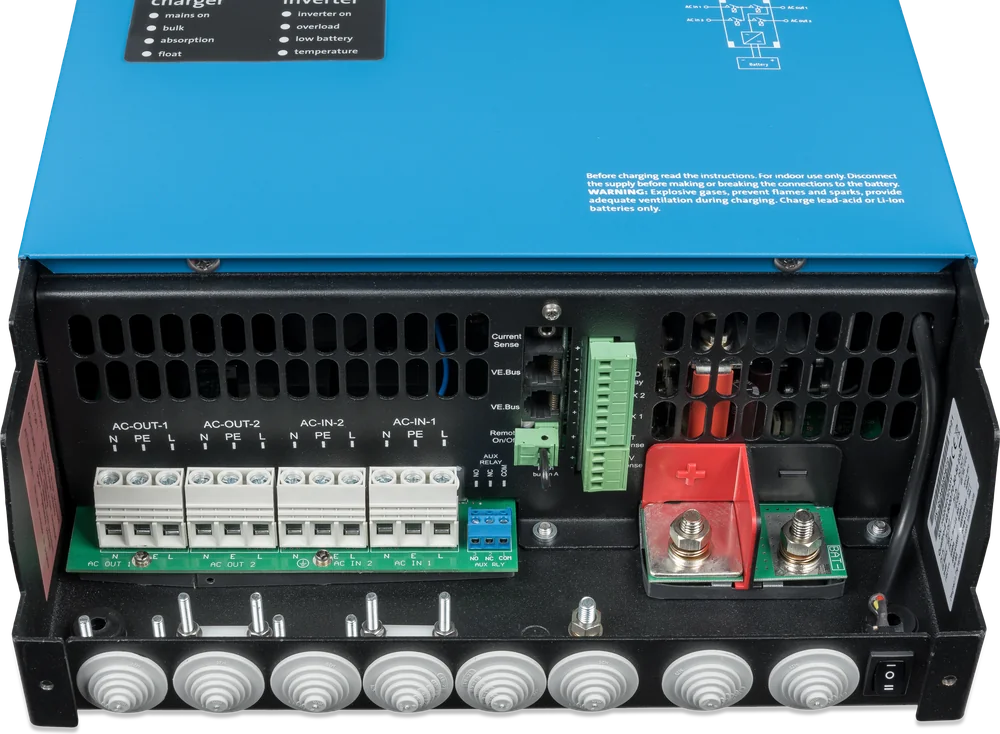
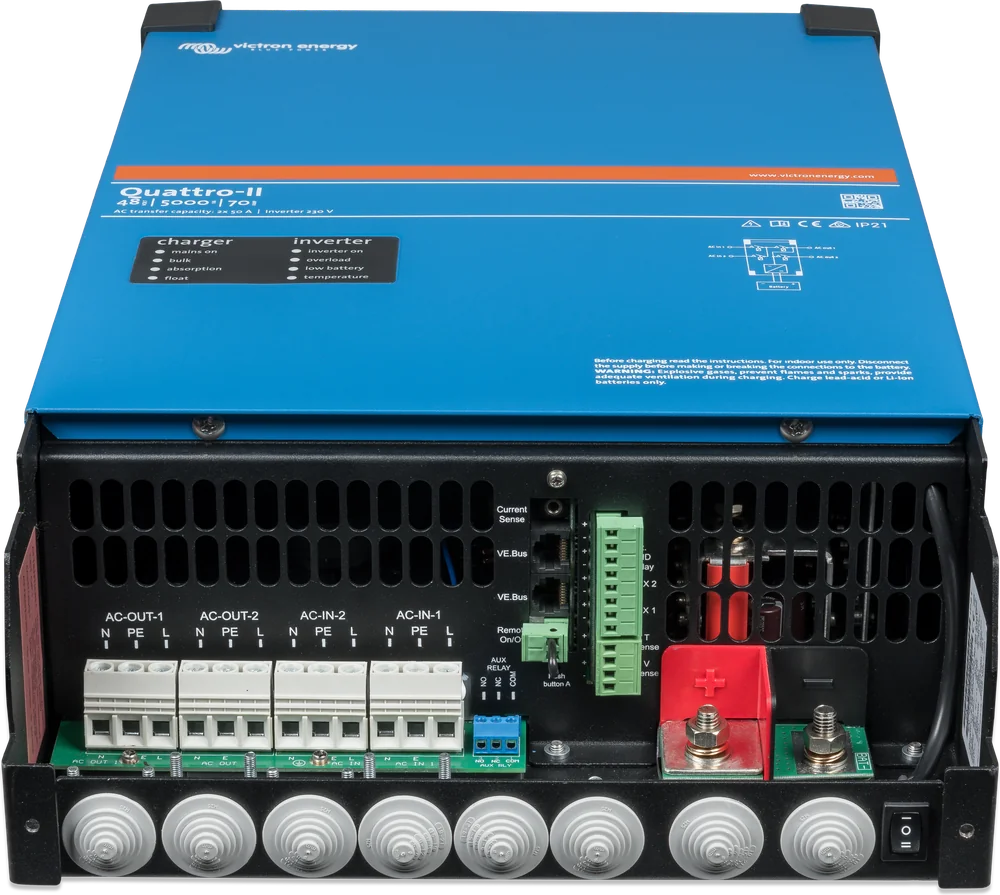
AC-in-1 and AC-in-2: max. 50 A; each input must be protected by a 50 A fuse or circuit breaker or smaller, also matched to the source and cable rating. The Quattro-II switches to the active source automatically; when both are available, AC-in-1 has priority.
UPS function
After external power is lost, it takes over supplying the loads on AC-out-1 in less than 20 ms. Computers and electronics keep running.
PowerControl
You set the maximum current drawn from the source. When the load draw approaches the limit, the Quattro-II reduces the battery charge current.
PowerAssist
At peak load it supplements a small generator or shore connection with battery power, and after the load drops it recharges the battery.
Second AC output
AC-out-2 works only when external power is present and is used for air conditioning or a water heater that should not discharge the battery. When AC appears on AC-in-1, the loads are switched on again after about 2 minutes.
ESS and expansion
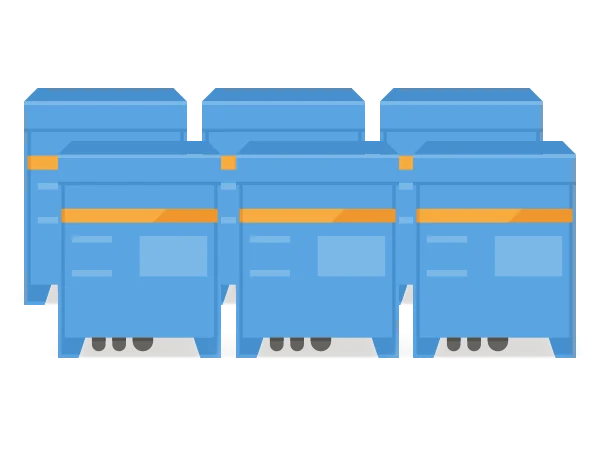
Together with a GX device it works as an energy storage system (ESS). Up to 6 identical units in parallel; three identical units can be configured as a three-phase star (Y) system; do not use delta (Δ) configuration.
Two 230 V models
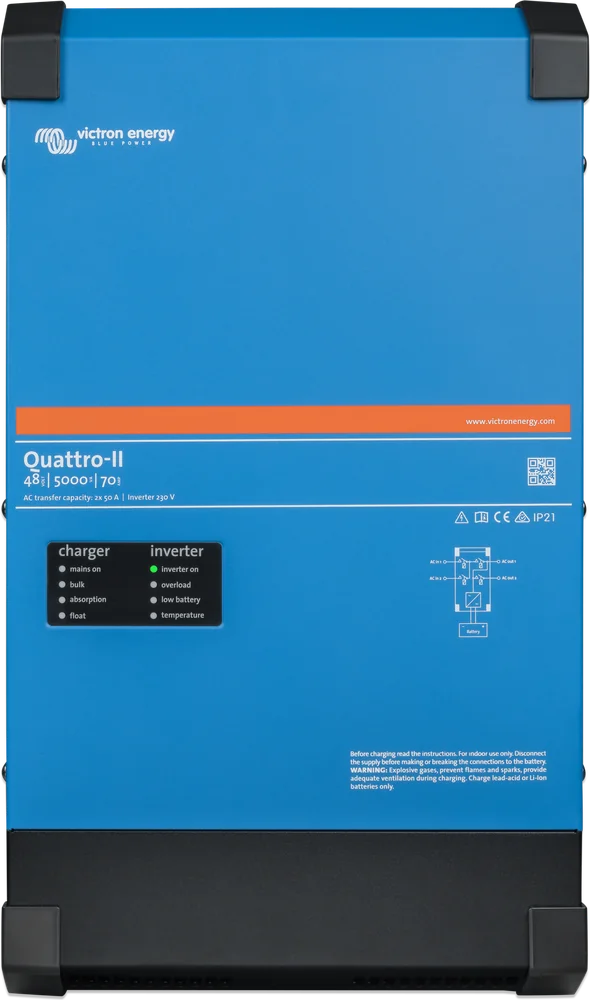
| Parameter | Quattro-II 24/5000/120-50/50 | Quattro-II 48/5000/70-50/50 |
|---|---|---|
| Battery voltage (range) | 24 V (19–33 V) | 48 V (38–66 V) |
| Continuous power at 25 °C | 5000 VA · 4000 W | 5000 VA · 4000 W |
| Continuous power at 40 °C / 65 °C | 3700 W / 3000 W | 3700 W / 3000 W |
| Peak power | 9000 W | 9000 W |
| Max. charging current | 120 A | 70 A |
| AC-in-1 / AC-in-2 switch | 50 A / 50 A | 50 A / 50 A |
| Maximum efficiency | 96% | 96% |
| No-load consumption / AES mode / search mode | 18 W / 12 W / 2 W | 18 W / 12 W / 2 W |
| Weight | 31 kg | 29 kg |
| Dimensions (H × W × D) | 607 × 329 × 149 mm | 565 × 320 × 148 mm |
How to read the name: 24/5000/120-50/50 = 24 V battery / 5000 VA power / 120 A charge current / 50 A AC-in-1 switch / 50 A AC-in-2 switch. The manufacturer also offers other Quattro-II variants (including 120 V for the US market) — the table covers the 230 V models from the datasheet.
- Output voltage
- 230 V ±2%, 50 Hz (60 Hz possible)
- Charger AC input
- 187–265 V, 45–65 Hz
- Absorption / float (default)
- 28.8 / 27.6 V · 57.6 / 55.2 V
- Auxiliary output
- 32 A, disabled by default in inverter mode
- Battery temperature sensor
- yes
- Programmable relay
- yes (alarm, low voltage, generator start)
- Operating temperature
- −40 … +65 °C
- Enclosure
- steel, IP21
- Battery connection
- M8 screws
- 230 V connections
- 13 mm² screw terminals
Grid, generator and battery in one system
An example of a home or yacht with two 230 V sources. Hover over or tap a diagram element to see its description.
- Grid / shore power → AC-in-2Up to 50 A, with its own current limit.
- Generator → AC-in-1Priority input, up to 50 A. When the generator is running, the Quattro-II switches to it.
- Quattro-IIPasses through the active source and charges the battery or generates 230 V from the battery.
- AC-out-1 → 230 V loadsThey always work — from the source or from the battery.
- AC-out-2 → air con, water heaterOnly when powered from an external source.
- Battery + MPPTA shared storage system charged from AC sources and from solar panels.
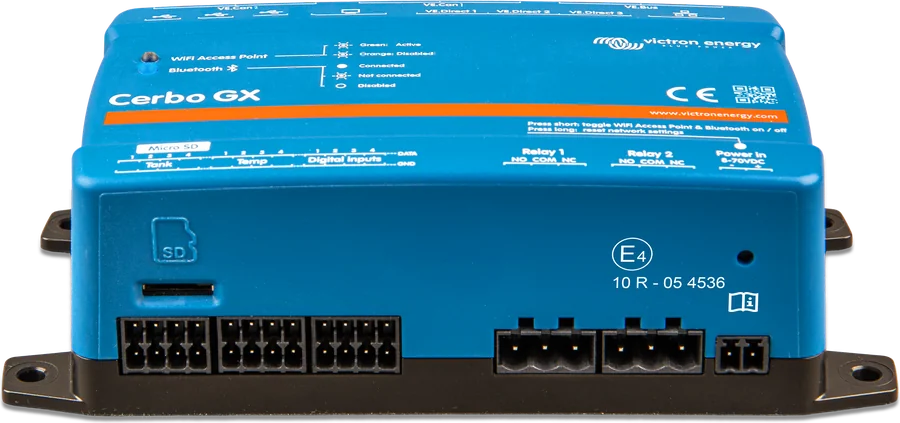
- Cerbo GX (VE.Bus)Monitoring, input limits, generator start, VRM.

When to use which device
| Quattro-II | MultiPlus-II | |
|---|---|---|
| AC inputs | 2 | 1 |
| AC outputs | 2 | 2 |
| UPS function (< 20 ms) | yes | yes |
| PowerControl / PowerAssist | yes | yes |
| ESS, parallel operation, 3 phases | yes | yes |
| 12 V versions | not in the 230 V datasheet | yes |
| 230 V datasheet power | 5 kVA | 3–15 kVA |
Choose Quattro-II when you have two independent 230 V sources and want the unit to select the active source itself — without an extra transfer switch box and its wiring.
Choose MultiPlus-II when you have a single source (for example, only a campsite hook-up), you need a 12 V version, or you need a power rating other than 5 kVA. With two sources, an external switch is enough.
Two AC inputs for 12 V or power above 5 kVA are provided by the classic Quattro 3–15 kVA — nine 230 V models from 12/3000 to 48/15000.
What to watch out for
Connecting both sources, RCDs, earthing and the link to the home installation should be done by a qualified electrician. Each AC input needs its own protection. Also choose the RCD and the fuse or circuit breaker in series with AC-out-1 to suit the expected load; with PowerAssist, the output can supply up to 71 A.
There must be a fuse and a disconnect switch between the battery and Quattro-II. Use the cable cross-sections and fuse ratings from the manual for your model.
Settings are changed by a qualified electrician; when configuring the charger, disconnect the AC input. Configuration is done with the MK3-USB interface in VictronConnect or VEConfigure. Via Bluetooth: the VE.Bus Smart dongle (Bluetooth) lets you monitor the device, switch it on and off, and change the AC input current limit — to change settings, you need the MK3-USB interface. Remotely — through the GX device and VRM.
The generator and the shore power usually have different capacity. Separate limits for AC-in-1 and AC-in-2 are set in VEConfigure; the GX device changes only inputs marked “Overruled by remote”.
Install in a dry, well-ventilated room, with free space for fan cooling.
Quattro-II FAQ
What happens when both sources are available at the same time?
Quattro-II uses one source at a time — it does not connect them together. In Quattro units, AC-in-1 has priority, so the generator is usually connected there, and the grid or shore power to AC-in-2: when the generator starts, Quattro switches to it. Note from the manual: Quattro-II may not start when voltage is present only on AC-in-2 and the battery voltage is 10% or more below nominal — in that case, connect the supply to AC-in-1 or charge the battery.
Can I connect two generators?
Yes — the manufacturer explicitly lists a configuration with two generators. Quattro-II switches to the one that is running.
Will Quattro-II replace a home UPS?
For circuits on AC-out-1 — yes: when the grid fails, it takes over in less than 20 ms. Just remember the battery capacity — that determines how long the loads will run.
Can I connect solar panels directly?
No — Quattro-II has no PV input. Panels are connected via an MPPT solar charge controller to the battery or via a grid-tie inverter on the AC output (the “Factor 1.0” rule from Victron documentation).
How many Quattro-II units can I connect together?
Up to 6 identical units in parallel. Three identical models can be configured as a three-phase star (Y) system; do not use delta (Δ) configuration. Up to 18 units in total (6 per phase) — the manual then states 72 kW / 90 kVA inverter power.
Devices it works with most often
Manufacturer documentation
- Quattro-II 230 V datasheetPDF · EN
- Quattro-II 230 V manualPDF · EN
- Manufacturer’s product page (certificates, drawings)victronenergy.com
We prepared this description independently based on the manufacturer’s documentation. If there are any discrepancies, the current Victron Energy documentation is binding. You can report an error here.
Content checked against Victron Energy documentation (datasheets and manuals) — as of 19 September 2026. Report a content error · Revision log