
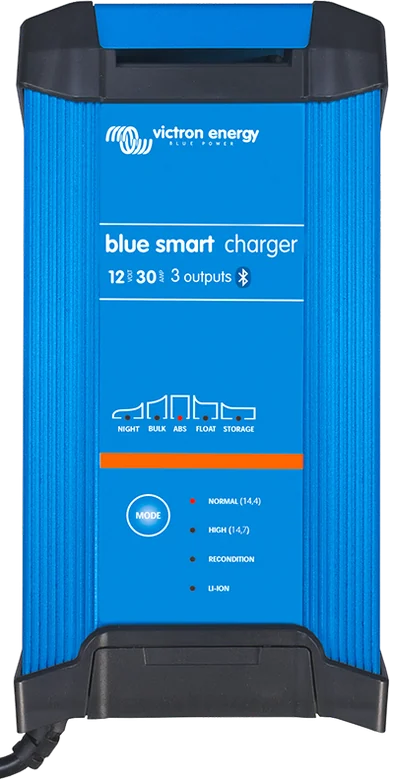
Blue Smart IP22 12|30 with three outputs — front with charge-status LEDs
Blue Smart IP22 Charger
Mains charger for indoor use (IP22) — for a location protected from water, moisture and dust, with good ventilation: garage, campervan conversion, technical room. Higher currents than the Blue Smart IP65; night mode, Bluetooth and VE.Smart networking. Versions with one or three isolated outputs.
- 12 / 24 V
- 8–30 A
- 1 or 3 outputs
- Bluetooth, VE.Smart
- IP22
Currents, fuses, capacities
| Model | Outputs | Max current / NIGHT / min. | Recommended fuse | Max capacity (≥ 0.1C) | Min. capacity lead-acid / Li-ion |
|---|---|---|---|---|---|
| 12/15 | 1 or 3 | 15 / 7.5 / 3.7 A | 20–30 A | 150 Ah | 50 / 30 Ah |
| 12/20 | 1 or 3 | 20 / 10 / 5 A | 30–40 A | 200 Ah | 67 / 40 Ah |
| 12/30 | 1 or 3 | 30 / 15 / 7.5 A | 40–70 A | 300 Ah | 100 / 60 Ah |
| 24/8 | 1 | 8 / 4 / 2 A | 15–20 A | 80 Ah | 27 / 16 Ah |
| 24/12 | 1 | 12 / 6 / 3 A | 20–30 A | 120 Ah | 40 / 24 Ah |
| 24/16 | 1 or 3 | 16 / 8 / 4 A | 25–40 A | 160 Ah | 53 / 32 Ah |
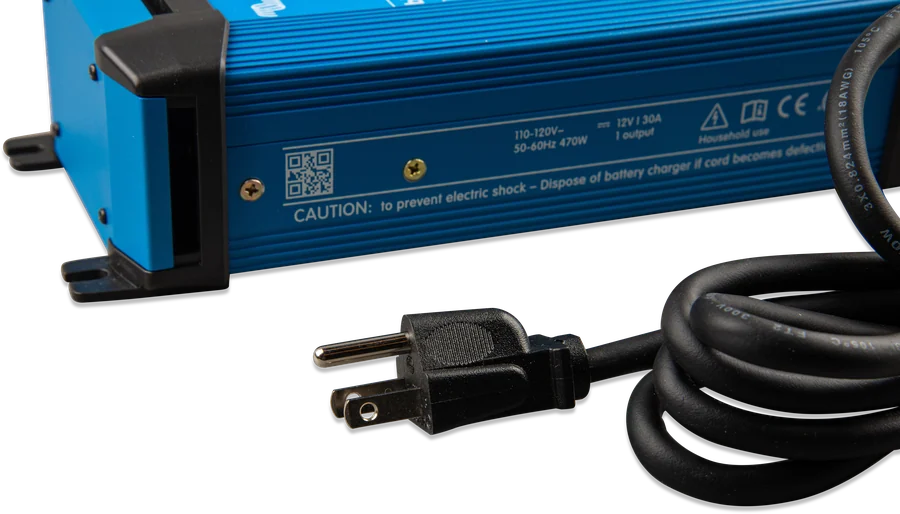
Minimum capacity at full current: lead-acid up to 0.3C, Li-ion up to 0.5C. Input 220–240 V (range 180–265 V), 45–65 Hz; 1.5 m mains lead with plug. Fan cooling (except 12/15 and 24/8 models). 16 mm² terminals, weight 1.3 kg, dimensions 235 × 108 × 65 mm. Models with three outputs have a built-in FET isolator; the total output current will not exceed the rated current. The outputs are not individually regulated — one algorithm and one voltage for all, so the connected batteries must match it.
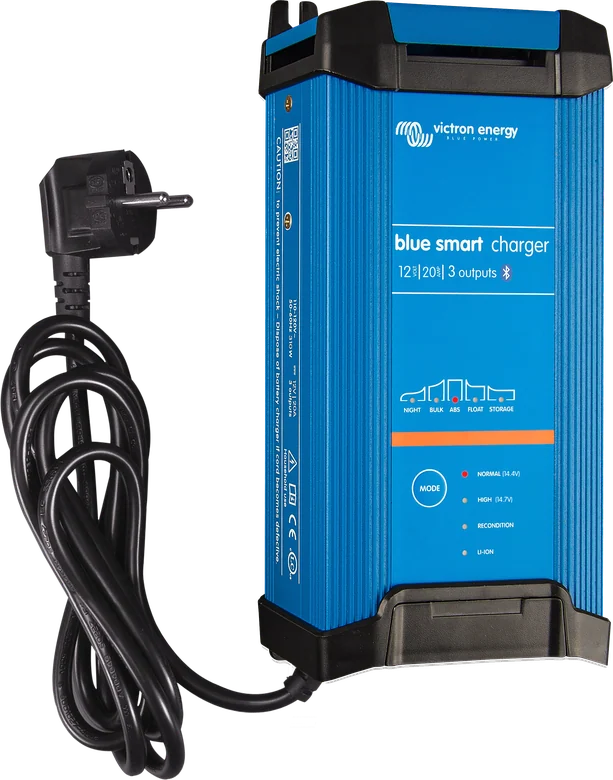
Voltages and operating modes
| Mode (12 V) | Absorption | Float | Storage |
|---|---|---|---|
| Normal | 14.4 V | 13.8 V | 13.2 V |
| High | 14.7 V | 13.8 V | 13.2 V |
| Li-ion | 14.2 V | then maintain 13.5 V | |
For 24 V: absorption 28.8 / 29.4 / 28.4 V, Li-ion maintenance 27.0 V.
- Six-stage algorithm for lead-acid batteries: test, bulk, absorption, recondition, float, storage; adaptive absorption 30 min – 8 h. Storage (13.2 V) after 24 h without discharge, with a return to absorption once a week. For Li-ion — a simple bulk–absorption–float cycle, temperature compensation automatically disabled.
- NIGHT: hold MODE for 3 s — current reduced to 50%, charger completely silent, after 8 h it returns to normal operation. LOW: MODE 6 s — the same limit permanently, until manually switched off.
- Recondition (16.2 V in Normal, 16.5 V in High at 12 V) — only for lead-acid batteries that allow it; the manufacturer does not recommend it for regular use, because excessive gassing shortens battery life.
- It also charges a battery discharged to 0 V, and a lithium battery cut off by undervoltage protection (UVP) is automatically unlocked and starts charging. It can operate as a power supply.
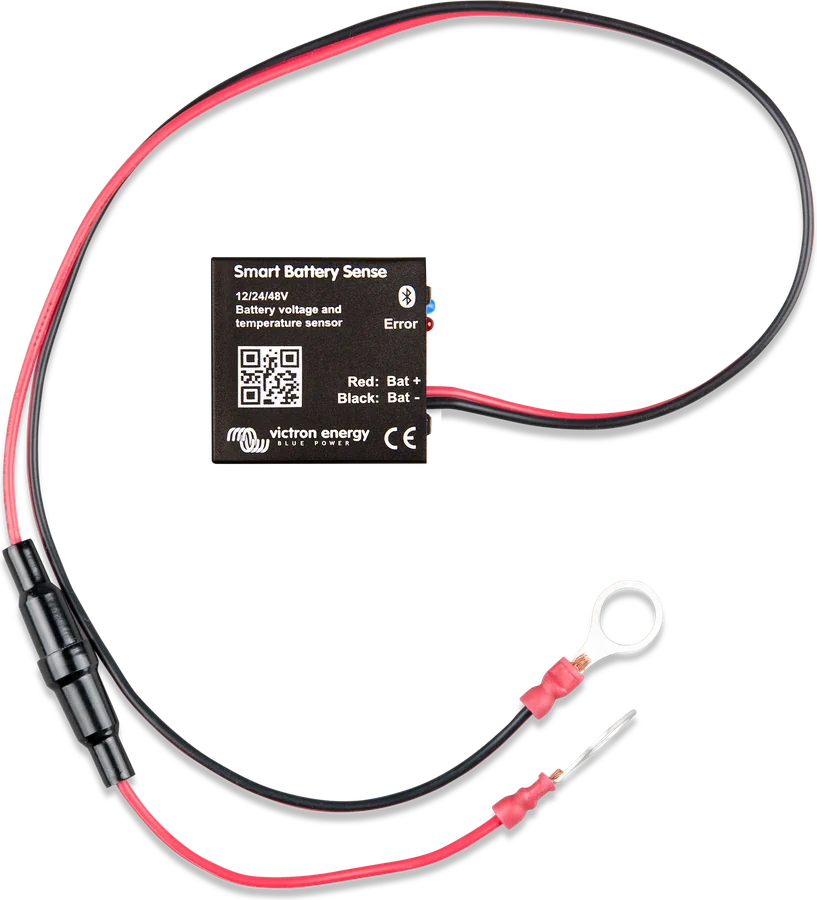
- VE.Smart (units from serial number HQ2024…, hw rev 2 and later): up to 10 devices, one battery monitor; several chargers (also with different currents) can charge synchronously as one — they must have the same charging settings.
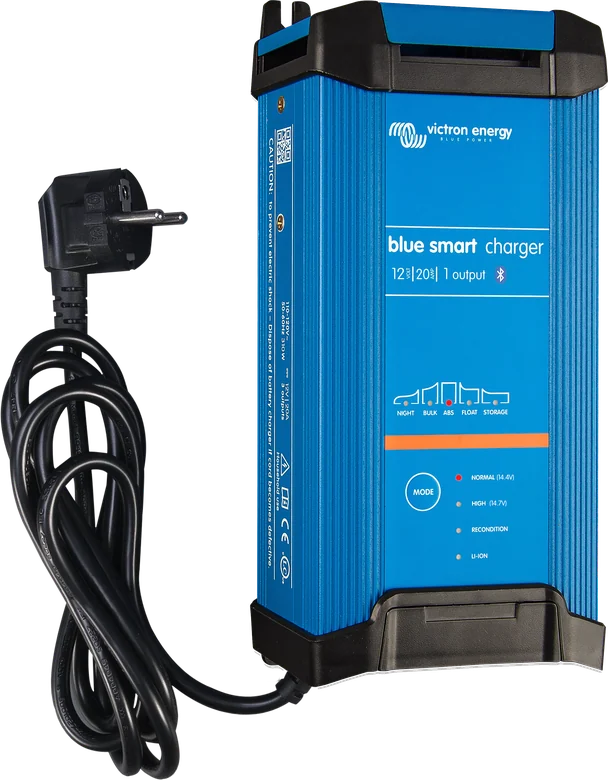
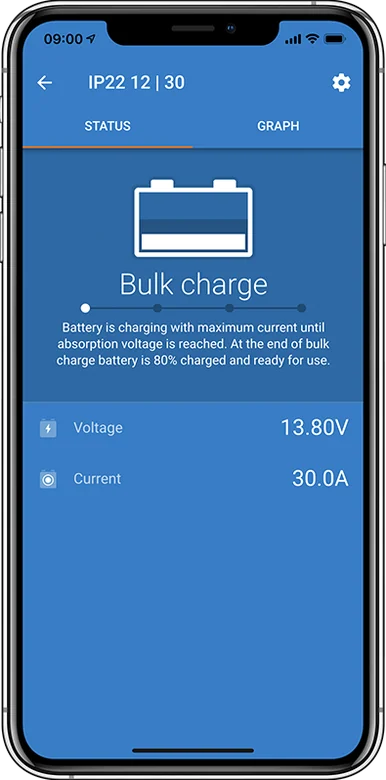
How to connect the Blue Smart IP22
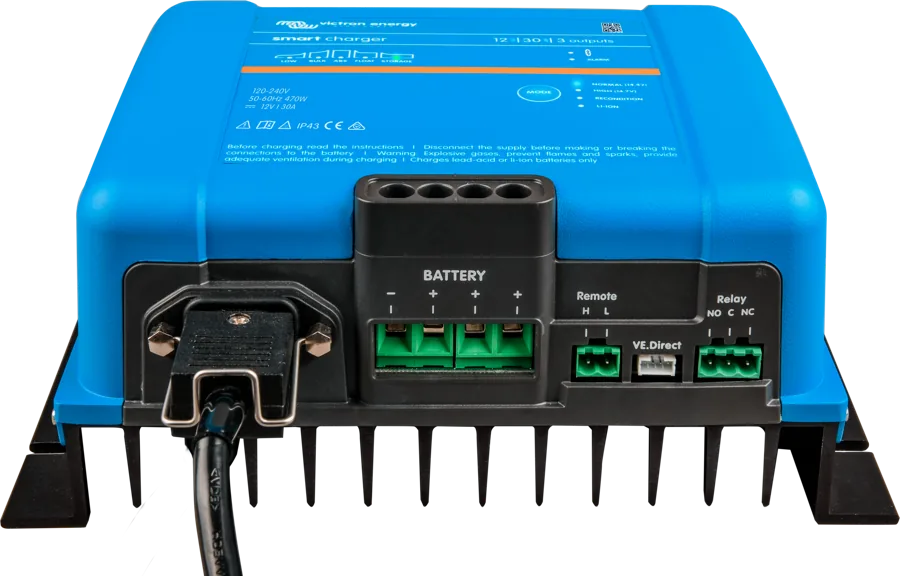
The charger hangs vertically, terminals facing down, with 10 cm free space above and below the casing — never above a battery or in a closed compartment with a battery. The three-output version charges several banks at the same time. Hover over or tap a diagram element to see details. Illustration only.
- 230 V mains → chargerOnly a grounded socket, AC cable undamaged.
- Charger → batteryFuse as close to the battery as possible, terminals 2.4 Nm.
- Additional outputsThe (3) version charges several banks; the sum of the currents will not exceed the charger current.
- In a vehicle with negative to chassisFirst positive to the battery positive terminal, then negative to chassis ground; disconnect in reverse order.
- VictronConnectCharging mode, current, night mode, VE.Smart networking.
Installation rules
- Vertically, terminals facing down, on a non-combustible surface, in a place with good natural ventilation; at least 10 cm of free space around it (100 mm above and below). Do not place it above a battery or in a closed compartment with a battery; do not put anything on the charger.
- Before work on the wiring, switch off and isolate the DC system. Fuse at the battery according to the table above; flexible cables, wire up to 0.4 mm diameter; tighten terminals to 2.4 Nm.
- Reverse polarity blows the fuse, which the user can replace.
- For temporary charging of a battery in a vehicle with negative to chassis: first positive to the battery positive terminal, then negative to the chassis ground point; disconnect in the reverse order.
- Only a grounded socket; do not use a damaged AC cable. The manual prohibits charging Li-ion below 0 °C — Victron LiFePO4 batteries require at least +5 °C (LiFePO₄ in winter).
- Above 40 °C the current is reduced — according to the manual, linearly to 25% at 50 °C.
What the LEDs show
- The LED for the current phase lights up: BULK, ABS, FLOAT, STORAGE; RECONDITION flashes during the recondition phase.
- BULK, ABS, FLOAT and STORAGE lit together — power supply mode. Flashing together — error; read the code in VictronConnect (charger error codes).
- NIGHT lit — night mode; flashing — low current mode. The active phase LED goes out briefly every 4 s — VE.Smart networking.
- Reset PIN to 000000 and re-enable Bluetooth: hold MODE for 10 s (pairing then has to be done again). Factory reset does not change the PIN or pairing.
IP22, IP65 or IP43
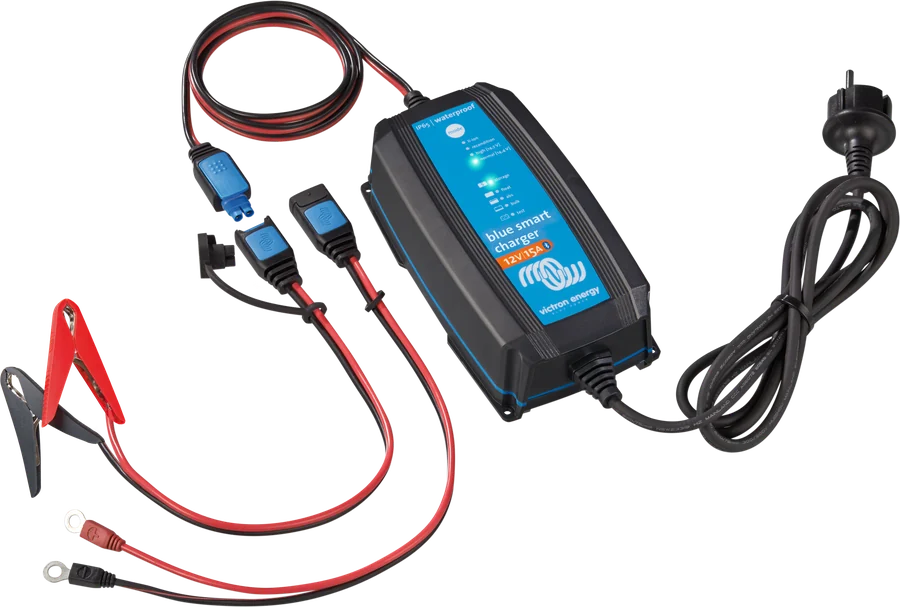
Blue Smart IP65 is sealed and portable, but has lower currents. IP22 — for dry indoor spaces, up to 30 A, night mode, option of three outputs. Smart IP43 — up to 50 A, fanless, with VE.Direct and relay; for permanent installation in larger systems.
Most frequently asked questions about Blue Smart IP22
What is the difference between IP22 and IP65?
IP22 is an indoor charger: install it in a place protected from water, moisture and dust, but it delivers higher currents and is available with either one or three isolated outputs. IP65 withstands splashes and dust, but has a lower current.
Can I charge three batteries at the same time?
Yes, with the version with three outputs. Each output is isolated and can deliver full current, but their total will not exceed the charger’s rated current. The outputs are not regulated separately — one algorithm and one voltage apply to all, so the connected batteries must suit it.
The charger is noisy at night. Can it be silenced?
Yes. Holding the MODE button for 3 seconds turns on NIGHT mode: current drops to 50%, the charger becomes completely silent, and after 8 hours it returns to normal operation. Holding it for 6 seconds turns on LOW mode — the same limit, permanently, until you switch it off manually.
Will it charge a lithium battery that the BMS has disconnected due to low voltage?
Yes. The charger also charges a battery discharged to 0 V, and it unlocks a lithium battery cut off by the undervoltage protection (UVP) and starts charging it. Just remember that the manual forbids charging Li-ion below 0 °C, and Victron LiFePO4 batteries require at least +5 °C.
What does Recondition mode do and when should you use it?
It is charging at a higher voltage (16.2 V in Normal mode, 16.5 V in High at 12 V) only for lead-acid batteries that allow it. The manufacturer does not recommend it for regular use, because excessive gassing shortens battery life. Do not use it with lithium batteries.
Can several chargers charge the same bank?
Yes — on the VE.Smart network (units from serial number HQ2024…, hw rev 2 and later) up to 10 devices work in sync as one. The condition is the same charging settings, and only one battery monitor on the network.
Manufacturer documentation
Content checked against Victron Energy documentation (datasheets and manuals) — as of 19 September 2026. Report a content error · Revision log