
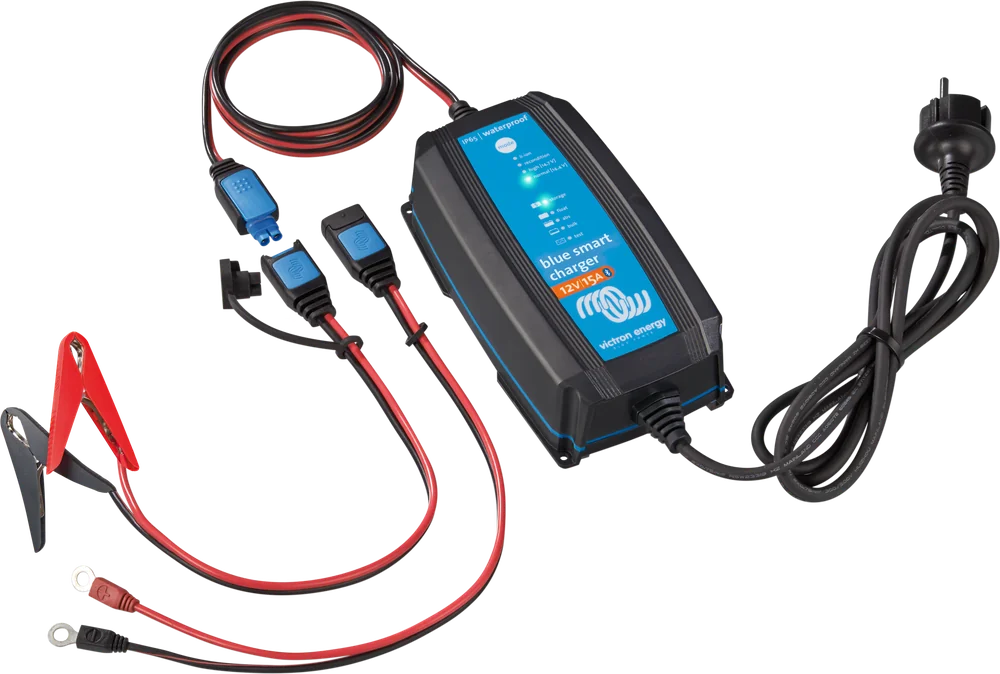
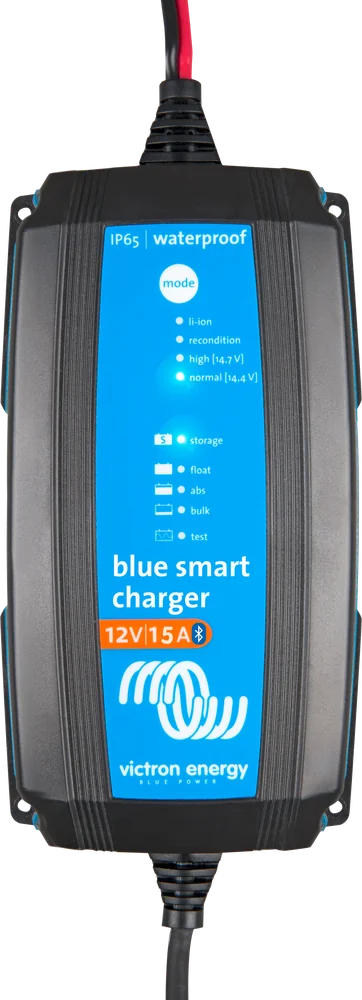
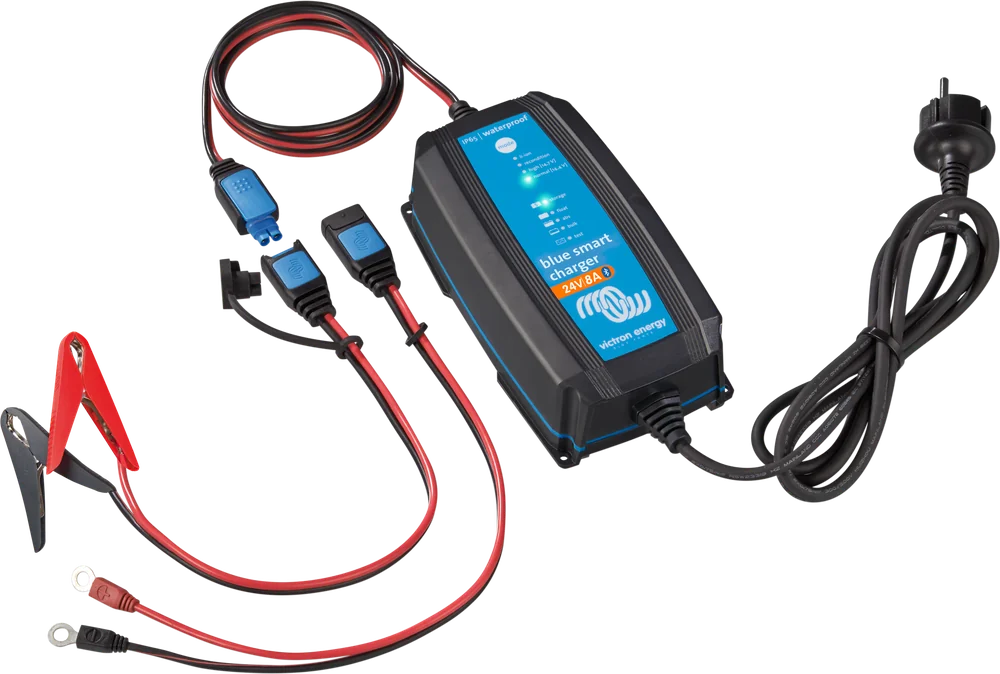
Blue Smart IP65 12 V 15 A with mains lead and battery leads
Blue Smart IP65
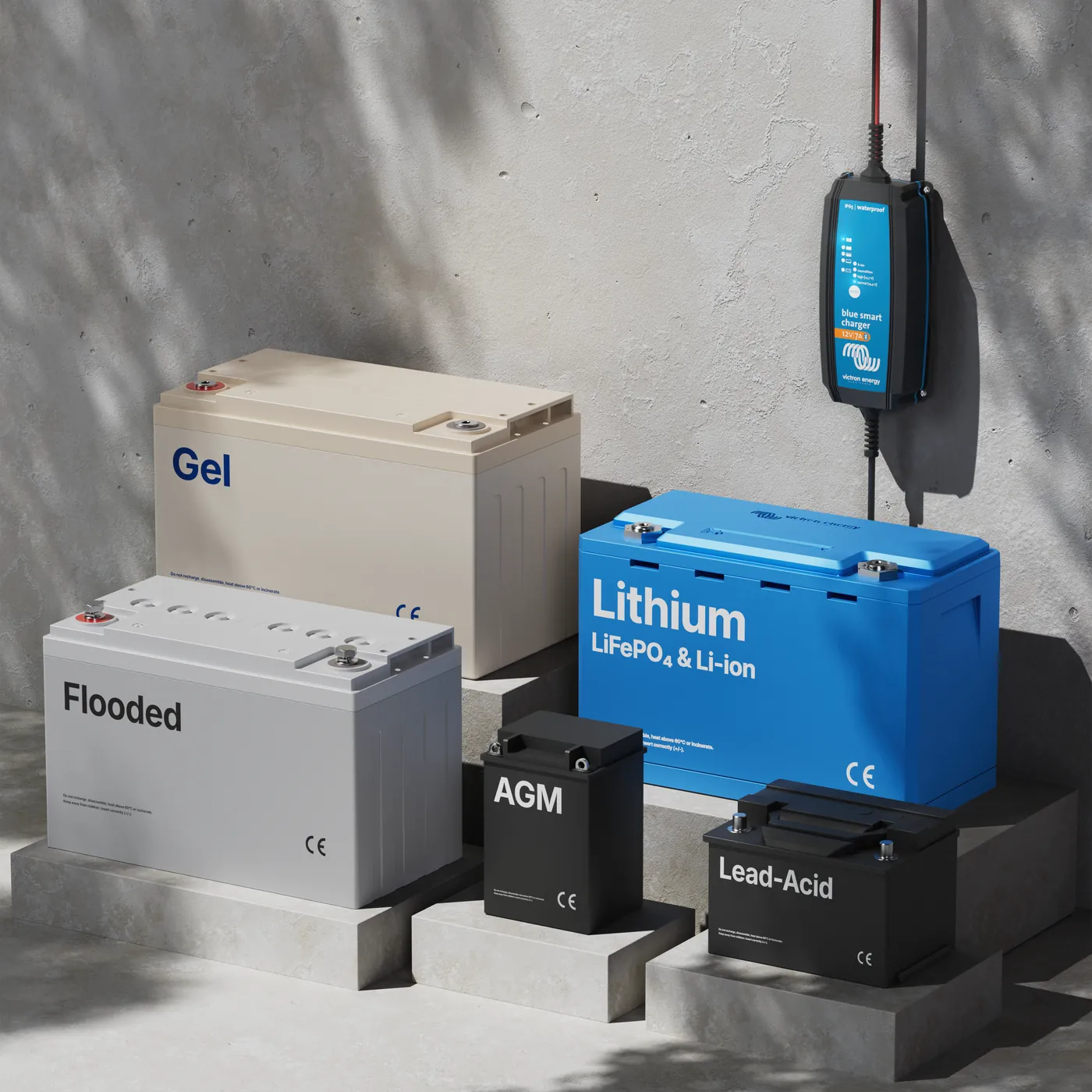
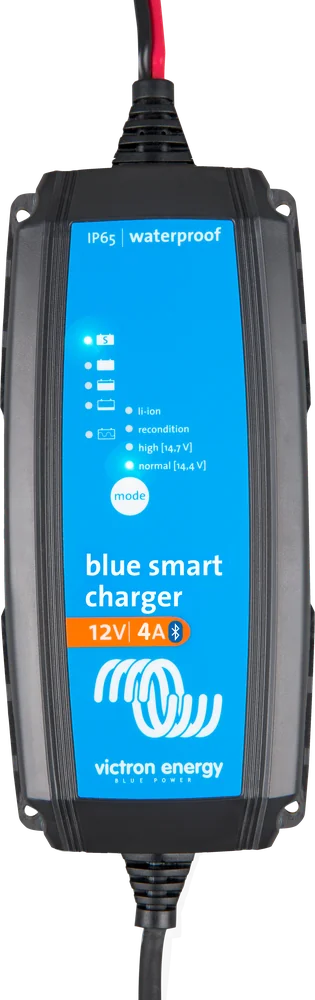
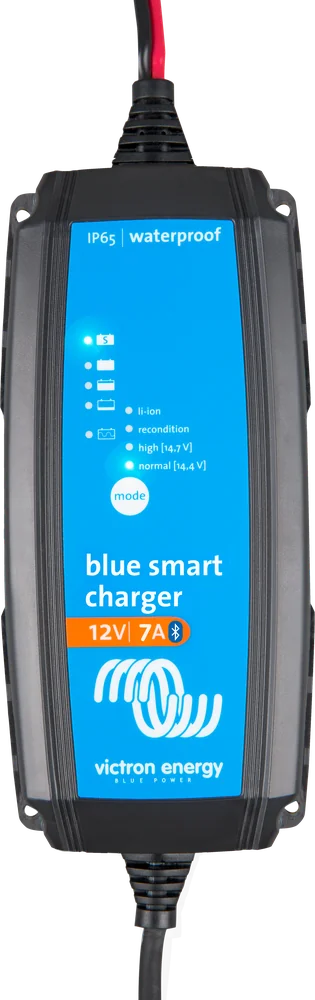
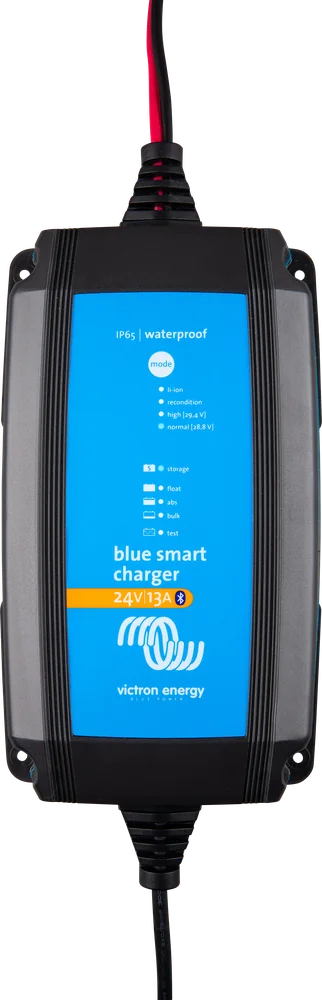
A 12 and 24 V battery charger from a socket, in an IP65 dust-tight housing. It has ready-made modes for lead-acid, AGM, gel and LiFePO4 batteries, and via Bluetooth it shows charging progress on your phone.
- 12 V: 4–25 A
- 24 V: 5–13 A
- IP65
- Bluetooth
- fanless
Charging from a socket — in the garage, at the marina, at home
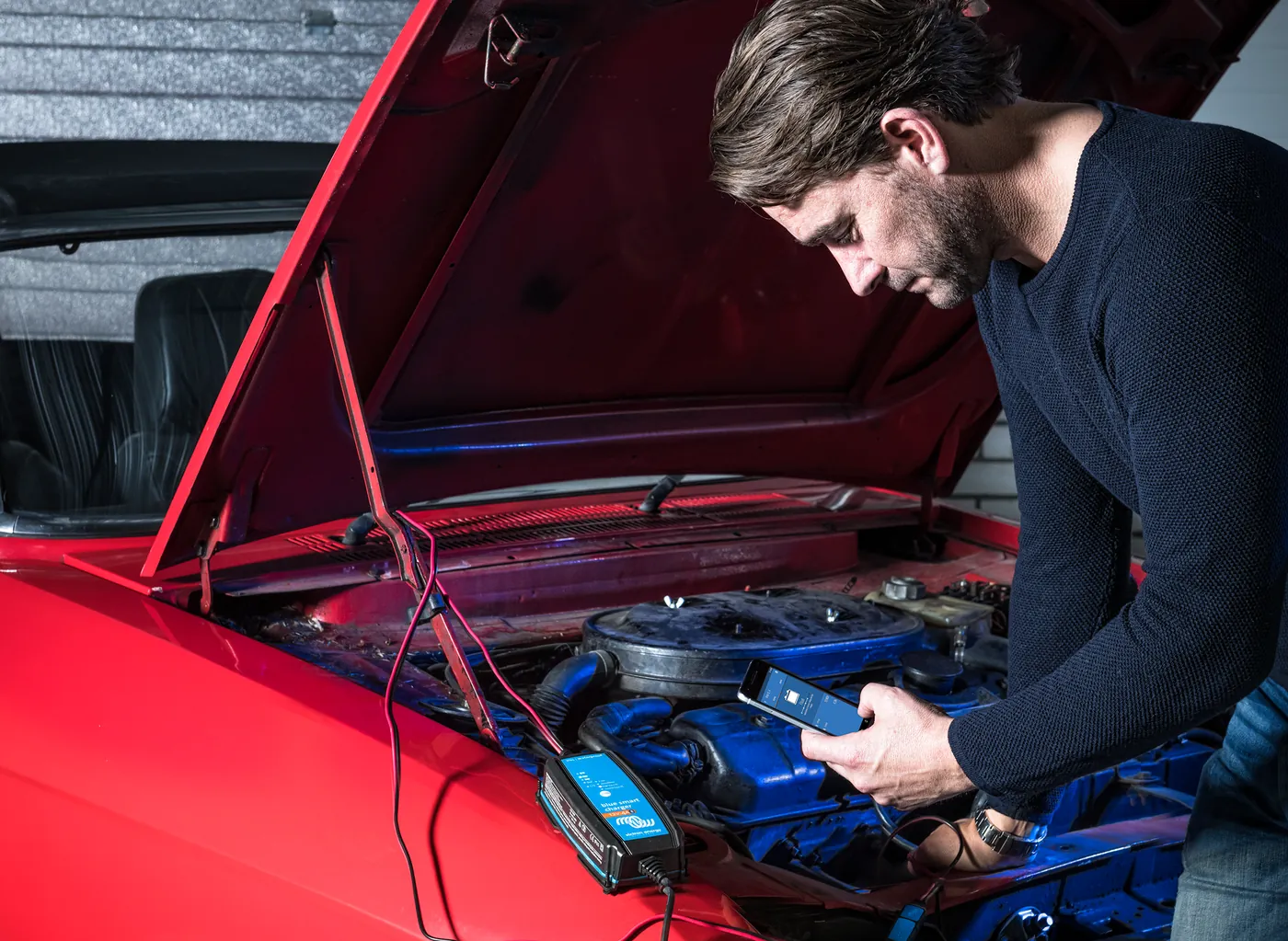
Blue Smart IP65 charges a battery from 230 V mains and can safely keep it topped up for weeks. It is most often used in a garage with a car or motorbike, at a marina with a boat, and in a camper van for winter storage.
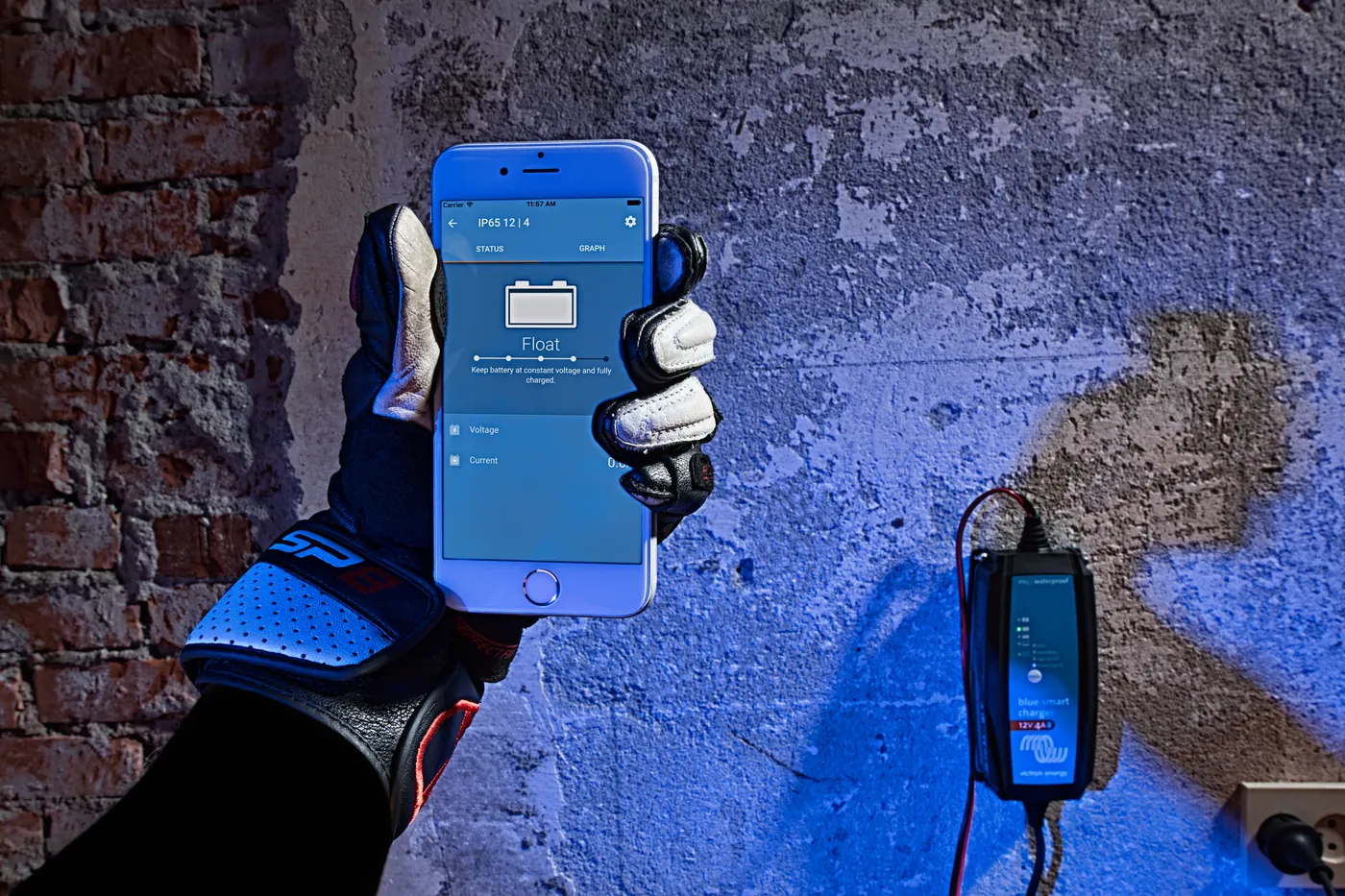
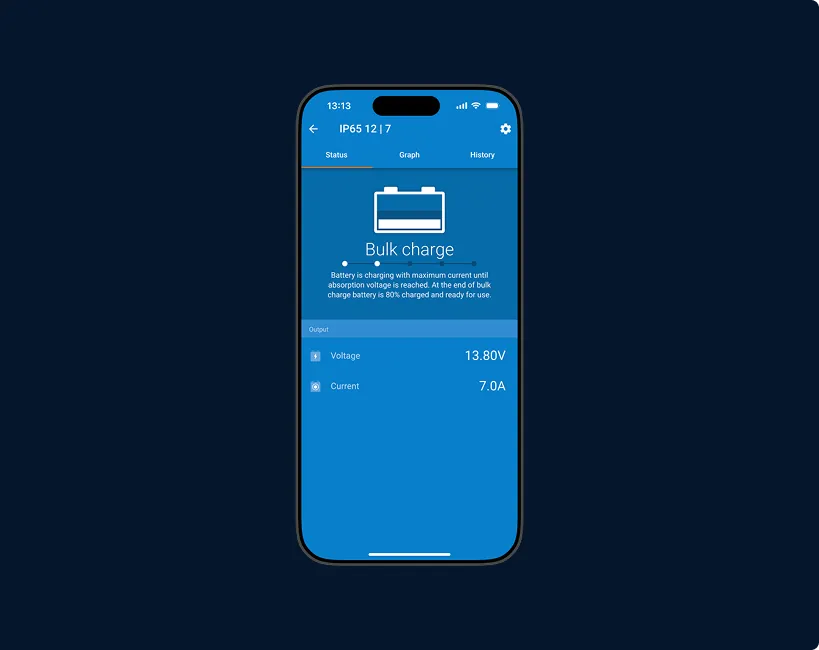
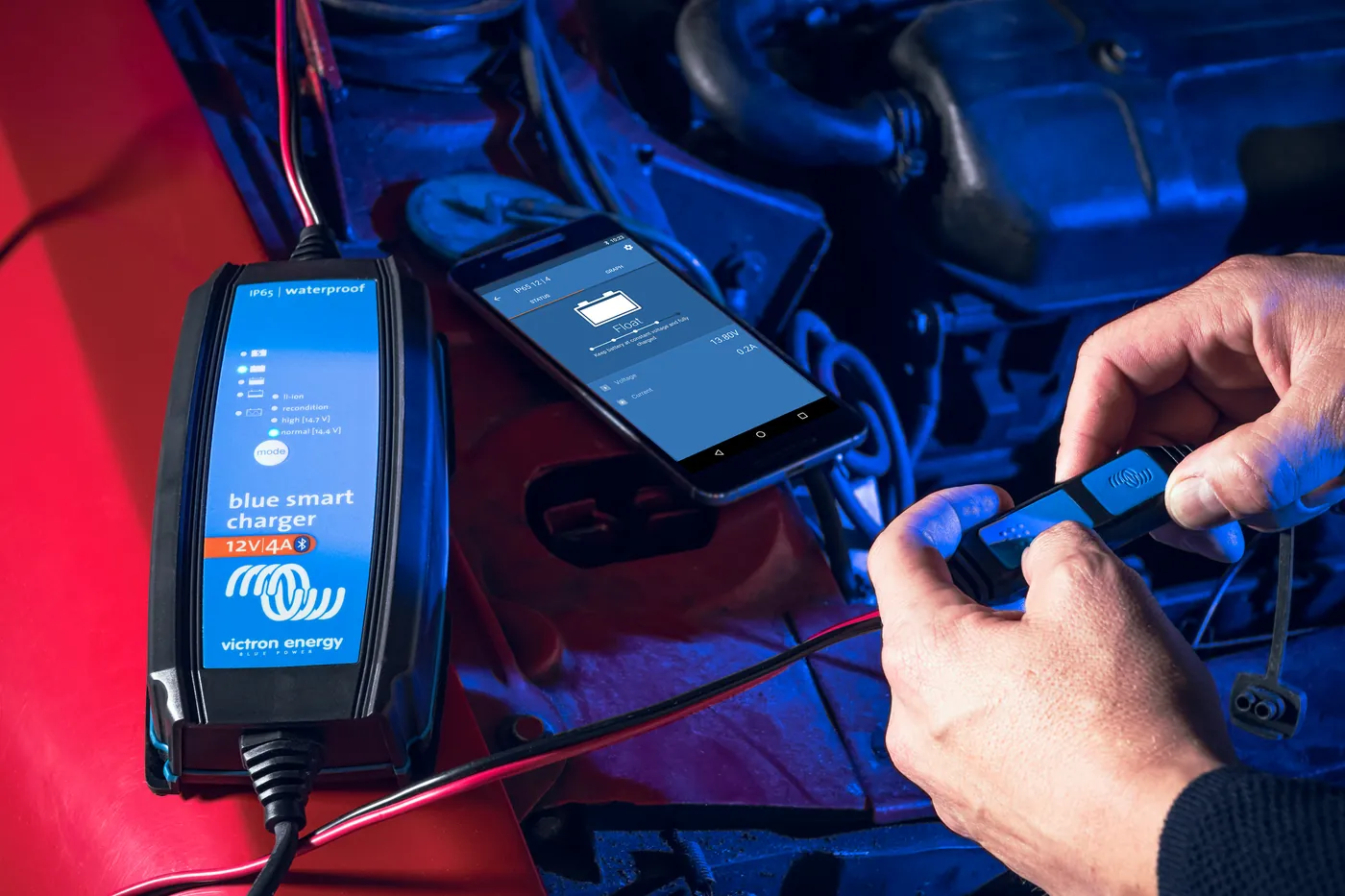
It has an IP65 housing and fanless cooling, so it runs silently and does not draw in dust. All models have Bluetooth: on your phone you can see voltage, current and the charging stage.
- ready-made modes for lead-acid, AGM, gel and LiFePO4 batteries,
- tries to charge even a battery discharged to almost 0 V,
- protection against reverse polarity, short circuit and overheating.


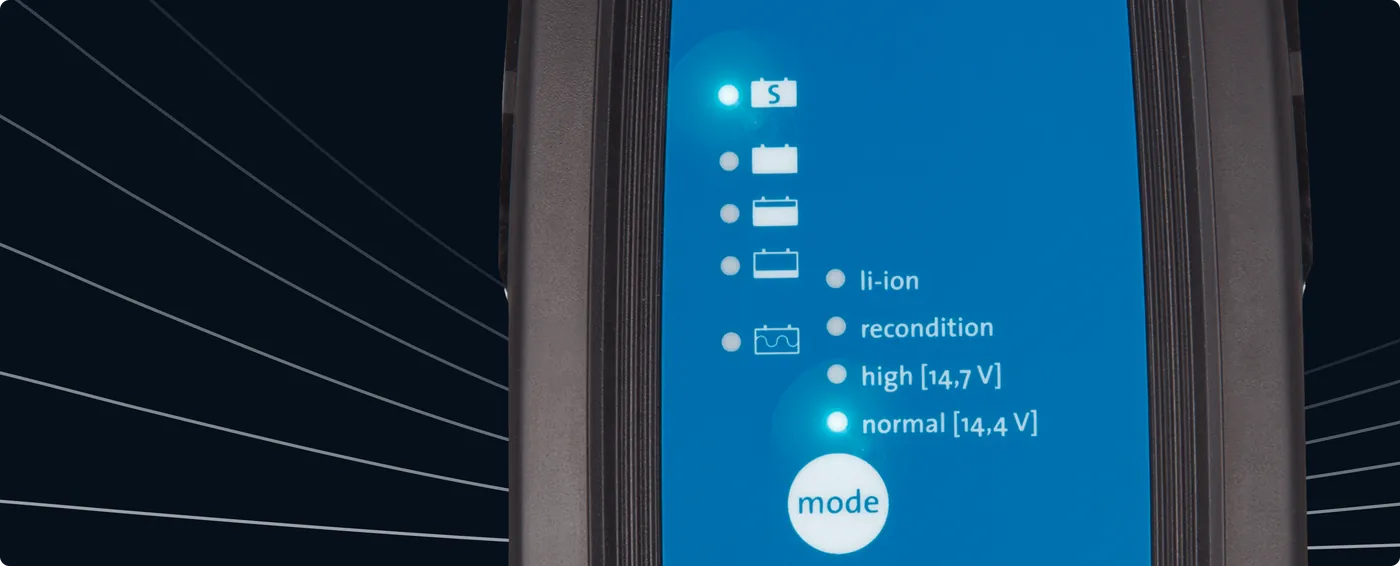
One MODE button
You select the mode with the button on the housing or in the VictronConnect app. The LEDs show the selected mode and the current charging stage.
| Mode (12 V) | Absorption | Float | Storage | Recondition |
|---|---|---|---|---|
| Normal | 14.4 V | 13.8 V | 13.2 V | — |
| Normal + Recondition | 14.4 V | 13.8 V | 13.2 V | 16.2 V |
| High | 14.7 V | 13.8 V | 13.2 V | — |
| High + Recondition | 14.7 V | 13.8 V | 13.2 V | 16.5 V |
| Li-ion (LiFePO4) | 14.2 V | — | 13.5 V | — |
For 24 V chargers the values are twice as high (for example Normal: 28.8 / 27.6 / 26.4 V; Li-ion: 28.4 / 27.0 V). Select the mode according to the battery manufacturer’s recommendations.
Seven charging stages
The charger goes through the stages automatically. The manufacturer specifies 7 stages, and 4 in Li-ion mode.
Test
Checks whether the battery will accept charge — even when it is almost at 0 V. It lasts until the charging pulse raises the voltage above 12.5 V (25.0 V for 24 V), or for a maximum of 2 minutes. It detects reverse polarity, short circuit and excessive battery voltage. If there is an error, first disconnect the AC supply.
Bulk
Charges at full current until the voltage reaches the absorption level. After this stage, a lead-acid battery is about 80% charged, a lithium battery over 95%.
Absorption
Constant voltage, decreasing current. Time is selected automatically: from 30 minutes to 8 hours, depending on how deeply the battery was discharged. In Li-ion mode, a fixed absorption time applies by default.
Recondition (optional)
For lead-acid batteries only, when needed: higher voltage at low current (8% of rated current), maximum 1 hour. Helps with sulphation.
Float
The battery is charged and ready to use. Float voltage for 4–8 hours.
Storage and refresh
Reduced voltage for long storage, and every 7 days an hour of absorption so that the battery does not self-discharge.
More than a standard battery charger
- Bluetooth and VictronConnect — monitoring, advanced settings, custom charge profiles and software updates.
- Low current mode — limits current to 2–10 A (depending on model) when you charge a small battery with a powerful charger. You switch it on by holding the MODE button for 3 s (the LED of the selected mode will start flashing) or by using VictronConnect.
- Temperature compensation — adjusts the voltage (−16 mV/°C for 12 V). It is disabled in Li-ion mode.
- VE.Smart Networking — more accurate battery temperature reading from BMV, SmartShunt or Smart Battery Sense.
- Power supply mode — operates as a DC power supply with a constant, adjustable voltage, with or without a battery.
- Wakes a lithium battery after BMS disconnect — the charger resets the lithium battery’s undervoltage protection and starts charging.
Nine 230 V models
| Model | Max current | Low current mode | Battery cable included (cross-section) | Weight | Dimensions (H × W × D) |
|---|---|---|---|---|---|
| 12 V | |||||
| 12/4 | 4 A | 2 A | 1.5 mm² / 16 AWG | 0.6 kg | 45 × 81 × 183 mm |
| 12/5 | 5 A | 2 A | 1.5 mm² / 16 AWG | 0.6 kg | 45 × 81 × 183 mm |
| 12/7 | 7 A | 2 A | 1.5 mm² / 16 AWG | 0.8 kg | 47 × 95 × 190 mm |
| 12/10 | 10 A | 3 A | 2.5 mm² / 14 AWG | 0.9 kg | 60 × 105 × 190 mm |
| 12/15 | 15 A | 4 A | 4 mm² / 12 AWG | 0.9 kg | 60 × 105 × 190 mm |
| 12/25 | 25 A | 10 A | 6 mm² / 10 AWG | 1.9 kg | 75 × 140 × 240 mm |
| 24 V | |||||
| 24/5 | 5 A | 2 A | 1.5 mm² / 16 AWG | 0.8 kg | 47 × 95 × 190 mm |
| 24/8 | 8 A | 3 A | 2.5 mm² / 14 AWG | 0.9 kg | 60 × 105 × 190 mm |
| 24/13 | 13 A | 4 A | 6 mm² / 10 AWG | 1.9 kg | 75 × 140 × 240 mm |
There is also a small Blue Smart IP65 6 V / 12 V 1.1 A charger for motorcycle and lawn mower batteries — it has separate documentation and is not included in this table.
- Supply voltage
- 220–240 V AC (180–265 V), 50–60 Hz
- Max efficiency
- 94% (12 V) · 95% (24 V)
- Standby current
- 0.5 W
- Operating temperature
- −40 … +50 °C (full current up to 30 °C)
- Mains cable
- 1.5 m with plug
- Battery cable
- 1.5 m, M8 lugs and crocodile clips included
- Cooling
- convection, no fan
- Ingress protection
- IP65
Which model suits which capacity
The manufacturer gives three limits: maximum capacity (so that the charging current is at least 0.1C) and minimum — for lead-acid batteries the current should not exceed 0.3C, and for lithium batteries 0.5C. You can charge a smaller battery in low current mode.
| Model | Max. capacity | Min. lead-acid / AGM (full current) | Min. lead-acid / AGM (low current) | Min. LiFePO4 (full current) | Min. LiFePO4 (low current) |
|---|---|---|---|---|---|
| 12/4 | 40 Ah | 13 Ah | 7 Ah | 8 Ah | 4 Ah |
| 12/5 | 50 Ah | 17 Ah | 7 Ah | 10 Ah | 4 Ah |
| 12/7 | 70 Ah | 23 Ah | 7 Ah | 14 Ah | 4 Ah |
| 12/10 | 100 Ah | 33 Ah | 10 Ah | 20 Ah | 6 Ah |
| 12/15 | 150 Ah | 50 Ah | 13 Ah | 30 Ah | 8 Ah |
| 12/25 | 250 Ah | 83 Ah | 33 Ah | 50 Ah | 20 Ah |
| 24/5 | 50 Ah | 17 Ah | 7 Ah | 16 Ah | 8 Ah |
| 24/8 | 80 Ah | 27 Ah | 10 Ah | 24 Ah | 12 Ah |
| 24/13 | 130 Ah | 43 Ah | 13 Ah | 32 Ah | 16 Ah |
12/4 or 12/5
8–20 Ah batteries. For the smallest ones, turn on low current mode.
e.g. 12 Ah AGM → 12/4 in low current mode12/7 or 12/10
Typical starter batteries: 50–100 Ah.
e.g. 74 Ah → 12/1012/15 or 12/25
House batteries: 100–250 Ah, including LiFePO4.
e.g. LiFePO4 200 Ah → 12/25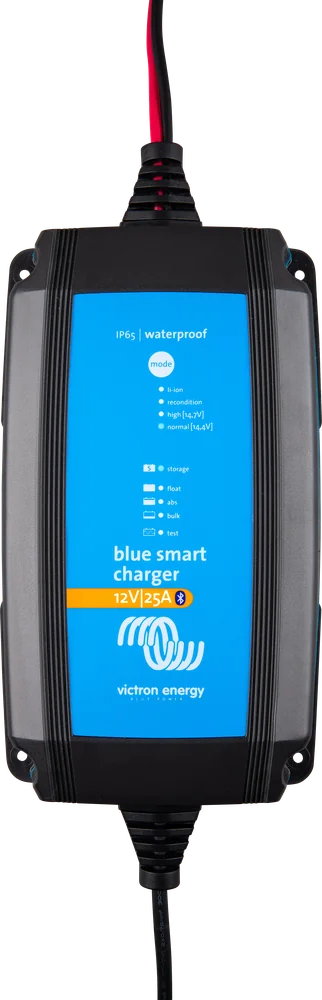
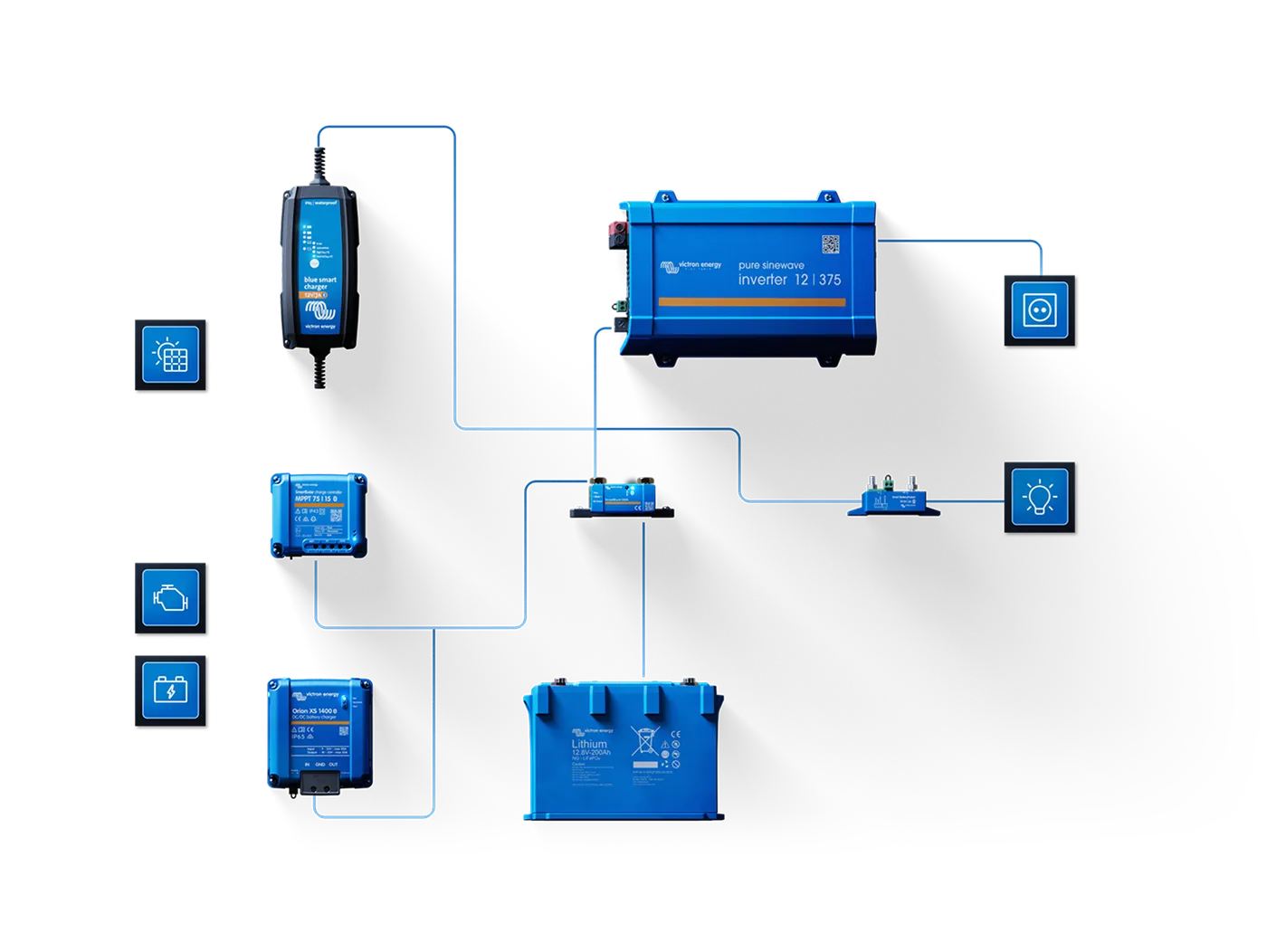
As simple as from a socket to a battery
Hover over or tap a diagram element to see its description.
- Battery cablesOutside the vehicle: red to positive, black to negative. In a vehicle with negative to chassis: first red to positive, then black to the body ground (not to the negative terminal). In a vehicle with positive to chassis: first black to negative, then red to the body ground (not to the positive terminal). For permanent installation, before working switch off and isolate the DC system: all DC loads and charging sources must be switched off/disconnected. Place the fuse close to the battery.
- 230 V plugOnly after connecting the battery. Disconnect in reverse order.
- Mode: MODE buttonNormal, High, Li-ion — according to battery type.
- Phone (Bluetooth)View and settings in VictronConnect.
- Battery monitor (optional)Battery temperature via VE.Smart Networking.
Wall-mounted or in a carry case
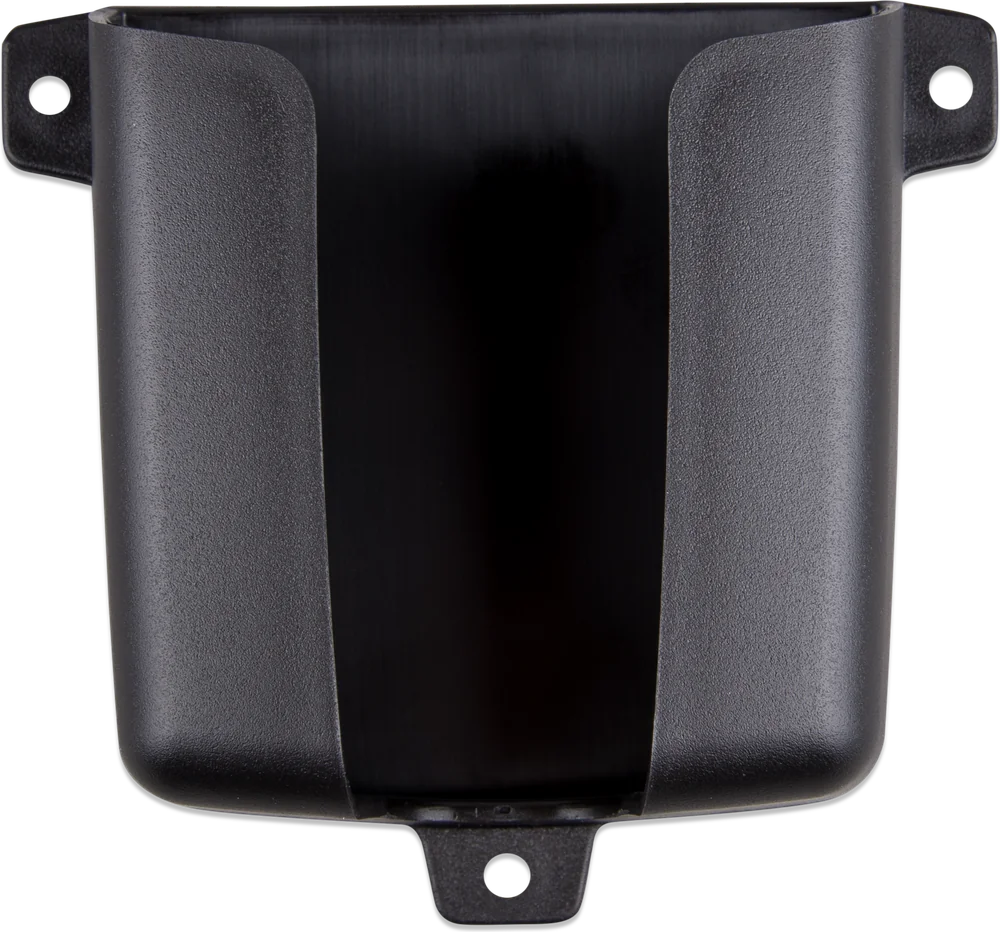
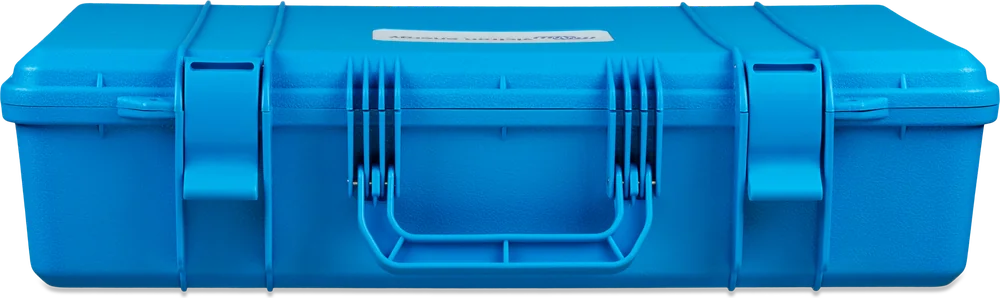
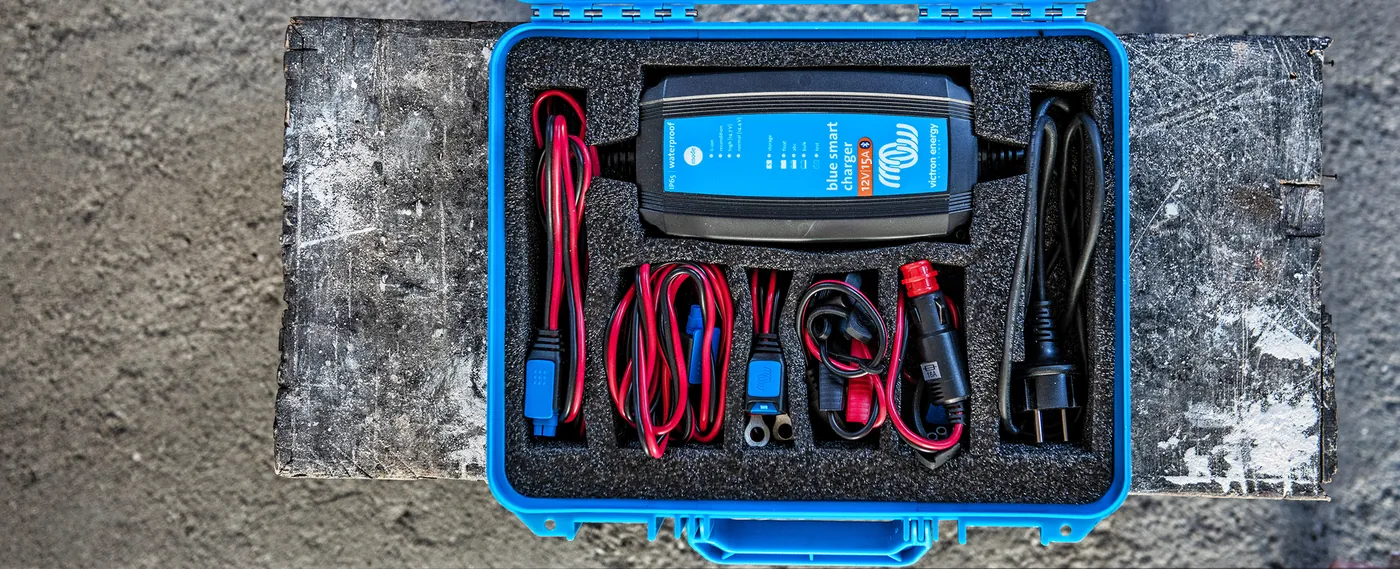
Batteries can give off explosive gases. Mount the charger next to the battery in a well-ventilated place, on a non-flammable surface — it gets warm during operation. For permanent installation: vertically, with the mains lead facing down, at least 100 mm of free space above and below the charger; do not cover the charger or place any objects on it.
The manual recommends a fuse or switch on the DC cable as close to the battery as possible (min.–max.): 12/4 and 12/5 — 7.5–20 A, 12/7 — 10–20 A, 12/10 — 15–30 A, 12/15 — 20–40 A, 12/25 — 40–50 A, 24/5 — 7.5–20 A, 24/8 — 15–30 A, 24/13 — 20–50 A.
The charger manufacturer specifies this. Victron LiFePO4 Smart batteries have an even narrower range: charging from 5 °C.
Above 30 °C the current is gradually reduced — at 50 °C to 25% of the rated value. Charging takes longer in hot conditions.
The reconditioning mode is for lead-acid batteries and is not suitable for continuous use — too frequent use shortens battery life through gassing.
Frequently asked questions about Blue Smart IP65
Can I leave the charger connected all winter?
Yes, that is what the float and storage stages are for. After charging, the charger lowers the voltage, and every 7 days it performs a one-hour refresh to prevent the battery from self-discharging.
Does it charge LiFePO4 lithium batteries?
Yes — in Li-ion mode (14.2 V for 12 V, with no float stage). The charger can also “wake up” a lithium battery that has been cut off by undervoltage protection. Do not charge a lithium battery when it is below 0 °C.
The battery is completely flat. Will the charger charge it?
It will try: in the test stage it charges even a battery close to 0 V with a low current and switches to normal charging when the voltage rises. If loads are connected to the battery, disconnect them — they may cause the battery to be rejected incorrectly.
I have a 15 A charger and a small 20 Ah battery. What should I do?
Switch on low-current mode (for 12/15 this is 4 A). According to the manufacturer, the smallest lead-acid battery for the 12/15 is 50 Ah at full current and 13 Ah in low-current mode.
Can I use it as a 12 V power supply?
Yes. You enable power supply mode in the VictronConnect app — the charger then disables the charging algorithm and provides a constant, set voltage, with or without a battery.
Devices it works with most often
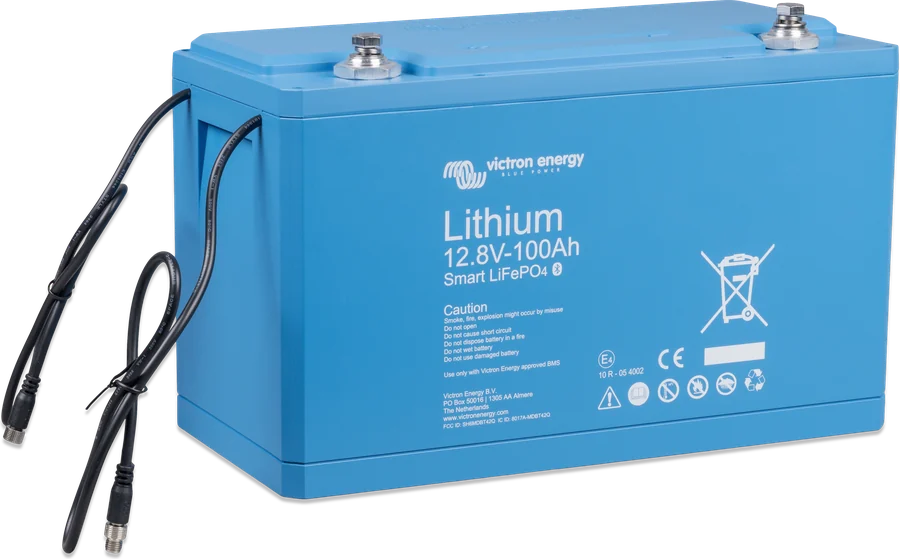
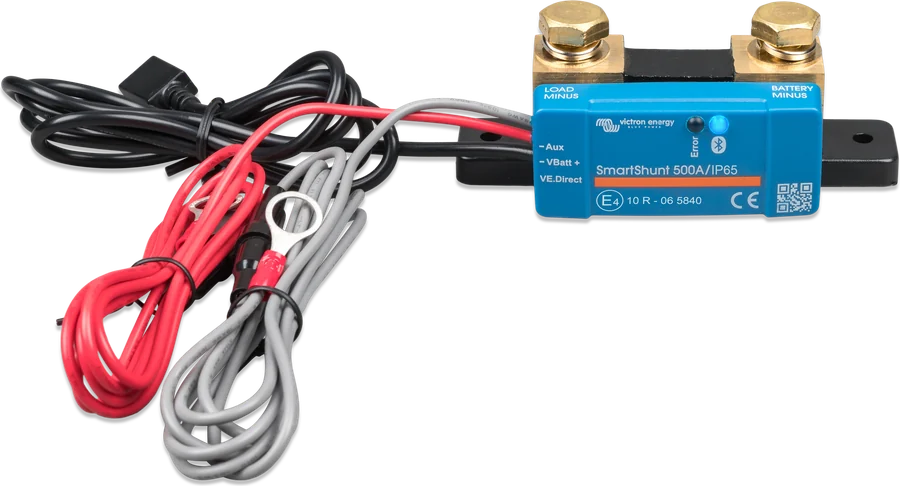
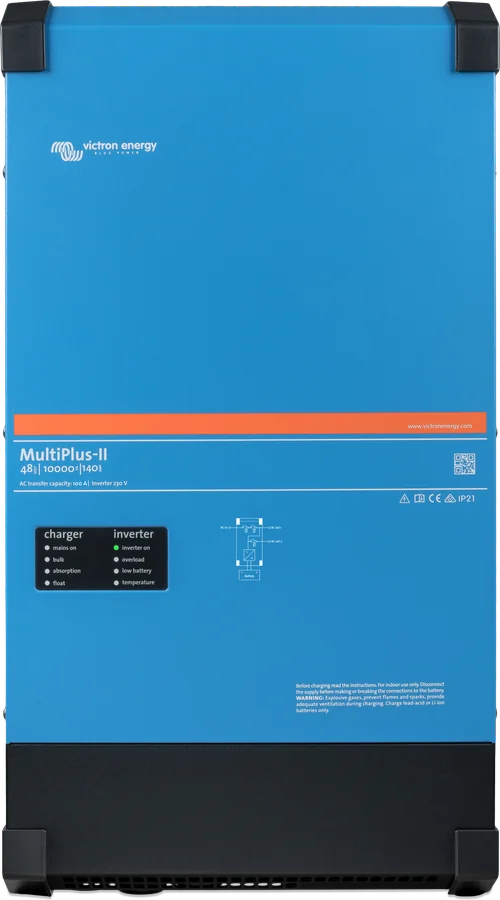
Manufacturer documentation
- Blue Smart IP65 Charger 230 V manual (with technical specifications)PDF · EN
- Carry case — datasheetPDF · EN
- Product page at the manufacturervictronenergy.com
We prepared this description independently based on the manufacturer’s documentation. If there are any discrepancies, the current Victron Energy documentation is binding. You can report an error here.
Content checked against Victron Energy documentation (datasheets and manuals) — as of 19 September 2026. Report a content error · Revision log