
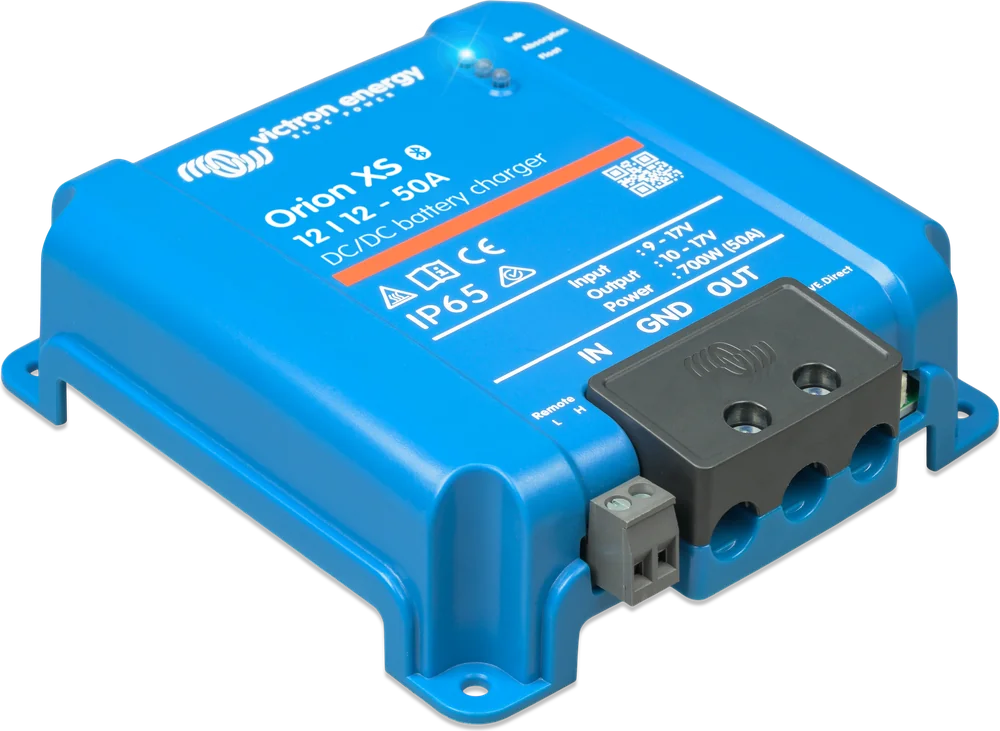
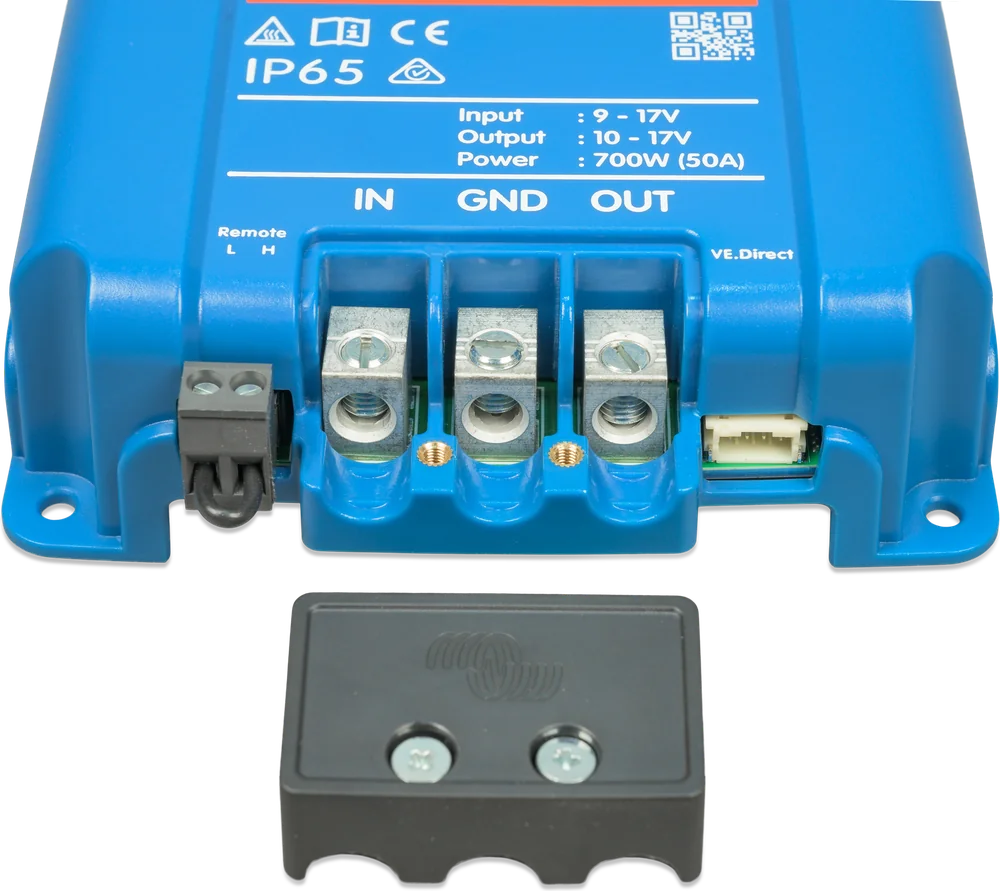
Orion XS 12/12-50A — angled front view
Orion XS
Charges the house battery from the vehicle or boat alternator — including a smart Euro 5/6 alternator that on its own provides too low a voltage. It also protects the starter battery.
- 12/12 V · 50 A or 70 A
- XS 1400: 12 and 24 V
- 98.5%
- Bluetooth
- VE.Direct
The alternator charges both batteries — intelligently
In a campervan or boat there are usually two batteries: the starter battery for the engine and the house battery (often lithium) for the fridge, lights and inverter. Connecting them directly or with a simple separator ends badly: the lithium battery draws too much current from the alternator and also receives the wrong voltage.
The problem is greater in vehicles with a smart Euro 5 and Euro 6 alternator. Such an alternator reduces the voltage when the starter battery is charged — the house battery then gets too low a voltage, especially at the end of long cables. Orion XS generates the correct charging voltage itself, but by default it only charges when it detects that the engine is running. In some Euro 6 vehicles you need to set this differently (see the questions below and Orion diagnostics in Euro 6 vehicles).
- full charging of the house battery despite low alternator voltage,
- starter battery protected against discharge,
- adjustable current — the alternator is not overloaded.


What Orion XS can do
Engine running detection
It detects whether the engine is running and starts charging only when the alternator is delivering current. You do not need to run a wire from the ignition switch.
Current adjustable in 0.1 A steps
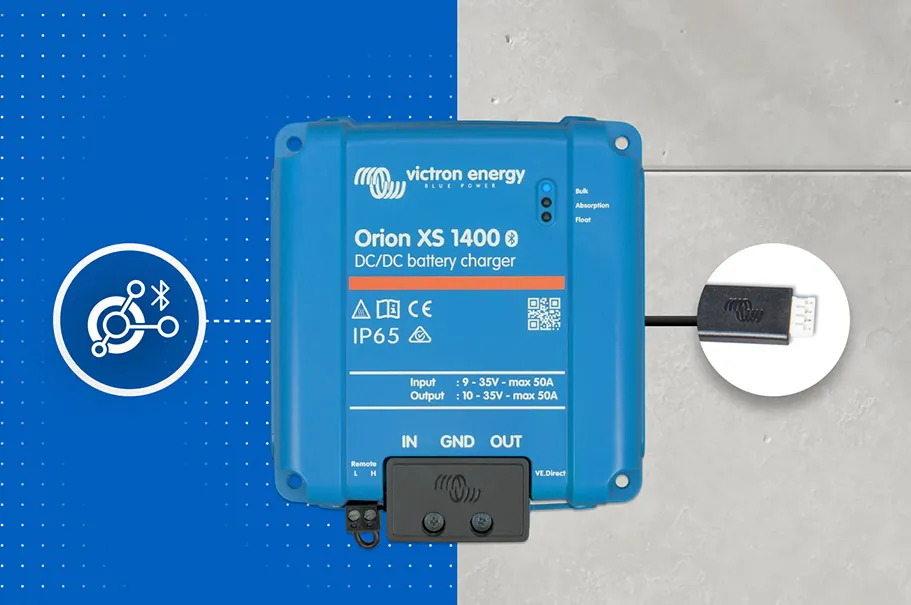
In the VictronConnect app, you can set the current from 1 A up to the maximum of the given model — matching it to the alternator and battery capacity.
Adaptive 4-stage charging
Eight ready-made battery profiles and full custom configuration. With a lead-acid battery, absorption time increases after a deep discharge and is short after a shallow one.
Battery protection
It stops charging when the input voltage drops below the threshold (default 12.5 V, restart at 12.8 V) so as not to discharge the starter battery. Low temperature cut-off is configurable in VictronConnect; with DVCC/BMS control, charging can also be stopped because of low temperature.
Parallel operation
Devices can be connected in parallel to increase charging current. However, linked Orions do not synchronise charging stages.
Also as a power supply
It can work as a stabilised power supply — set the output voltage in the app.
Working with the rest of the system
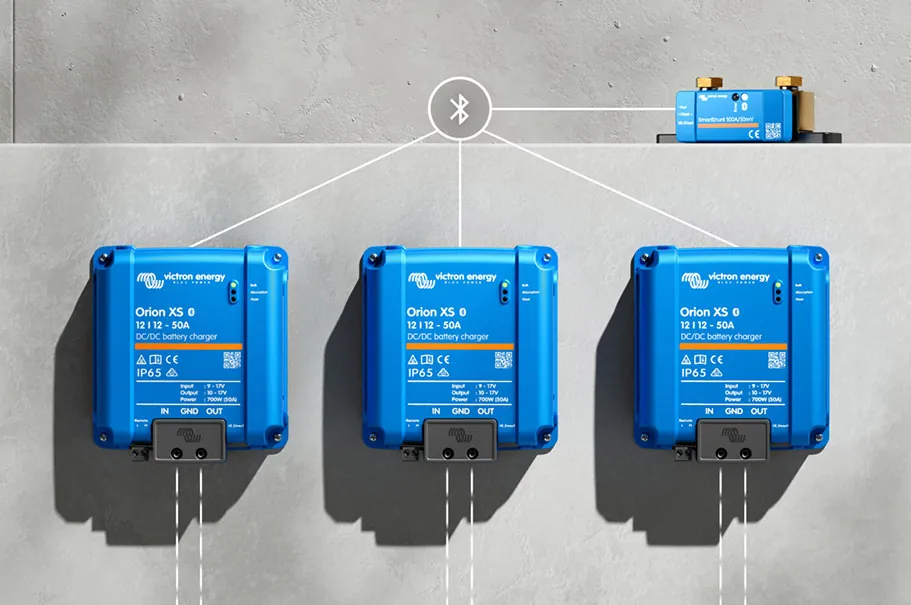
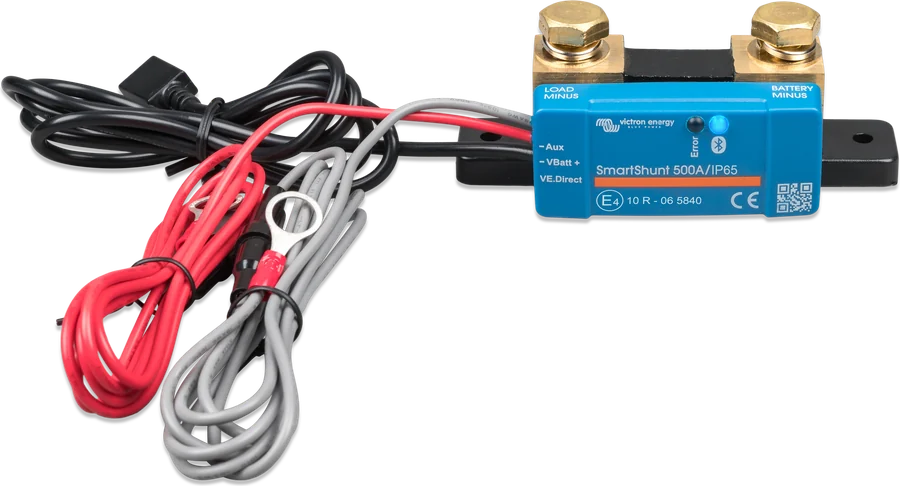
Via VE.Smart Networking, Orion XS receives battery data wirelessly: voltage and current from SmartShunt or BMV, voltage and temperature from Smart Battery Sense (which does not measure current). SmartShunt and BMV provide temperature only with the optional sensor.
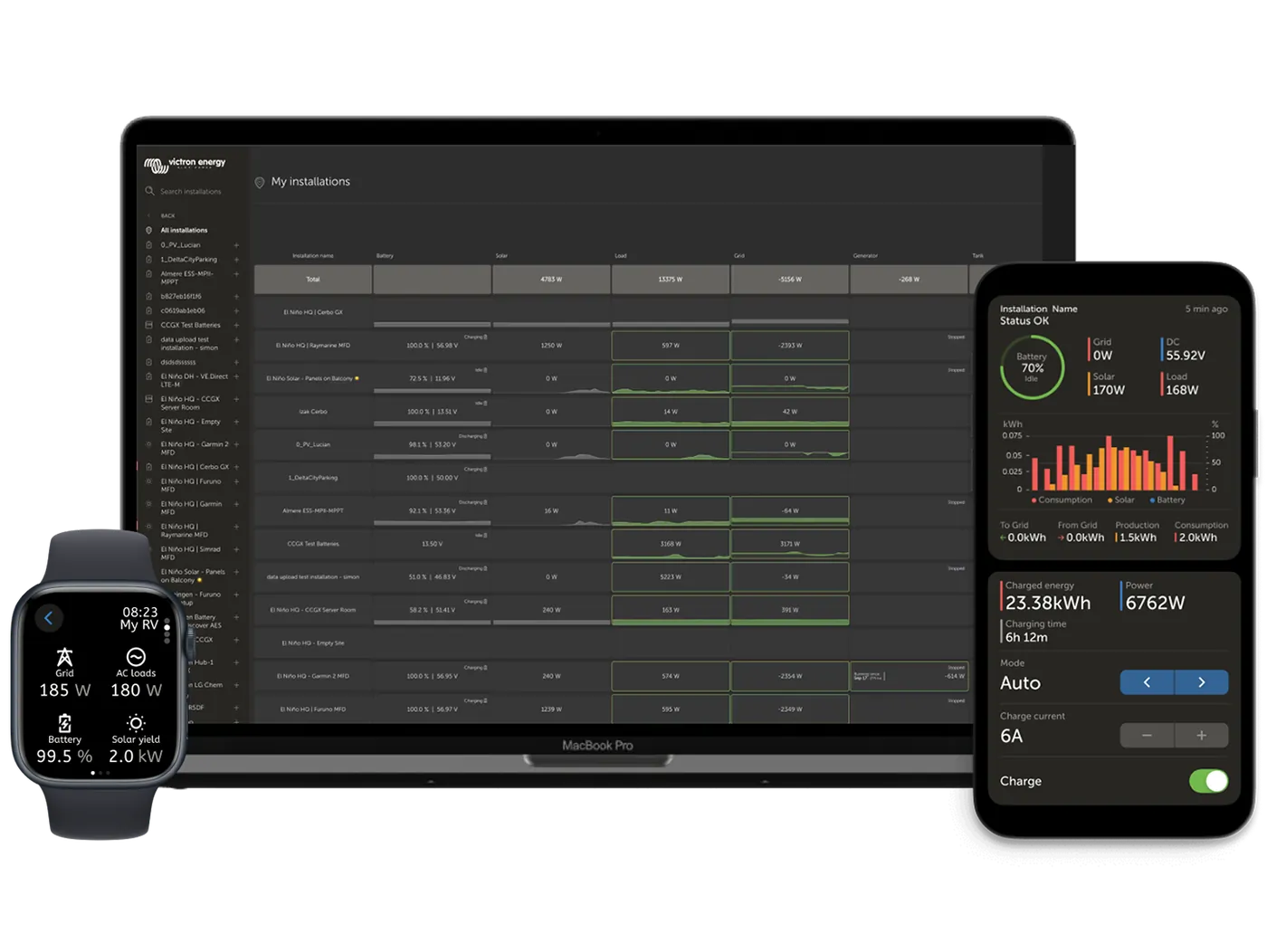
Via VE.Direct it connects to a GX device (Cerbo GX, Ekrano GX). It then supports DVCC — shared charge limits for the whole system and control by BMS (requires Orion XS firmware v1.03 and Venus OS v3.20). Note: with DVCC enabled, the Orion output must charge the main battery of the GX system — if it charges an auxiliary battery, do not connect it to the GX via VE.Direct.
You can also switch it off with the Remote terminal — for example with a switch or a BMS signal.
Three models — comparison
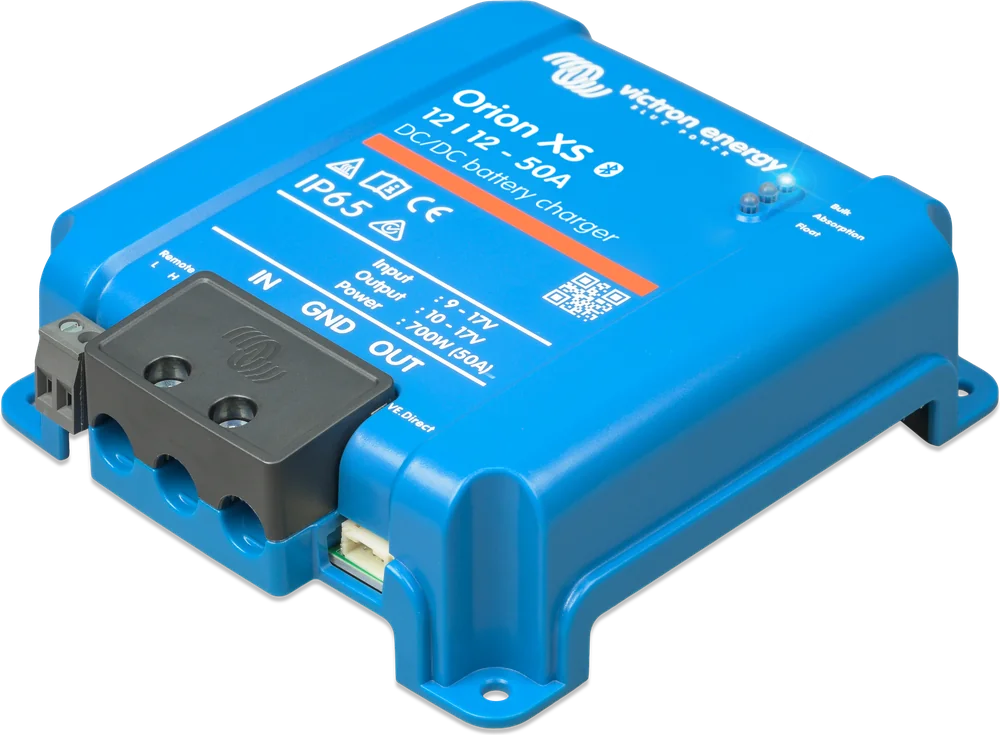
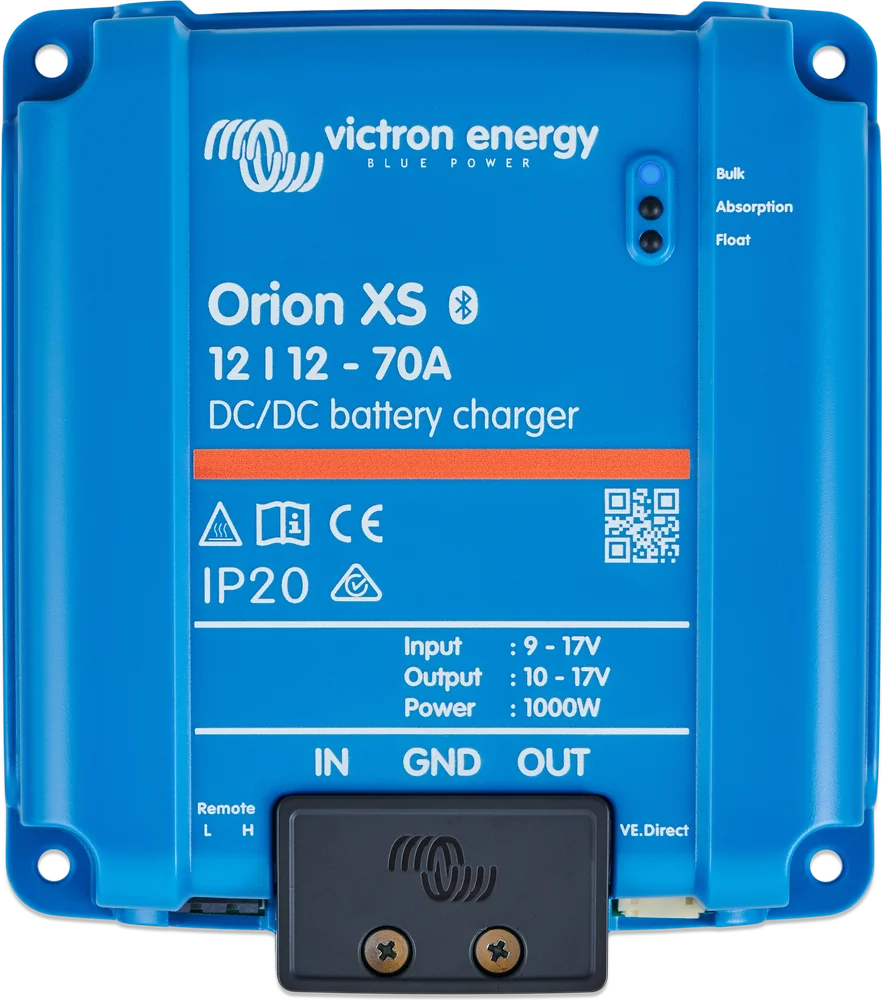
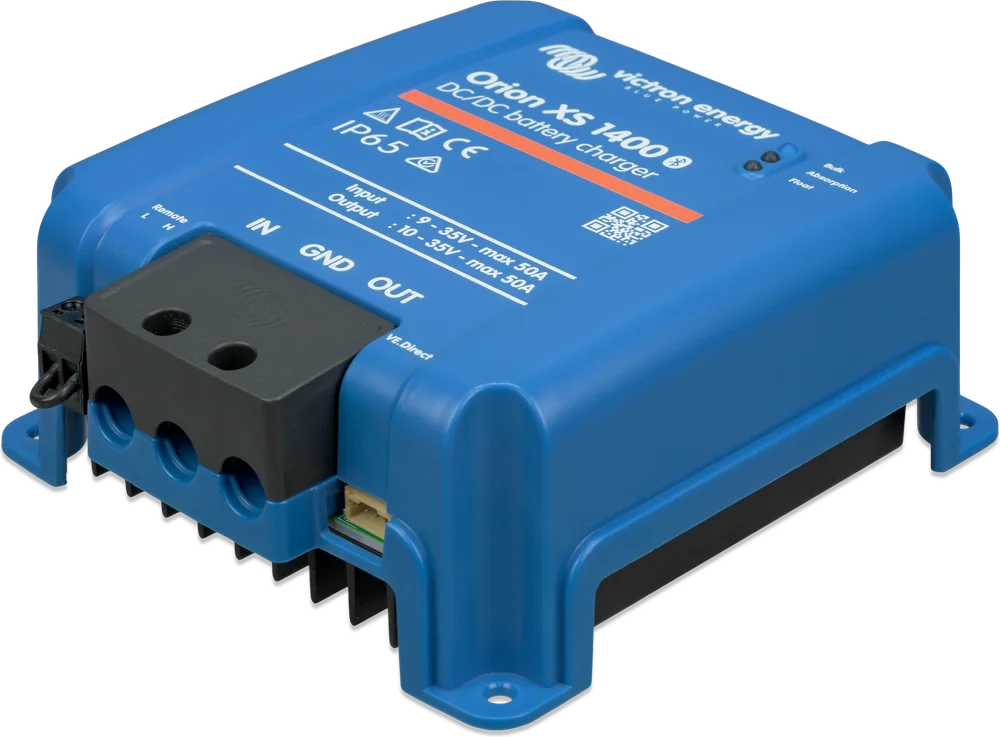
| Parameter | XS 12/12-50A | XS 12/12-70A | XS 1400 |
|---|---|---|---|
| Input voltage | 9–17 V | 9–17 V | 9–35 V |
| Output voltage (adjustable) | 10–17 V | 10–17 V | 10–35 V |
| Current (adjustable) | 1–50 A | 1–70 A | 1–50 A |
| Continuous power up to 40 °C | 700 W (at 14 V) | 1000 W (at 14.3 V) | 1400 W (at 28 V) |
| Maximum efficiency | 98.5% | ||
| Max. cable cross-section (terminals) | 25 mm² / 4 AWG | 25 mm² / 4 AWG | 25 mm² / 4 AWG |
| Ingress protection | IP65 | IP20 (electronics in IP65 enclosure) | IP65 |
| Weight | 0.33 kg | 0.34 kg | 0.52 kg |
| Dimensions (H × W × D) | 137 × 123 × 40 mm | 137 × 123 × 40 mm | 138 × 124 × 53 mm |
Power depends on voltage: 50 A at 12 V is 600 W, at 14 V — 700 W, at 28 V — 1400 W. Above 40 °C, power drops by 1.5% for each degree; with poor airflow, derating starts earlier.
- Output voltage tolerance
- ±0.25%
- Output voltage ripple
- 10 mV rms
- No-load consumption
- < 100 mA
- Standby current
- < 1.5 mA
- Operating temperature
- −20 … +60 °C
- Protections
- overload, short circuit, temperature
- Connections
- screw terminals
- EMC approval for vehicles
- ECE R10
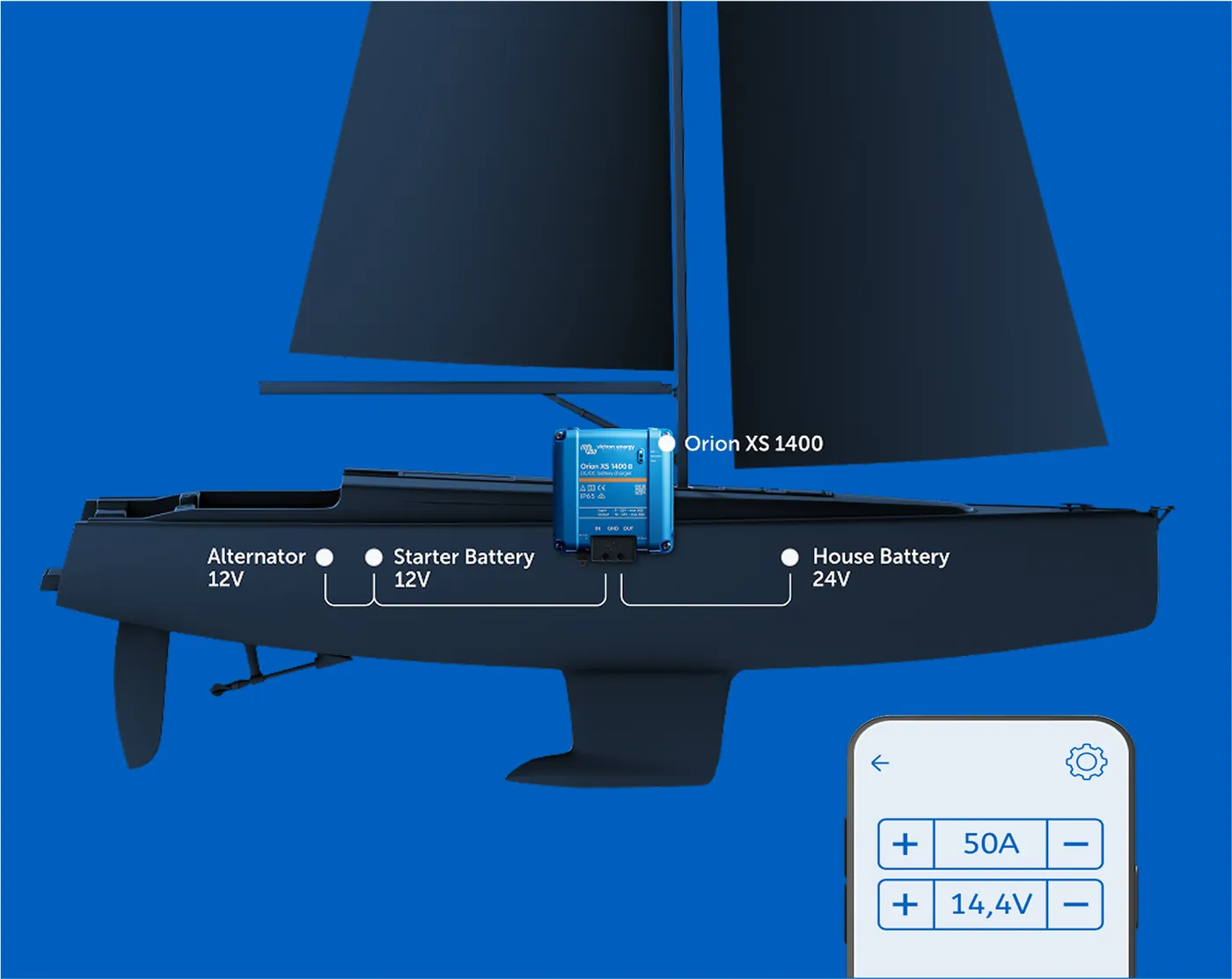
Between the alternator and the house battery
Connect IN to the starter battery, OUT to the house battery, and GND to the common ground. Before connecting, check the polarity without fail — Orion XS is not protected against reverse polarity. Hover over or tap a diagram element to see its description.
- Alternator → starter batteryNo changes to the vehicle installation.
- Starter battery → INFirst disconnect Remote, connect the input through a fuse close to the battery, and configure the correct charging algorithm in VictronConnect before connecting the battery to OUT.
- OUT → house batteryOnly after configuration, connect the battery through a fuse close to the battery; finally reconnect Remote. GND is common ground.
- SmartShunt (optional)Wirelessly provides battery voltage, temperature and current.
- VE.Direct → Cerbo GX (optional)VRM, DVCC and BMS control.
Which Orion XS should you choose?
12/12-50A
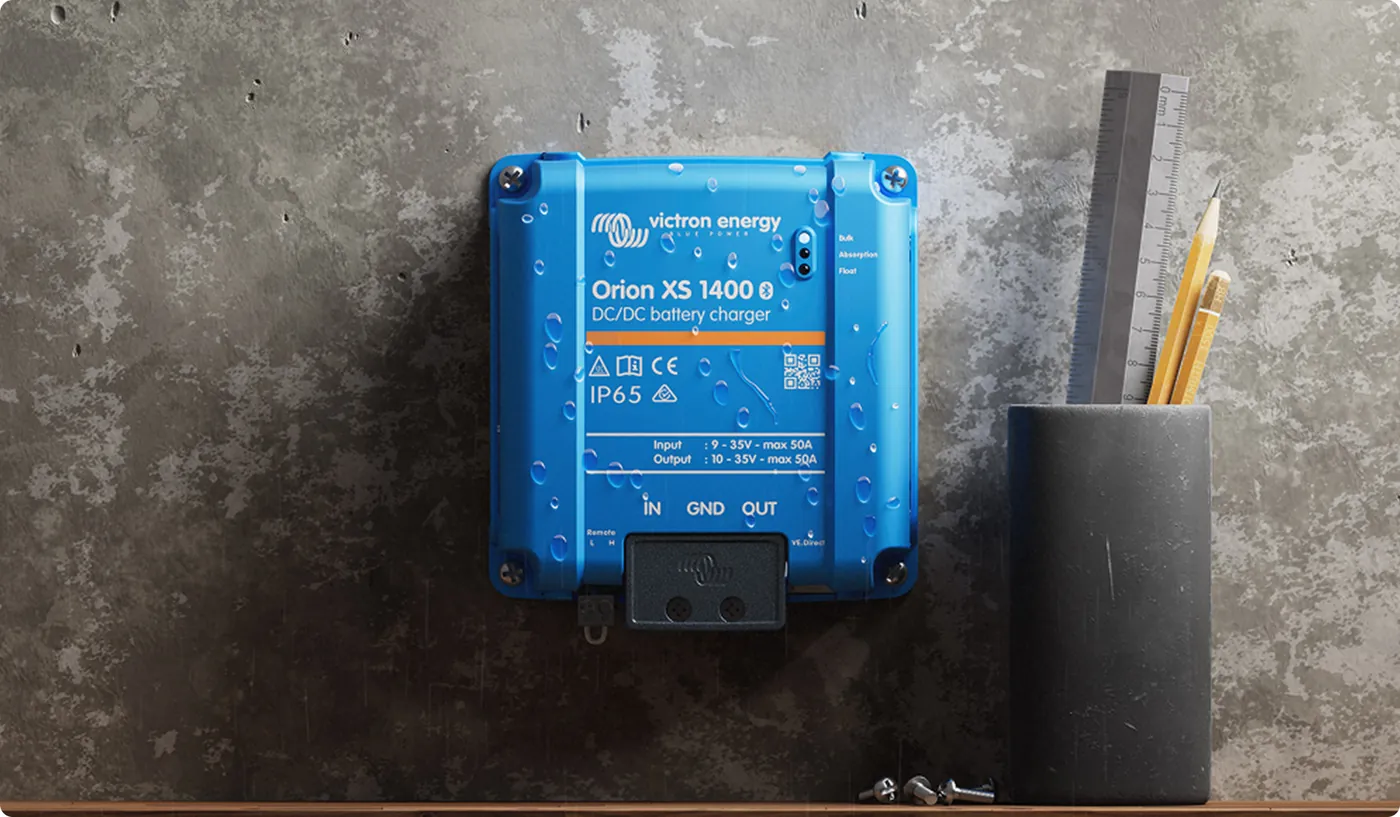
The smallest and lightest model. Mount vertically, with the terminals facing down, on a non-combustible surface, close to the battery, but never directly above it.
up to 700 W at 14 V12/12-70A
Faster charging of a large battery bank while driving. Requires a powerful alternator and a dry mounting location (IP20).
up to 1000 W at 14.3 VXS 1400
9–35 V input, 10–35 V output: works in 24 V vehicles (trucks, boats) or charges a 24 V bank from a 12 V alternator — then max. about 600–700 W, because input current is limited to 50 A.
1400 W at a typical 28 V voltageOrion current adds to what the vehicle consumes. Set it so the alternator does not constantly run at its limit — you adjust the current in the app in 0.1 A steps.
Orion XS can be connected in parallel. Two 50 A units will provide up to 100 A — if the alternator can handle it. Orion units connected in parallel do not synchronise charging stages.
What to watch out for
Protect the cable from the starter battery to IN and from OUT to the house battery with fuses fitted as close as possible to each battery: 12/12-50A and XS 1400 — 60–70 A, 12/12-70A — 80–100 A (manual).
Minimum cross-section according to the manual: 12/12-50A and XS 1400 — 16 mm² for cable runs up to 5 m, 25 mm² (4 AWG) for 5–10 m; 12/12-70A — 25 mm² up to 10 m. Terminal tightening torque: 5.6 Nm (25 mm²), 4.5 Nm (6–16 mm²), 2.8 Nm (4–10 mm²); cable cover below 0.7 Nm. Orion compensates for voltage drop only on the input cable — keep the cable to the house battery short and thick, or send the battery voltage to Orion via VE.Smart.
The declared power applies to installation as described in the manual: vertically, with the terminals facing down, with at least 10 cm of free space around the device for cooling. In a cramped locker, Orion will reduce current earlier to avoid overheating.
In VictronConnect, select the house battery type and check the low input voltage cut-off threshold — this is what protects the starter battery.
Most common questions about Orion XS
Do I need to connect the ignition wire (D+)?
Usually not. Orion XS has built-in engine-running detection and only starts charging when the alternator is supplying current. The Remote terminal is useful if you want to switch it on manually or let the BMS switch it off.
I have a smart alternator (Euro 6). Will the Orion cope?
Usually yes, but not always straight away. Orion generates the voltage needed by the house battery itself, but by default it only charges after detecting that the engine is running: Orion XS assumes the engine is off when the input voltage drops below 13.1 V for more than 1 minute. In Euro 6 vehicles the alternator may be switched off while driving, so the house battery may then not charge properly. If the battery does not charge, the manual advises turning off engine-running detection in VictronConnect and starting charging with an external signal on the Remote input. The most reliable signal is engine running from the vehicle itself (for example via a CAN bus interface). Victron does not recommend using the ignition signal: with the ignition on and the engine off, Orion may discharge the starter battery. Euro 6 vehicles often no longer have a D+ signal. Details in Orion diagnostics (Euro 6).
Will Orion XS discharge the starter battery when parked?
It should not. It only charges when the engine is running, and it also switches off when the input voltage falls below the set threshold. In standby it draws less than 1.5 mA.
Can I use it as a normal 12 V power supply?
Yes. In the VictronConnect app you can set a fixed output voltage, and Orion XS will work as a regulated power supply — for example for devices sensitive to voltage fluctuations.
Does Orion XS have galvanic isolation?
No — the input and output share a common ground (GND), as in a typical motorhome or van. If your installation needs separated grounds, look for chargers with isolation (Orion-Tr Smart isolated series).
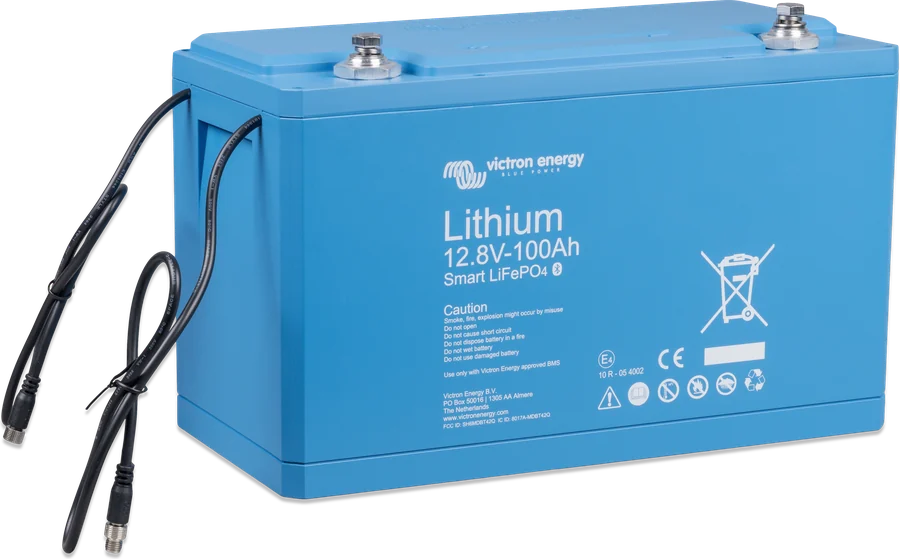
Devices it works with most often
Manufacturer documentation
We prepared this description independently based on the manufacturer’s documentation. If there are any discrepancies, the current Victron Energy documentation is binding. You can report an error here.
Content checked against Victron Energy documentation (datasheets and manuals) — as of 19 September 2026. Report a content error · Revision log