
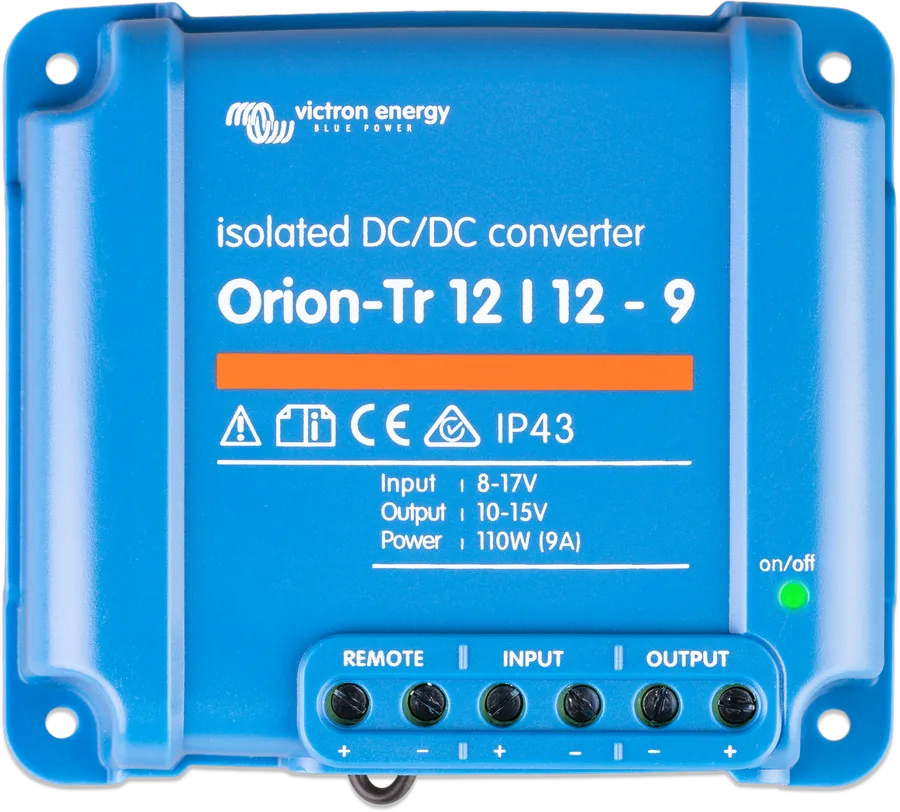
Orion-Tr 12/12-9 isolated view from above — REMOTE, INPUT and OUTPUT terminals, data: input 8–17 V, output 10–15 V, 110 W
Orion-Tr — isolated and non-isolated
DC-DC converters that power loads with a different voltage from the battery voltage: a 12 V radio in a lorry with a 24 V system, 24 V equipment from a 48 V battery bank, or a stable 12.2 V from a battery whose voltage varies. Isolated versions (110–400 W) provide galvanic isolation between input and output and have remote on/off and voltage regulation. Non-isolated 24/12 units are small and the most efficient. None is a charger — for that use Orion-Tr Smart.
- 12 / 24 / 48 V
- isolated 110–400 W
- non-isolated 24/12, 5–20 A
- remote on/off (isolated)
- IP43
Different voltage for loads
A 24 V system in a lorry, bus or boat, while the radio, fridge or USB charger is 12 V. A 48 V battery bank in a cabin, while the controller runs on 24 V. Orion-Tr converts one DC voltage to another and keeps it stable — even when battery voltage rises during charging or drops under load.
In isolated versions, the input, output and enclosure are separated (200 V DC). The same models also work as a stabiliser — for example, 12/12 powers sensitive equipment with a steady voltage from a 12 V battery that in practice is between 11 and over 14 V. If the output voltage is set to nominal or lower, it remains stable across the full input voltage range.
- short-circuit proof at the output — can be connected in parallel for higher current (isolated: no limit on quantity),
- overtemperature protection — above 40 °C output current decreases by 3% for each degree,
- IP43 when mounted terminals down; screw terminals, no special tools.
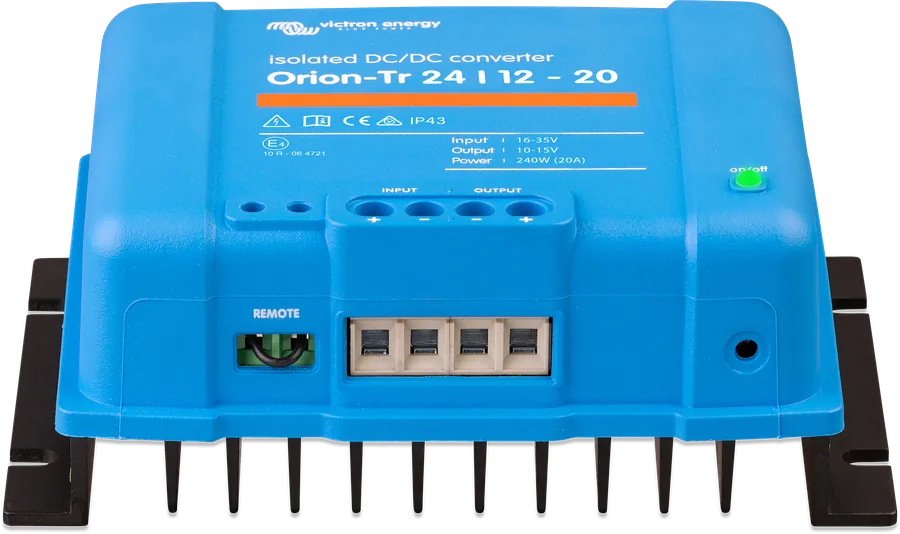
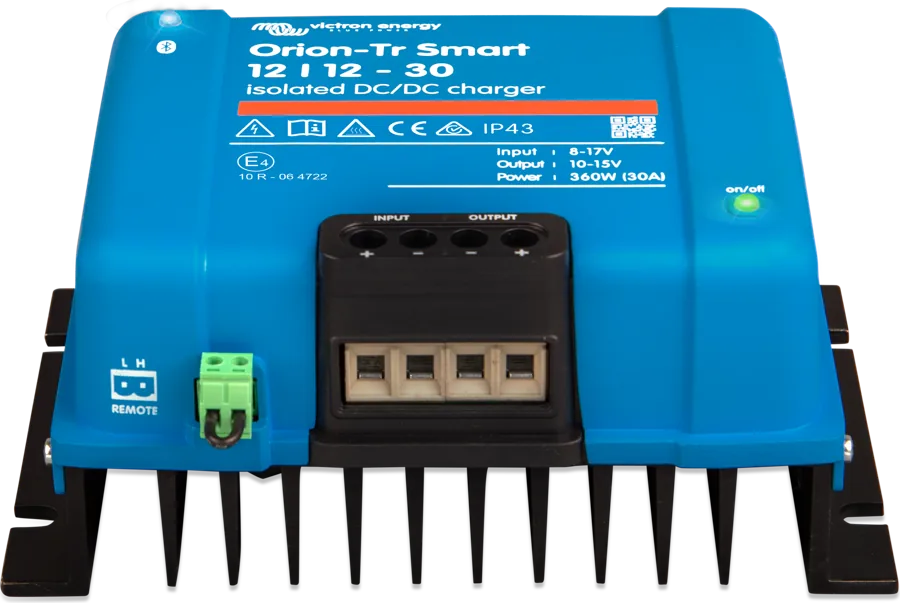
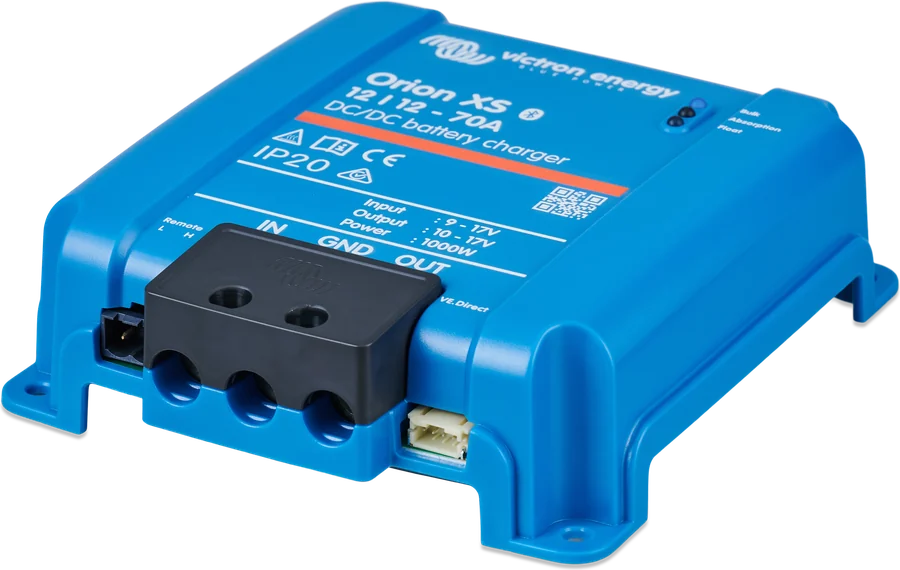
The datasheet for isolated Orion-Tr explicitly states that the adjustable output voltage is not intended for charging batteries. To charge a house battery from an alternator or another Victron battery, Orion-Tr Smart is recommended; for high currents — Orion XS or Buck-Boost.
Which Orion to choose
Isolated Orion-Tr
Any combination of 12, 24 and 48 V on input and output, 110–400 W. Galvanic isolation, remote on/off, output voltage regulation. Powering loads.
110–400 WNon-isolated Orion-Tr
Only 24 V → 12 V, 5–20 A. Efficiency 95–97%, very small enclosure, common negative for input and output. No remote and no regulation.
60–240 WOrion-Tr Smart
DC-DC charger with charging algorithm, engine running detection and Bluetooth — for the house battery in a vehicle.
separate cardOrion-Tr isolated: 110 to 400 W
| Input | 110–120 W | 220–280 W | 360–400 W |
|---|---|---|---|
| 12 V (8–17 V) | 12/12-9 (110 W), 12/24-5 (120 W) | 12/12-18 (220 W), 12/24-10 (240 W) | 12/12-30 (360 W), 12/24-15 (360 W), 12/48-8 (380 W) |
| 24 V (16–35 V) | 24/12-9 (110 W), 24/24-5 (120 W), 24/48-2.5 (120 W) | 24/12-20 (240 W), 24/24-12 (280 W), 24/48-6 (280 W) | 24/12-30 (360 W), 24/24-17 (400 W), 24/48-8.5 (400 W) |
| 48 V (32–70 V) | 48/12-9 (110 W), 48/24-5 (120 W), 48/48-2.5 (120 W) | 48/12-20 (240 W), 48/24-12 (280 W), 48/48-6 (280 W) | 48/12-30 (360 W), 48/24-16 (380 W), 48/48-8 (380 W) |
| Dimensions, weight | 100 × 113 × 47 mm, 0.42 kg | 130 × 186 × 70 mm, 1.3 kg | 130 × 186 × 70 mm, 1.6 kg; models with 12 V on input or output 130 × 186 × 80 mm, 1.8 kg |
| Cables | up to 6 mm² | up to 16 mm² | up to 16 mm² |
Designation: input/output voltage – continuous current, e.g. 24/12-20 = from 24 V to 12 V, 20 A. Power in brackets — continuous at 40 °C (in the 110–120 W class the current is given for 25 °C). Current for 10 s: e.g. 25 A for 12/12-18 and 24/12-20, 40–45 A for 30 A models. Efficiency 85–89%.
| Parameter | 12 V input | 24 V input | 48 V input |
|---|---|---|---|
| Input voltage range | 8–17 V | 16–35 V | 32–70 V |
| Low voltage shutdown / restart | 7 V / 7.5 V | 14 V / 15 V | 28 V / 30 V |
| Input fuse | internal, non-replaceable | internal, non-replaceable | none — external required |
| Output | Nominal voltage | Adjustment range |
|---|---|---|
| 12 V | 12.2 V | 10–15 V |
| 24 V | 24.2 V | 18–30 V |
| 48 V | 48.2 V | 40–60 V |
Common: ±0.2 V tolerance, 2 mV rms noise, 200 V DC isolation between input, output and enclosure, current draw below 200 µA after remote shutdown, −20…+55 °C (above 40 °C −3% per °C), humidity up to 95% non-condensing, ECE R10-5. If you set the output voltage above nominal by a certain percentage, the minimum input voltage at which the output remains stable increases by the same percentage.
Orion-Tr 24/12 non-isolated
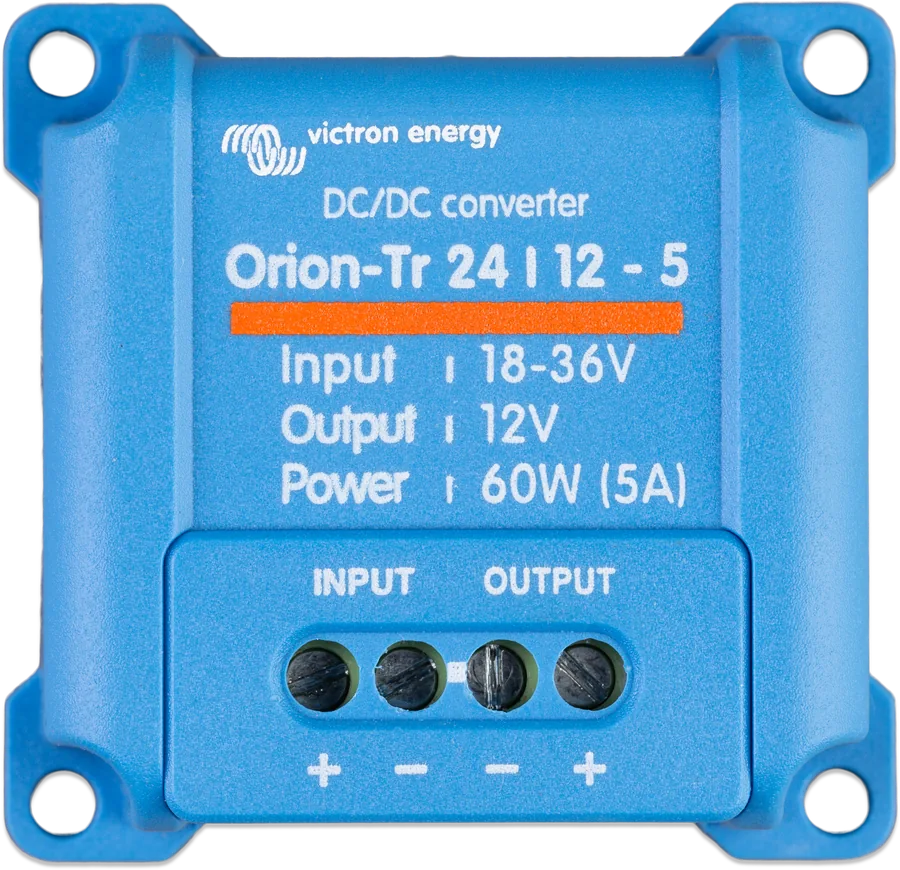
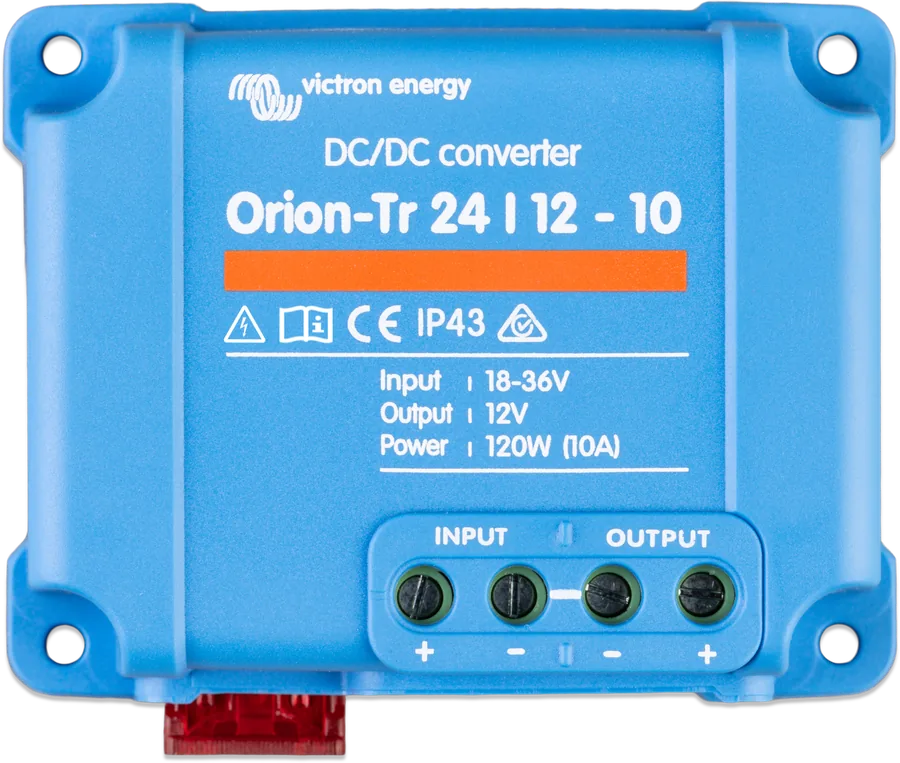
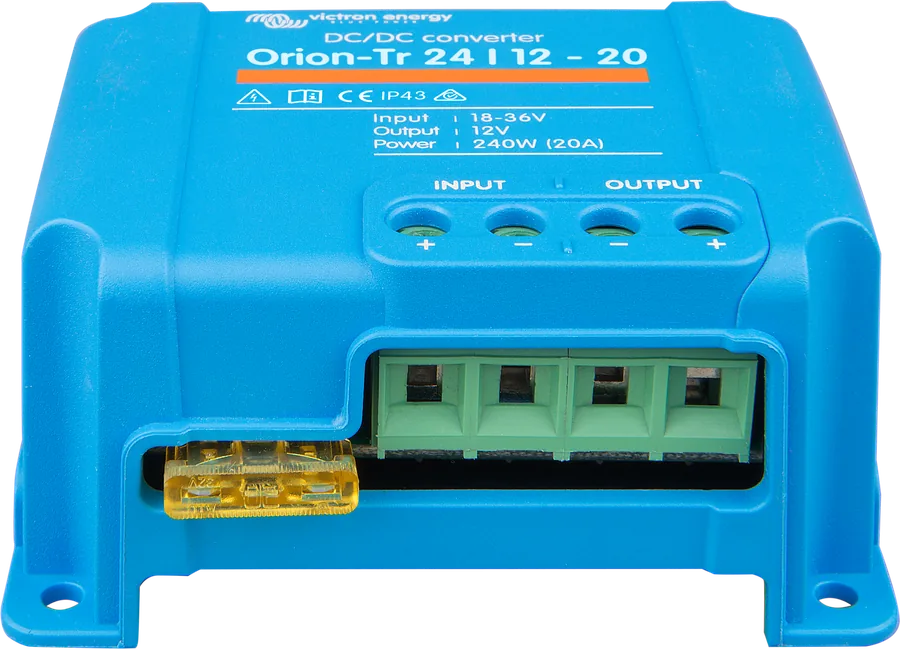
| 24/12-5 | 24/12-10 | 24/12-15 | 24/12-20 | |
|---|---|---|---|---|
| Input voltage | 18–35 V | |||
| Output voltage | 12.7 V | 12.5 V | 12.5 V | 12.5 V |
| Continuous / maximum current | 5 / 7 A | 10 / 12 A | 15 / 20 A | 20 / 25 A |
| Efficiency | 95% | 97% | 97% | 97% |
| Current with no load | < 20 mA | < 45 mA | < 35 mA | < 35 mA |
| Max. cables | 3.3 mm² | 6 mm² | 6 mm² | 6 mm² |
No galvanic isolation, −20…+55 °C (above 40 °C −3% per °C), IP43 when mounted terminals down, ECE R10-6. On the device labels, the input range is 18–36 V, in the datasheet 18–35 V.
In non-isolated models, connect the power negative cable first to one of the negative terminals (both are internally linked), then connect the rest. A poor negative connection can cause overvoltage at the output.
12 V radio in a 24 V system
The isolated Orion-Tr 24/12 powers 12 V loads from a 24 V battery and switches on with the ignition via the remote connector. Simplified diagram.
- Input24 V battery; 48 V models require an external input fuse.
- RemoteReplace the bridge on the green connector with a switch or ignition switch.
- VoltageSet the knob before connecting loads, batteries or parallel operation.
- Output12 V loads; 20 A continuous at 40 °C.
Step-by-step connection
- LocationCool, dry, ventilated. Terminals down — then the enclosure is IP43.
- PowerConnect the input cables. Non-isolated: negative first. Isolated 48 V and non-isolated 24/12-5: external input fuse (24/12-5: 5 A).
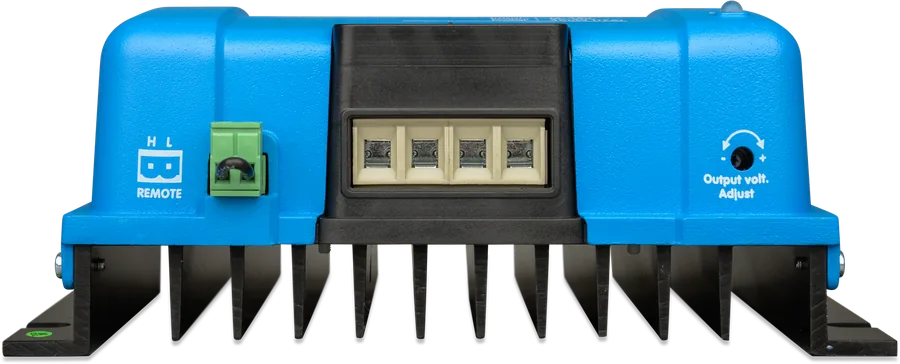
- Remote (isolated)Leave the bridge on the green connector or replace it with a switch (below 100 mA). Another option: remove the bridge and connect the right-hand terminal to the battery positive through a switch, for example the ignition switch.
- Output voltage (isolated)Knob next to the terminals (left or right, depending on the model): clockwise — higher, counter-clockwise — lower, about −15…+25% of the factory setting. Set it before paralleling converters or connecting the battery.
- LoadsConnect the load — the converter is ready.
The adjustment range in the datasheet (for example 10–15 V for a 12.2 V output) differs slightly from the manual description (−15…+25%).
Frequently asked questions about Orion-Tr
Can I charge a battery with Orion-Tr?
Victron does not recommend it — the datasheet for isolated Orion-Tr units says they are not intended for charging batteries. For charging, use Orion-Tr Smart (charging algorithm, engine running detection), and for higher currents Orion XS or Buck-Boost.
Isolated or non-isolated?
The non-isolated model (24 → 12 V only) is smaller and more efficient (95–97%), but it has a common negative for input and output and a fixed voltage. The isolated model has 200 V galvanic isolation, remote on/off, voltage adjustment and any combination of 12, 24 and 48 V.
Can I connect several converters in parallel?
Yes — the outputs are short-circuit and overload resistant. Isolated models can be connected in parallel without limit. First, set the same output voltage on each unit.
How do I switch the converter on with the ignition?
For isolated models: remove the jumper from the green remote terminal and connect the right-hand terminal through the ignition switch to battery positive. Then no switch is needed in the current circuit, and the switched-off converter draws less than 200 µA.
Why does the power drop at high temperature?
Above 40 °C ambient temperature, output current decreases by 3% for each degree — this protects against overheating. That is why the datasheet gives two power ratings: at 25 °C and at 40 °C.
I have a 12 V battery, and the equipment requires a constant 12 V — will the Orion-Tr 12/12 help?
Yes. The isolated 12/12 accepts 8–17 V and provides a stable 12.2 V (adjustable 10–15 V), as long as the output voltage is set to nominal or lower.
Manufacturer documentation
- Orion-Tr DC-DC isolated 100/250/400 W datasheetvictronenergy.com · PDF · EN
- Orion-Tr isolated manual (version 07, 09/2024)victronenergy.com · PDF · EN and others
- Orion-Tr low power, non-isolated datasheetvictronenergy.com · PDF · EN
- Orion-Tr 24/12 non-isolated manualvictronenergy.com · PDF · EN and others
Content checked against Victron Energy documentation (datasheets and manuals) — status as of 23 September 2026. Report an error in the content · Correction log