
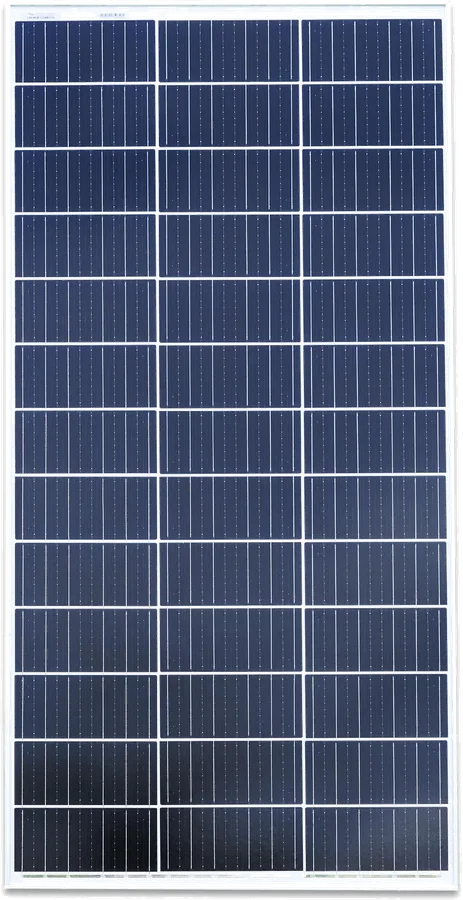
BlueSolar monocrystalline 190 W panel (39 cells) front view — aluminium frame
BlueSolar monocrystalline panels
Victron solar panels for battery systems: from 20 W for boats or caravans to 365 W for a cabin. The 36- and 39-cell models (Vmp about 21 V) are suitable for PWM and MPPT controllers with a 12 V battery, and the 56–72-cell models (Vmp 33–41 V) for MPPT controllers and series connection. Monocrystalline cells, tempered glass, anodised aluminium frame, bypass diodes in the junction box.
- 20–365 W
- 36–72 cells
- efficiency 16–21%
- max. 1,000 V system
- MC4 from 235 W
Panels for battery systems
BlueSolar panels are for off-grid and mobile systems: motorhome, caravan, boat, cabin, measurement station. Smaller models have a working voltage of about 21 V — enough to charge a 12 V battery even in hot weather, also with a simple PWM controller. Larger ones (56–72 cells) are connected in series and to an MPPT controller, which converts the higher voltage into charging current.
- low voltage temperature coefficient — better performance at high temperature,
- good performance in weak light and across the full spectrum,
- bypass diodes in a sealed junction box — less power loss in partial shade,
- high-transmission tempered glass, EVA laminate with a three-layer back sheet,
- surface load up to 200 kg/m², hail up to 23 m/s (7.53 g).
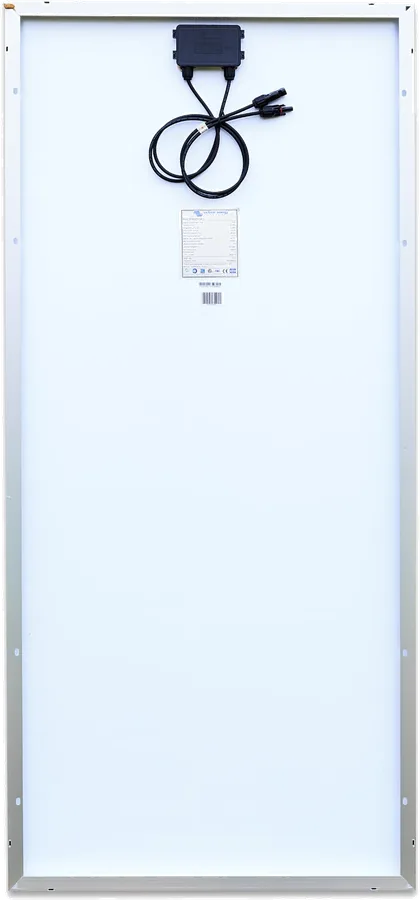
Current models — data under STC conditions
| Power | Cells | Dimensions (mm) | Weight | Vmp | Imp | Voc | Isc | Series fuse | Efficiency |
|---|---|---|---|---|---|---|---|---|---|
| 20 W | 36 | 275 × 450 × 25 | 1.30 kg | 21.3 V | 0.95 A | 24.7 V | 1.99 A | 10 A | 16.16% |
| 30 W | 36 | 380 × 450 × 25 | 1.80 kg | 21.2 V | 1.42 A | 24.7 V | 1.49 A | 10 A | 17.89% |
| 40 W | 36 | 425 × 668 × 25 | 3.10 kg | 18.3 V | 2.19 A | 22.45 V | 2.40 A | 10 A | 16.20% |
| 55 W | 36 | 715 × 445 × 25 | 3.34 kg | 21.0 V | 2.63 A | 24.8 V | 2.79 A | 10 A | 17.29% |
| 95 W | 30 | 770 × 668 × 30 | 5.40 kg | 17.6 V | 5.42 A | 20.4 V | 5.7 A | 10 A | 18.47% |
| 130 W | 36 | 1020 × 668 × 30 | 7.10 kg | 21.1 V | 6.18 A | 24.80 V | 6.53 A | 10 A | 19.10% |
| 150 W | 36 | 1485 × 668 × 30 | 11.00 kg | 18.2 V | 8.25 A | 22.3 V | 8.69 A | 15 A | 18.90% |
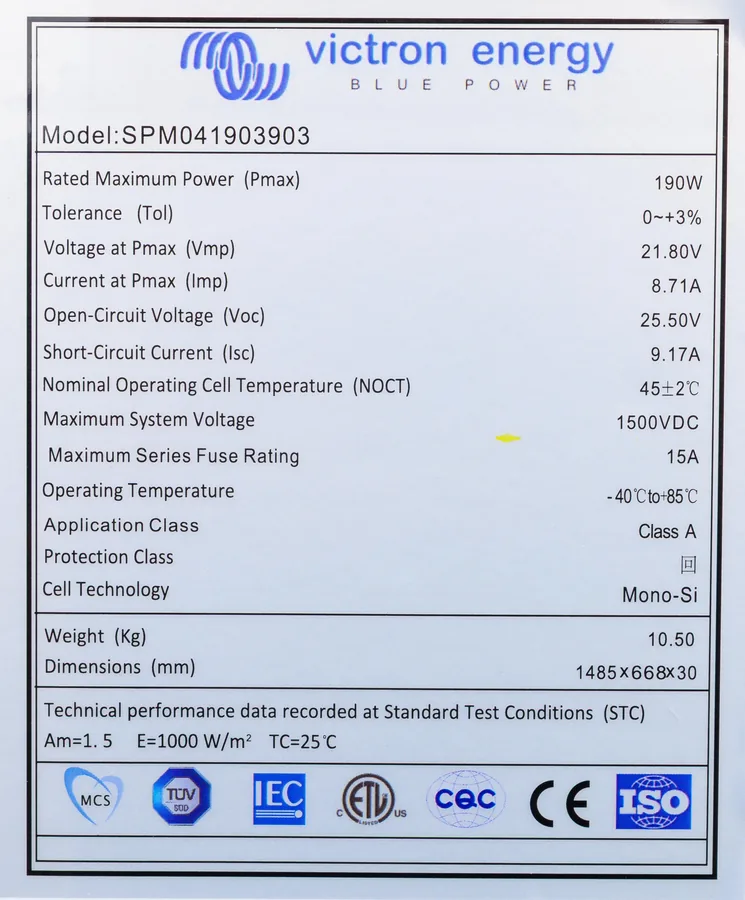
| 190 W | 39 | 1485 × 668 × 30 | 10.50 kg | 21.8 V | 8.71 A | 25.5 V | 9.17 A | 15 A | 19.16% |
| 235 W (4c) | 72 | 1350 × 880 × 30 | 12.48 kg | 41.4 V | 5.68 A | 49.6 V | 6.02 A | 10 A | 19.78% |
| 235 W (4d) | 72 | 1350 × 880 × 30 | 12.48 kg | 41.0 V | 5.60 A | 49.4 V | 5.94 A | 10 A | 19.36% |
| 285 W | 56 | 1550 × 880 × 35 | 14.32 kg | 33.4 V | 8.63 A | 38.9 V | 9.08 A | 15 A | 20.89% |
| 345 W | 68 | 1870 × 880 × 35 | 17.28 kg | 38.7 V | 8.80 A | 45.20 V | 9.27 A | 15 A | 20.96% |
| 365 W | 72 | 1980 × 880 × 35 | 18.30 kg | 41.4 V | 8.83 A | 48.40 V | 9.30 A | 15 A | 20.95% |
STC: 1000 W/m², 25 °C, AM 1.5. Power tolerance ±3%. Common values: power temperature coefficient −0.45%/°C, Voc −0.35%/°C, Isc +0.04%/°C; −40…+85 °C; maximum system voltage 1000 V; aluminium frame. Models up to 190 W without cables, 235–365 W with 900 mm cables and MC4 connectors. Warranty: 5 years on the product, 10 years at 90% power and 25 years at 80%. Inconsistencies: in the datasheet for the 20 W model, Isc (1.99 A) is more than twice Imp (0.95 A), which differs from the other models; the nameplate on the 190 W panel in the photo gives a maximum system voltage of 1500 V DC, while the datasheet states 1000 V.
How many panels in series and which controller
- 1.25 safety margin: in real-world conditions, a panel gives different voltages and currents than in the datasheet. The manual says to multiply Isc and Voc from the datasheet by 1.25 when selecting rated voltages, cables, fuses and the controller.
- Frost increases Voc: open-circuit voltage (Voc) rises when the temperature drops below 25 °C — by the percentage per degree stated by the panel’s Voc temperature coefficient in the datasheet. With Victron BlueSolar panels (−0.35%/°C), at −20 °C this is about 16% more than in the catalogue. The highest voltage of the panels in series must stay within the PV controller’s maximum voltage (for example 100, 150 or 250 V).
- Heat reduces Vmp: power drops by 0.45% for each degree above 25 °C cell temperature, and voltage by about 0.35%/°C. A 36-cell panel with a PWM controller will still charge a 12 V battery; with MPPT the panel voltage must be at least 5 V higher than the battery voltage.
- Maximum number in series: according to the manual, N = maximum system voltage / Voc (STC) — in practice the controller, not the panel, is the limiting factor.
- One type in one system: do not connect panels with different parameters in one system.
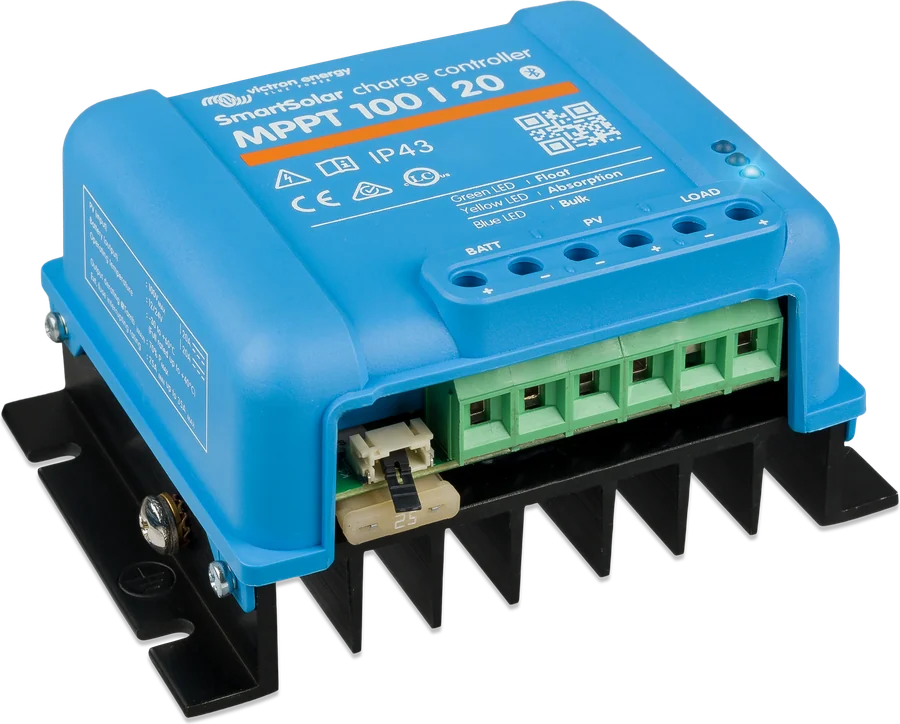
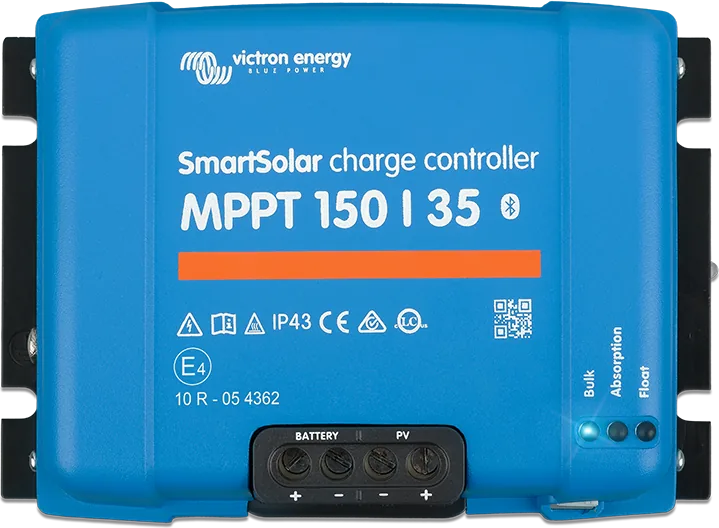
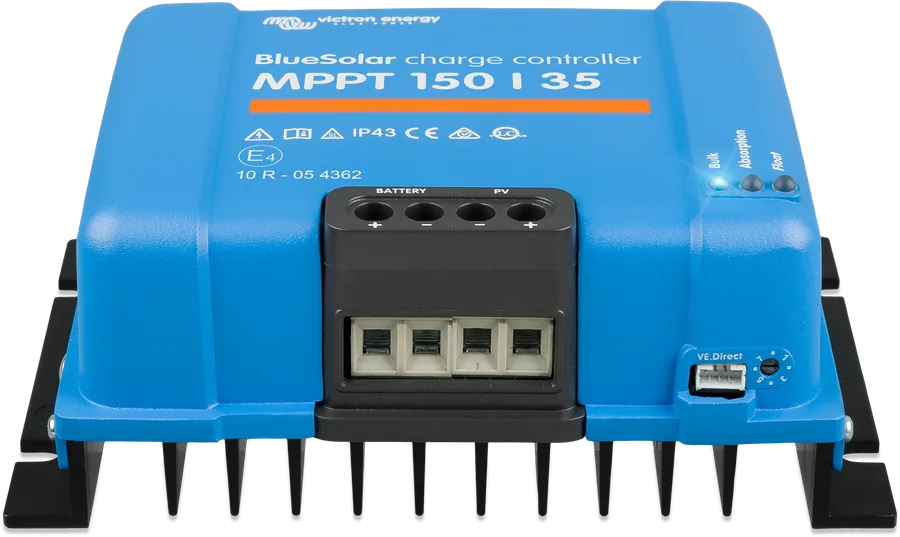
You can calculate the figures for a specific set in the MPPT calculator; we explain the rules in the guide choosing an MPPT controller for panels.
How to connect BlueSolar panels
Panels in series (or series-parallel) through a disconnect switch to the MPPT controller, controller to battery. Panel frames earthed. Diagram for guidance.
- InstallationFrame in the factory holes, frame earthing, panels covered.
- StringPanels of one type; Voc × 1.25 with frost correction ≤ controller PV voltage.
- MeasurementMeasure the string Voc before connecting.
- ConnectionFirst battery to controller, then panels through the disconnect switch.
Installation rules
- Orientation: in the Northern Hemisphere, face south; the panel should not be shaded at any time of day.
- Mounting: only through the factory holes in the frame — four symmetrical points; in high wind or snow, all eight. Do not drill additional holes in the frame or glass (warranty void).
- Roof: at least 10 cm of free space under the panel for cooling; watertight roof penetrations. The panels have fire class C (suitable above an A-class roof).
- Ground: the lower edge high enough that it is not buried by snow and not shaded by plants.
- Structure: durable, corrosion-resistant and UV-resistant. Load calculations are the responsibility of the designer or installer.
- Handling: do not lift by the junction box or cables, do not stand on the panel, do not place heavy objects on it; do not paint or glue the surface, do not concentrate light with mirrors.
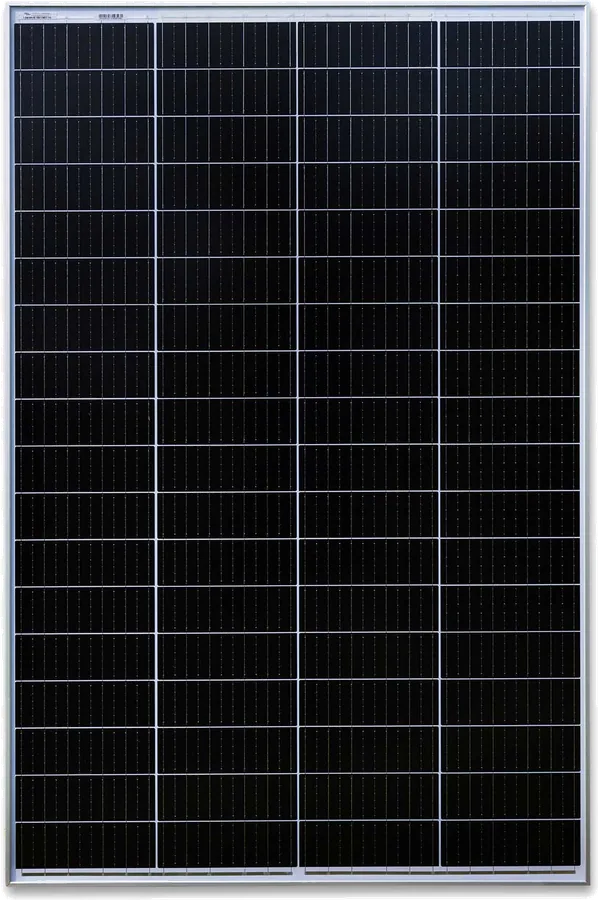
Cables, earthing, diodes
Cables and connectors
For a single panel, a 4 mm² cable and a connector rated above 10 A are recommended. The cable must withstand at least 85 °C, the connector 105 °C. Select cross-sections according to the system’s maximum short-circuit current.
Frame earthing
The frame must be earthed through the earthing hole: ILSCO GBL4-DBT clamp, stainless M3 or M5 screw with a star washer cutting through the anodising; torque 0.8 or 1.5 Nm. On a boat and in a vehicle, follow the rules for the installation in question.
Bypass and blocking diodes
Bypass diodes are in the junction box and protect shaded cells from overheating. A blocking diode (to prevent battery discharge at night) is recommended only when there is no charge controller.
Security
A single panel in sunlight can produce more than 30 V DC. Cover the panel with an opaque material during installation, do not disconnect under load, use insulated tools, and remove metal jewellery.
How to check panels
- String open-circuit voltageBefore connecting to the controller, measure the Voc of each series string — it should equal the sum of the panels’ Voc values from the datasheet (with correction for temperature and sunlight).
- Short-circuit currentMeasure the string Isc; the meter range must be at least 1.25 × the datasheet Isc. The result depends heavily on weather, time of day and shading.
- Voltage too lowThis is usually poor-quality connections or a faulty bypass diode. Cover the panels, disconnect the cables, uncover one panel and measure its Voc. Half the rated value — faulty diode; a difference of more than 5% (in not-too-weak light) — poor connection.
Maintenance: wash the glass with water and a soft sponge (or a mild, non-abrasive cleaner); check electrical and mechanical connections every six months.
BlueSolar panel FAQs
Which panel for a PWM controller, and which for MPPT?
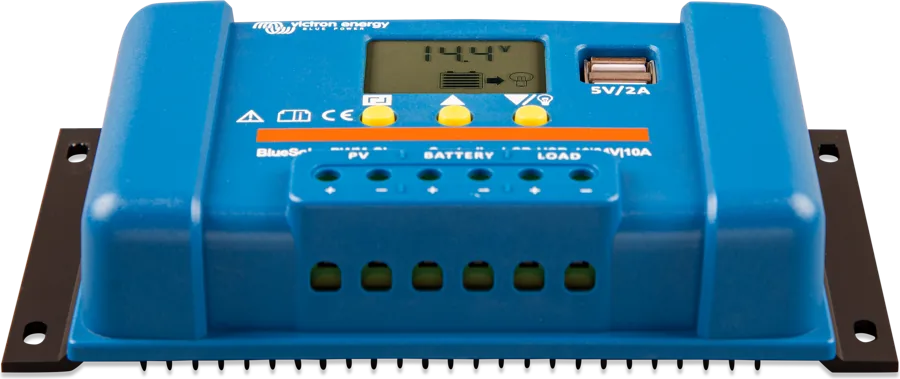
For PWM with a 12 V battery, 36- and 39-cell models are suitable (Vmp about 21 V; 40 W and 150 W — about 18 V). 56–72-cell panels (Vmp 33–41 V) require an MPPT controller — PWM would waste the excess voltage.
Can I connect different panels?
The manual recommends not connecting panels with different configurations in one system. If you have different panels, connect them to separate controllers.
Do I need a blocking diode?
Only without a charge controller. A Victron controller does not allow reverse current from the battery to the panels.
What is the warranty?
5 years for materials and workmanship; for power — 90% after 10 years and 80% after 25 years.
Is the panel suitable for a boat and a vehicle?
Yes — the manual allows installation on the ground, roof, pole, in vehicles and on boats, with a suitably designed support structure.
Manufacturer documentation
Content checked against Victron Energy documentation (datasheets and manuals) — status as of 23 September 2026. Report an error in the content · Correction log