
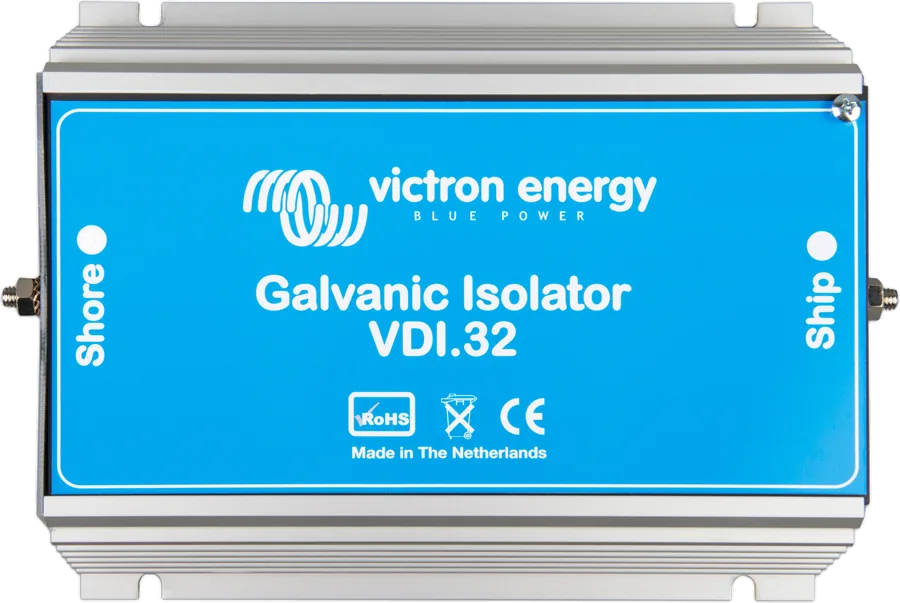
VDI-32 galvanic isolator from above — Shore and Ship markings on the sides, terminal bolts
Galvanic Isolator VDI-16, VDI-32, VDI-64
A small, resin-potted unit fitted in the protective earth conductor (PE) of shore power. It stops low DC voltages that flow from the marina earth through the PE conductor and cause corrosion of underwater boat parts — hull, shaft, propeller, anodes. If an AC fault occurs, it lets current through and the RCD disconnects the circuit.
- 16 / 32 / 64 A
- threshold approx. 1.4 V DC
- IP67, resin potted
- M6 bolts
Two diodes instead of a broken PE conductor
Inside are two diodes connected anti-parallel. They allow current in both directions, but only above a threshold of about 1.4 V DC. The potential difference between metals in water is below this threshold, so no galvanic current flows through the protective earth conductor and it does not damage underwater boat parts.
If the AC installation fails, the voltage on the protective earth conductor is much higher — the diodes conduct, fault current flows to earth, and the RCD trips. This means you do not need to disconnect the protective earth conductor, which would be dangerous.
- resin potted, IP67, anodised aluminium heatsink,
- mounted directly behind the boat’s 230 V shore power inlet,
- in normal operation the heatsink warms by no more than 20 °C; it can become hot when carrying fault current.
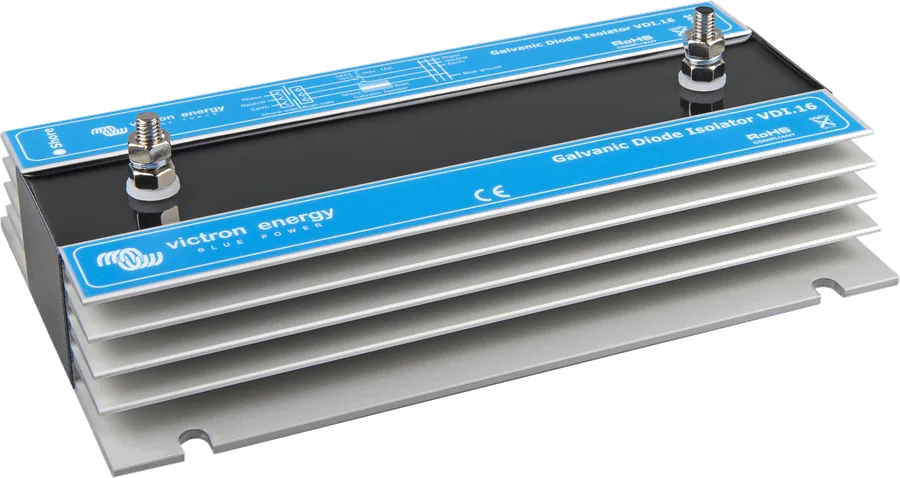
VDI-16, VDI-32 and VDI-64
| VDI-16 | VDI-32 | VDI-64 | |
|---|---|---|---|
| Maximum current | 16 A | 32 A | 64 A |
| Surge current (20 ms) | 1600 A | 3200 A | 6000 A |
| Connections | M6 bolts | ||
| Dimensions (H × W × D) | 60 × 120 × 200 mm | 63 × 164 × 200 mm | 63 × 164 × 335 mm |
| Weight | 1 kg | 2 kg | 3.2 kg |
All: resin potted (waterproof, potted), IP67, anodised aluminium heatsink. Choose the model to match the shore power inlet rating (16, 32 or 64 A).
In the protective earth conductor, before all earthing points
Fit the isolator in the green/yellow protective earth conductor before all boat earthing connections. If any earth connection on the boat bypasses it, the isolator will not work.
- LocationWell ventilated, heat-resistant surroundings — no chemicals, plastics, curtains or fabrics nearby; 10 cm clear space all round.
- PositionMount with the longer side vertical — best cooling.
- ConnectionIn the PE conductor directly behind the shore power inlet: the “Shore” side to shore PE, the “Ship” side to the boat earth. Cross-sections and protection according to local regulations.
Galvanic isolator or isolation transformer
Galvanic isolator VDI
A small, light unit in the PE conductor. It blocks galvanic current below about 1.4 V, but the boat remains connected to shore earth through the diodes.
1–3.2 kgIsolation transformer
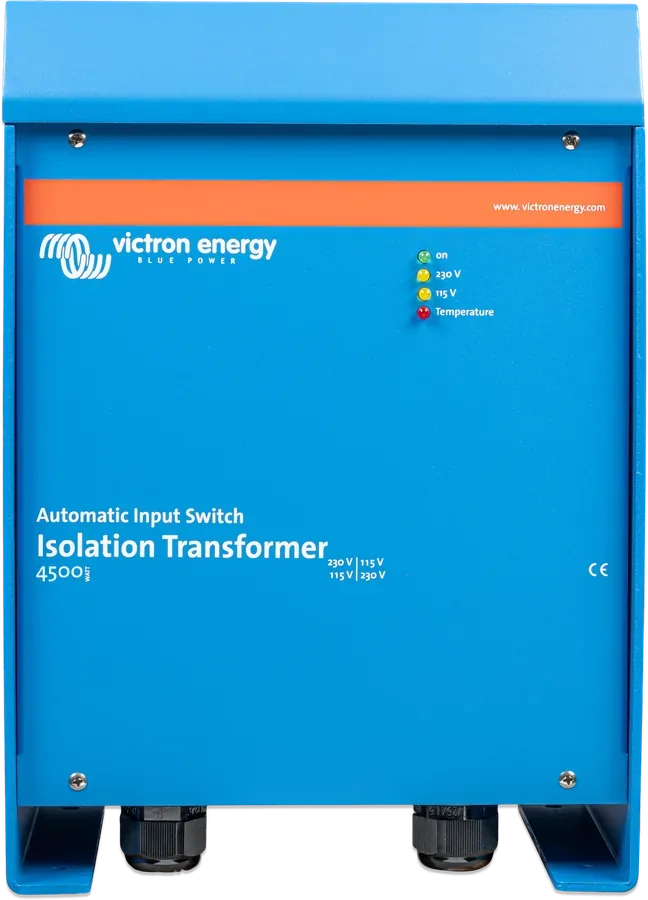
Completely separates the boat from shore; according to Victron it replaces the galvanic isolator and polarity alarm. It also boosts voltage by 5% and converts 115/230 V.
separate cardFrequently asked questions about the galvanic isolator
Does galvanic corrosion only affect steel and aluminium boats?
No. According to Victron, it affects every boat whose metal parts — for example the shaft and propeller — are in contact with water, including boats with a GRP hull.
Can I simply leave the shore protective earth conductor disconnected?
No — that is dangerous. Without a protective conductor, a short to a metal part of the boat will not trip either the RCD or the fuse. The galvanic isolator stops galvanic current and still leaves a path for fault current.
Why is the isolator warm?
In normal operation, the heatsink warms by no more than 20 °C. It can be very hot when it is carrying earth fault current during a fault — check the AC installation then.
Do I need an isolator if I have an isolation transformer?
No. Victron states that an isolation transformer removes the need for a galvanic isolator and a polarity alarm.
Content checked against Victron Energy documentation (datasheets and manuals) — status as of 23 September 2026. Report an error in the content · Correction log