
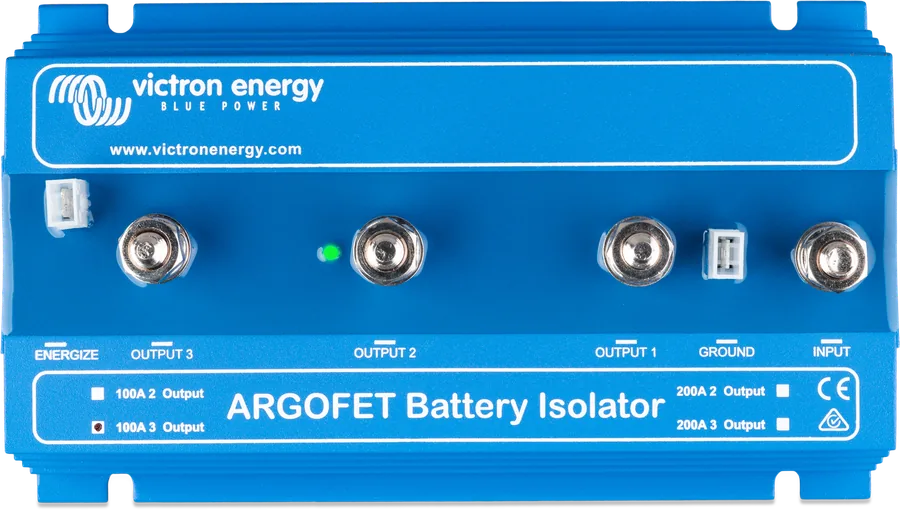
Argofet front view — blue enclosure with heatsink, M8 input and output bolts, energize and ground terminals, LED
Argofet and Argodiode
Separators (charge splitters) allow one alternator — or a charger with one output — to charge two or three batteries at the same time without connecting them together. Discharging the house battery will then not discharge the starter battery. Argofet uses FET transistors and practically has no voltage drop; Argodiode uses Schottky diodes with a drop of about 0.3–0.45 V.
- 12 i 24 V
- 2 or 3 batteries
- Argofet 100 / 200 A
- Argodiode 80–180 A
- energize input
One alternator, several independent batteries
In a boat, campervan or vehicle with an auxiliary battery, the alternator should charge all batteries, but the house battery must not discharge the starter battery. The separator allows current to flow in one direction only: from the input (alternator) to each output (batteries), not between batteries.
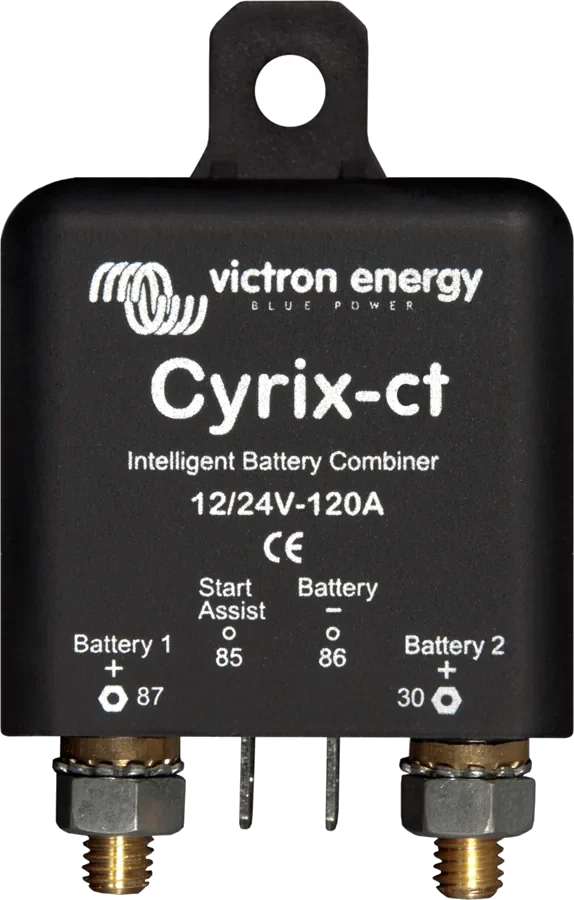
Unlike the Cyrix-ct combiner, which links batteries with a relay, the separator keeps them permanently isolated from each other. The Argofet datasheet lists an alternator or a battery charger with one output as the source.
- works in 12 V and 24 V systems (Argofet detects the voltage automatically),
- energize input (AC and Argofet models) for alternators that need voltage on B+ to start,
- M6 or M8 screw terminals, with no switches or settings.
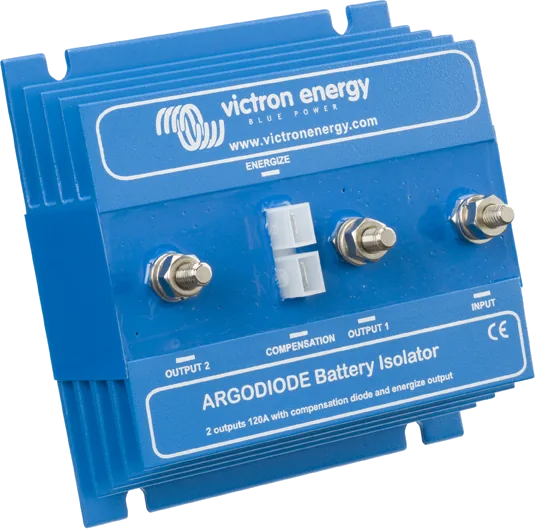
The separator gets hot when current flows — the manuals require it to be mounted only on a non-combustible surface. Before making changes to the installation, always disconnect the battery negative leads.
Argofet or Argodiode
Argofet
FET transistors: voltage drop below 0.02 V at low current and 0.1 V on average at high current. No need to raise the alternator voltage. Always with energize input and a blue LED indicating voltage at the input.
100 / 200 AArgodiode
Schottky diodes: about 0.3 V at low current and about 0.45 V at rated current. Each model has a compensation diode, which can slightly raise the alternator voltage; “AC” models also have an energize input.
80–180 ABCD diode combiner
The opposite of a separator: two sources (batteries) supply one critical load — failure of one source does not interrupt power.
BCD 402 / 802Example from the manual: 100 A through a 50 mm² cable 10 m long gives a 0.26 V drop; 50 A through 10 mm² and 5 m gives as much as 0.35 V. The cables should be short and of the correct cross-section — calculate them in the cable calculator.
Models and data
| Model | Max. current (charging and alternator) | Batteries | Energize | Connections | Dimensions, weight |
|---|---|---|---|---|---|
| Argofet 100-2 | 100 A | 2 | yes | M8 | 65 × 120 × 200 mm, 1.4 kg |
| Argofet 100-3 | 100 A | 3 | yes | M8 | 65 × 120 × 200 mm, 1.4 kg |
| Argofet 200-2 | 200 A | 2 | yes | M8 | 65 × 120 × 200 mm, 1.4 kg |
| Argofet 200-3 | 200 A | 3 | yes | M8 | 65 × 120 × 200 mm, 1.4 kg |
| Argodiode 80-2SC | 80 A | 2 | no | M6 | 60 × 120 × 75 mm, 0.5 kg |
| Argodiode 80-2AC | 80 A | 2 | yes | M6 | 60 × 120 × 90 mm, 0.6 kg |
| Argodiode 100-3AC | 100 A | 3 | yes | M6 | 60 × 120 × 115 mm, 0.8 kg |
| Argodiode 120-2AC | 120 A | 2 | yes | M8 | 60 × 120 × 115 mm, 0.8 kg |
| Argodiode 140-3AC | 140 A | 3 | yes | M8 | 60 × 120 × 150 mm, 1.1 kg |
| Argodiode 160-2AC | 160 A | 2 | yes | M8 | 60 × 120 × 150 mm, 1.1 kg |
| Argodiode 180-3AC | 180 A | 3 | yes | M8 | 60 × 120 × 200 mm, 1.5 kg |
All for 12 and 24 V systems. In Argodiode, the compensation diode and energize input use 6.3 mm flat connectors (Faston). Choose a separator whose current rating is no less than the alternator’s maximum current.
Alternator → separator → three batteries
Alternator positive to the separator input, battery positives to outputs 1, 2 and 3; battery negatives to the common busbar. Schematic based on the drawing in the Argofet manual.
- Disconnect negativesBefore work, disconnect the battery negative leads.
- InputAlternator positive (B+) to the separator input.
- OutputsBattery positives to outputs 1, 2 and (optionally) 3.
- EnergizeOptional ignition switch to the energize connector (min. 2.5 mm²).
- WeightArgofet: ground to the negative busbar (min. 2.5 mm²); battery negatives to the common busbar.
Why the alternator may not start
Some alternators only begin charging when there is voltage on the B+ output. Without a separator, a connected battery provides it. However, the separator blocks reverse current from the batteries to B+ — and such an alternator will not excite.
The solution is the energize input (Argofet and Argodiode with the AC designation): when the ignition switch is closed, it applies a limited current to B+. Argodiode 80-2SC does not have this input.
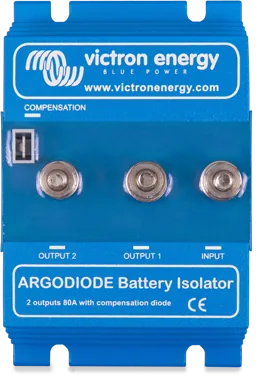
Argodiode also has a compensation diode: connecting the alternator’s sense wire to it slightly raises the charging voltage and compensates for the drop across the separator diodes. Without this, the batteries may not charge to 100% and will age faster.
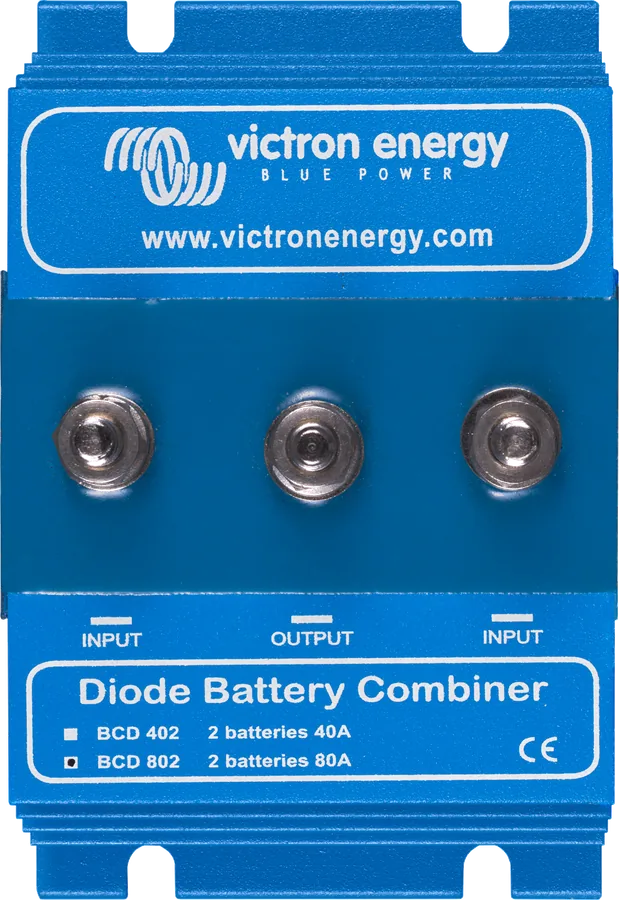
Argo Diode Battery Combiner BCD 402 and BCD 802
A diode combiner works the opposite way to a separator: two DC sources (for example two batteries) feed one critical load in parallel, for example an engine ECU. Failure of one source does not interrupt power to the load.
- BCD 402: 40 A continuous, 2 batteries.
- BCD 802: 80 A continuous, 2 batteries.
- Both: 12 and 24 V, Schottky diodes (drop about 0.3–0.45 V), M6 terminals, 60 × 120 × 75 mm, 0.8 kg. Hot surface — only on a non-combustible surface.
Most common questions about Argo separators
Separator or Cyrix-ct?
Cyrix-ct is a relay that connects batteries when one of them is being charged and disconnects them when the voltage drops — with no voltage drop, but the batteries are then linked together. The separator keeps them permanently isolated: current flows only from the alternator to the batteries.
Why are the batteries undercharged after fitting Argodiode?
Diodes reduce the voltage by about 0.3–0.45 V. Connect the alternator’s sense wire to the compensation diode (if the alternator allows it) or choose Argofet, which loses only 0.02–0.1 V. Also check the voltage drop in the cables.
The alternator stopped charging after the separator was fitted.
It most likely needs voltage on B+ to start. Connect the energize connector to the ignition switch (wire min. 2.5 mm²) — in Argofet or in Argodiode with the AC designation.
Is the separator suitable for a smart alternator (Euro 5/6) or LiFePO4 batteries?
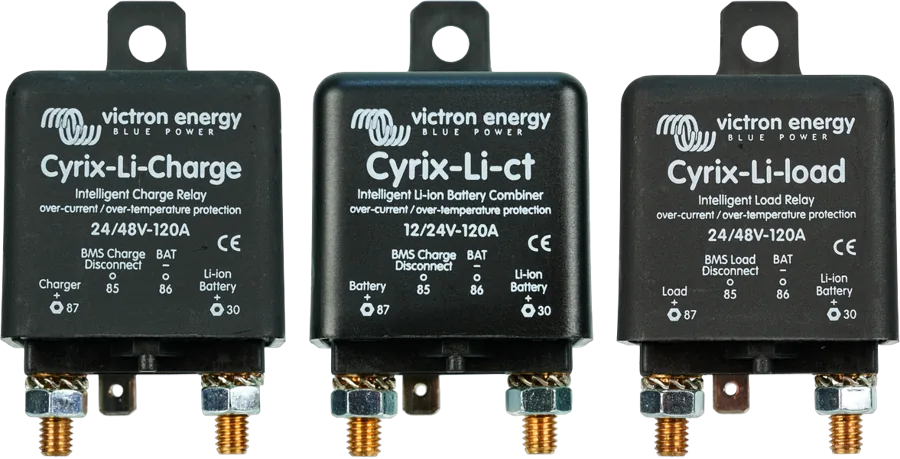
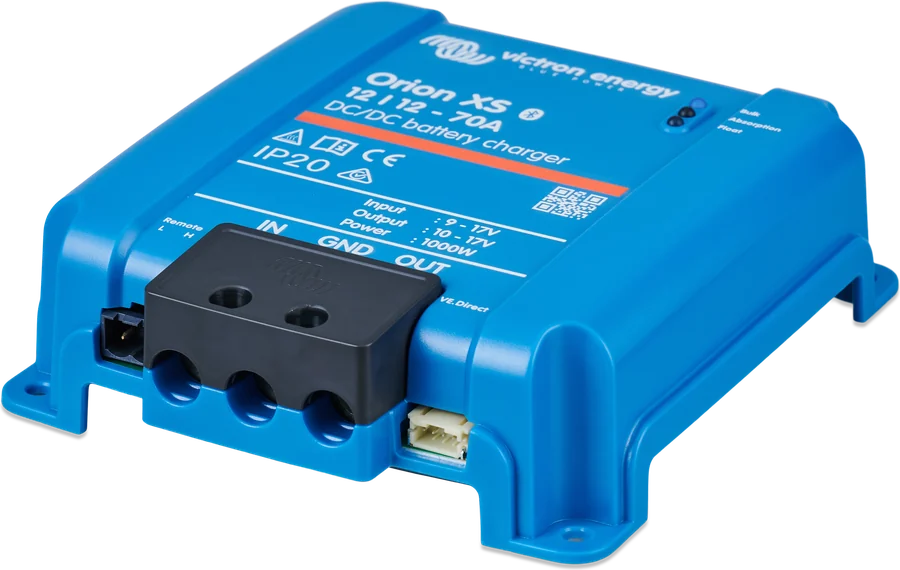
The separator documentation does not cover this. For charging a house battery from a smart alternator, and also lithium batteries, Victron provides DC-DC chargers: Orion XS, Orion-Tr Smart or Buck-Boost, and for lithium batteries with BMS — Cyrix-Li.
What does the blue LED on Argofet mean?
Lights when there is voltage at the isolator input (for example, when the alternator is running).
Manufacturer documentation
- Argofet Battery Isolators datasheetvictronenergy.com · PDF · EN
- Argofet manual (rev 14, 13 October 2021)victronenergy.com · PDF · EN and other languages
- Argodiode Battery Isolators datasheetvictronenergy.com · PDF · EN
- Argodiode manual (rev 05, 30 January 2017)victronenergy.com · PDF · EN and other languages
- Argodiode 80-2SC manual (rev 02)victronenergy.com · PDF · EN and other languages
- Argo Diode Battery Combiners datasheetvictronenergy.com · PDF · EN
Content checked against Victron Energy documentation (datasheets and manuals) — status as of 23 September 2026. Report an error in the content · Correction log