
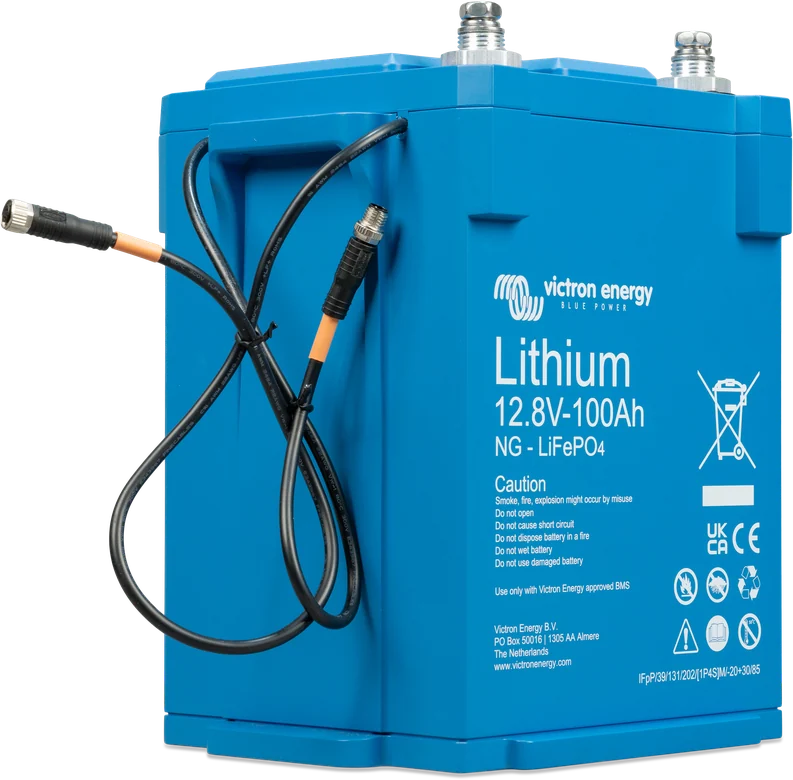
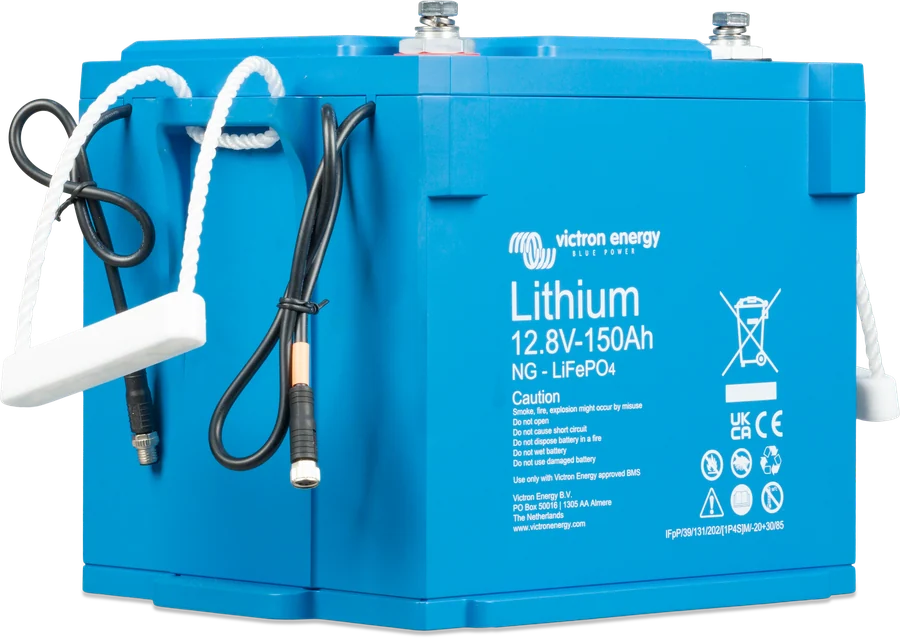
Lithium NG 12.8 V / 100 Ah battery — angled view, M8 terminals and communication cable
Lithium NG
Victron’s new generation of lithium iron phosphate batteries. Each battery measures cell voltages and temperatures and current, and sends this data to an external BMS NG, which calculates state of charge, warns you, disconnects charging and loads. IP65 enclosure, bracket mounting.
- 12.8 / 25.6 / 51.2 V
- 100–300 Ah
- IP65
- Built-in current measurement
- BMS NG required
A battery that measures itself, but does not make decisions
Lithium NG is Victron’s new generation of LiFePO4 batteries. Each battery measures cell voltages and temperatures and — this is new compared with the older series — the current flowing through the terminals, and sends this data to an external BMS.
The battery itself disconnects nothing. That is done by the BMS marked NG, which is mandatory and bought separately: it calculates state of charge, warns of low charge, stops charging and disconnects loads. The batteries are connected to it in a chain with communication cables.
- 12.8, 25.6 and 51.2 V voltages and capacities from 100 to 300 Ah,
- 2,500 cycles at 80% depth of discharge and 92% energy efficiency,
- IP65 enclosure with handles and brackets for permanent mounting.

What sets the NG series apart
Built-in current measurement
The battery measures not only cell voltages and temperatures, but also current. This allows the BMS NG to calculate state of charge without a separate battery monitor.
One chain to the BMS
The batteries are connected with communication cables in a chain leading to the BMS. The BMS automatically detects the system voltage and number of batteries, and updates their firmware.
Protection thresholds
Pre-alarm below 3.0 V per cell, disconnect loads below 2.8 V, stop charging above 3.6 V or when the temperature is outside the range.
2,500 cycles
At 80% depth of discharge; 3,000 cycles at 70% and 5,000 at 50% — until capacity falls to 80% of nominal. Energy efficiency 92%.
Large banks
Up to 50 12.8 V batteries (192 kWh), 50 25.6 V batteries (384 kWh) or 25 51.2 V batteries (128 kWh) per BMS.
Pulse currents
Continuous current equal to capacity (e.g. 200 A for 200 Ah), and double that for 10 seconds — inverter and motor starts are no problem.
IP65 enclosure
Dust-tight and resistant to low-pressure water jets, but intended for indoor installation only, in a dry place. M8 terminals, brackets included.
Low self-discharge
Up to 3% per month at 25 °C. Storage permitted from −45 to +70 °C.
Capacities and currents
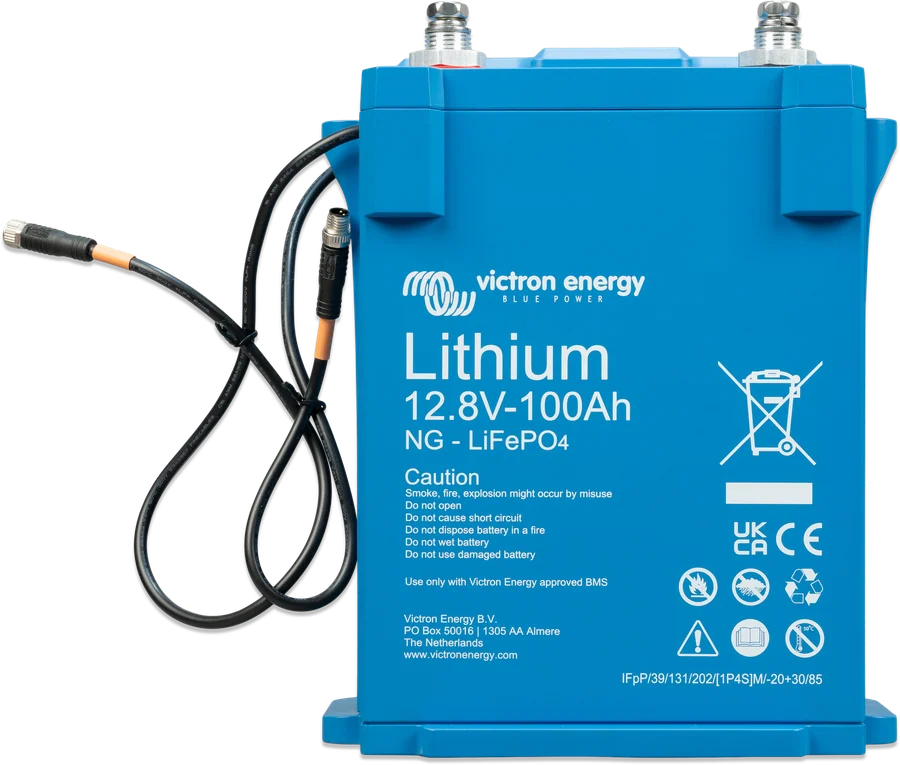
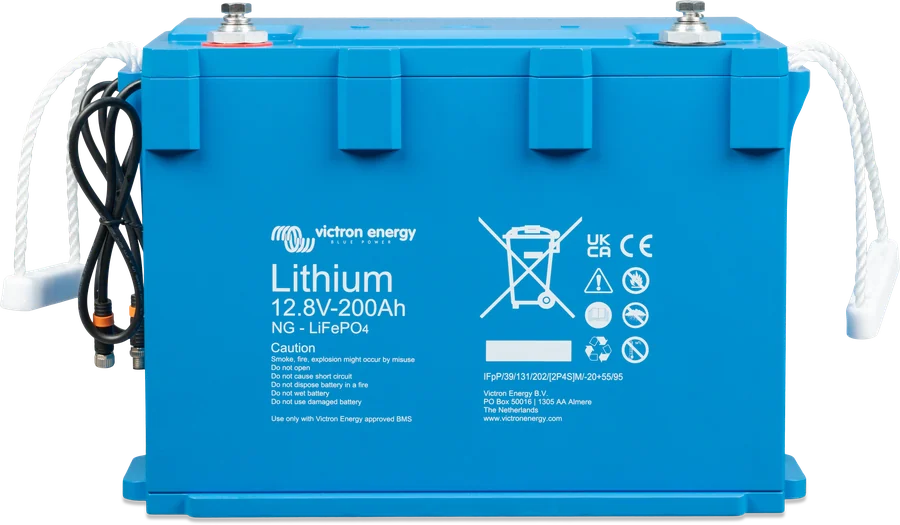
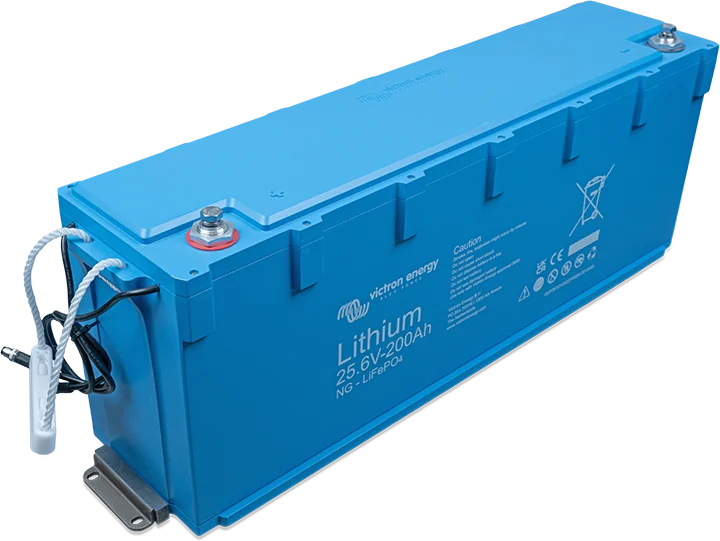
| Model | Energy | Continuous current (ch./disch.) | 10 s discharge pulse | Weight | Dimensions (h × w × d) |
|---|---|---|---|---|---|
| 12.8 V / 100 Ah | 1,280 Wh | 100 A | 200 A | 9 kg | 235 × 197 × 160 mm |
| 12.8 V / 150 Ah | 1,920 Wh | 150 A | 300 A | 14 kg | 205 × 250 × 205 mm |
| 12.8 V / 200 Ah | 2,560 Wh | 200 A | 400 A | 19 kg | 235 × 341 × 160 mm |
| 12.8 V / 300 Ah | 3,840 Wh | 300 A | 600 A | 29 kg | 206 × 447 × 205 mm |
| 25.6 V / 100 Ah | 2,560 Wh | 100 A | 200 A | 19 kg | 235 × 341 × 160 mm |
| 25.6 V / 200 Ah | 5,120 Wh | 200 A | 400 A | 37 kg | 235 × 648 × 162 mm |
| 25.6 V / 300 Ah | 7,680 Wh | 300 A | 600 A | 52 kg | 206 × 841 × 205 mm |
| 51.2 V / 100 Ah | 5,120 Wh | 100 A | 200 A | 37 kg | 235 × 648 × 162 mm |
Capacity at 25 °C and a discharge current up to 1C. Weights according to the datasheet are approximate. Service life (capacity ≥ 80% of nominal): 2,500 cycles at 80% DoD, 3,000 at 70%, 5,000 at 50%. M8 terminals. Banks per one BMS: up to 50 12.8 V batteries — max. 192 kWh; up to 50 25.6 V batteries — max. 384 kWh; up to 25 51.2 V batteries — max. 128 kWh.
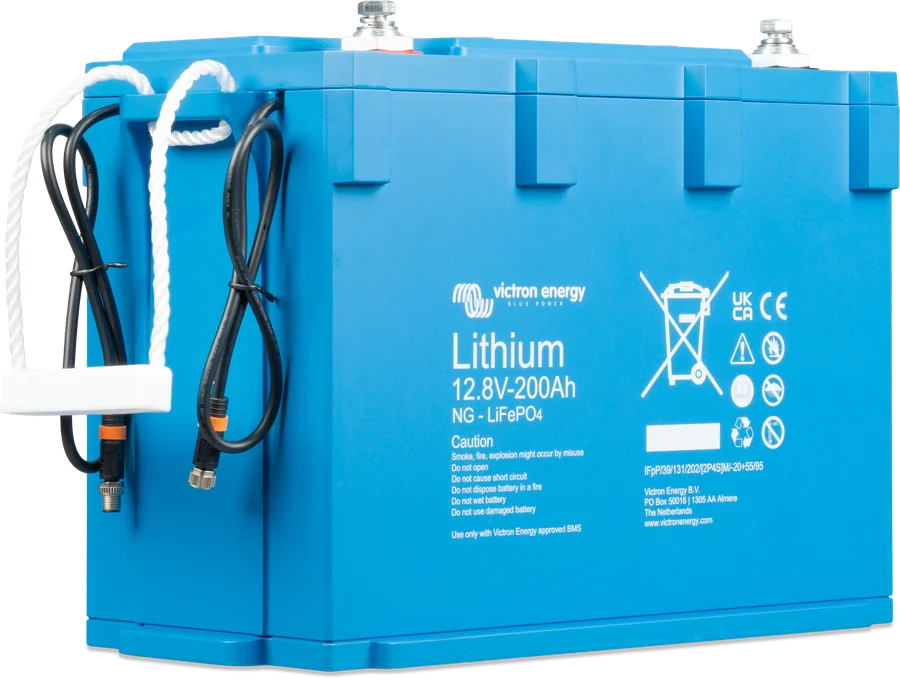
Only with BMS marked NG
Manufacturer: “use only with an NG-type BMS approved by Victron”. The BMS is mandatory, and operation without it voids the warranty. NG BMS units do not work with Lithium Smart batteries — those use older BMS units, for example Lynx Smart BMS and VE.Bus BMS (without NG).
How communication works between the battery and the BMS: image below.
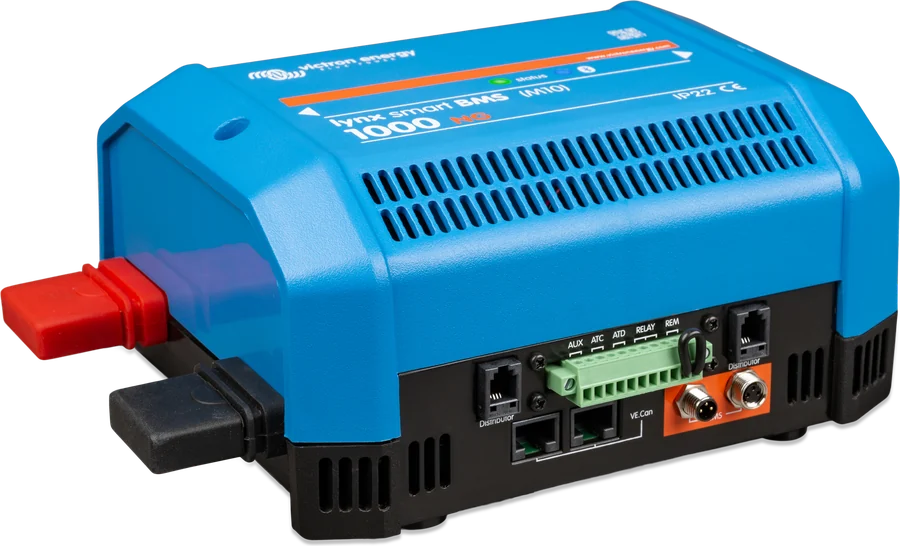
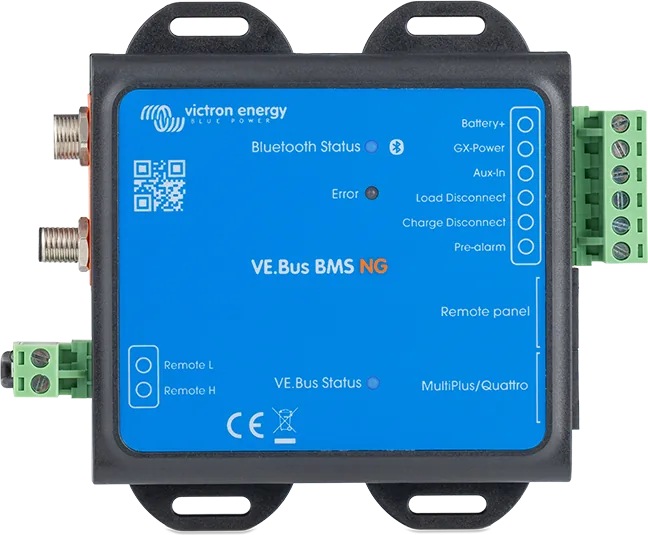
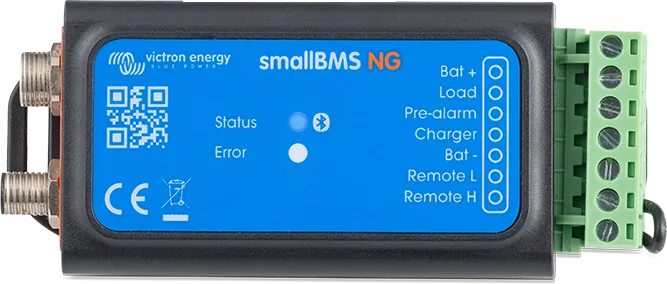
The BMS is mandatory and bought separately. The batteries are connected with M8 cables in a chain leading to the BMS; the BMS automatically detects the system voltage and number of batteries and updates their firmware. According to the Lithium NG manual, you can choose from:
| BMS | For which systems |
|---|---|
| Lynx Smart BMS NG (500 A / 1000 A) | medium and large systems (yachts, campervans) with DC and AC loads; contactor disconnecting the DC system, load disconnect and charge disconnect outputs, pre-alarm, battery monitor, VE.Can to GX |
| VE.Bus BMS NG | systems with a VE.Bus inverter or inverter/charger — it controls it via VE.Bus, the rest via control outputs |
| smallBMS NG | smaller systems — load disconnect and charge disconnect outputs and pre-alarm |
BMS thresholds according to the datasheet: pre-alarm when cell voltage drops below 3.0 V; load disconnection below 2.8 V; charging stops above 3.6 V or at too high or too low a temperature. Load disconnection due to low voltage is the last protection against battery damage; after such a disconnection, the battery must be charged immediately and no residual currents should be left in the system.
Example of a complete system with two 200 Ah batteries and a Lynx Smart BMS NG: yacht diagram. Alarm diagnostics: the codes are shown by the BMS to which the battery is connected — with Lynx Smart BMS NG see Lynx Smart BMS codes, with smallBMS NG or VE.Bus BMS NG — NG BMS codes.
How the battery talks to the BMS and what is passed on
The Lithium NG battery measures everything itself, while the NG BMS makes the decisions. Data is sent digitally via M8 cables from the battery to the BMS, and the BMS converts it into signals for chargers and loads, plus data for GX, VRM and the app. Hover over the diagram or tap it.
- Batteries in a chainM8 cables (3-pin, 50 cm) from battery to battery, in any order; the first and last to the BMS NG.
- Battery → BMSDigital: battery voltage, current and temperature, cell voltages and temperatures, balancing, alarms.
- BMS → batteryBattery firmware update — including batteries added later.
- ATC and ATDCharging and discharging permitted or not permitted — for chargers and loads.
- Pre-alarmAt 3.0 V per cell, at least 30 s before load disconnection.
- GX and VRMLynx Smart BMS NG: full data and DVCC via VE.Can; VE.Bus BMS NG: SoC via Multi; smallBMS NG: no GX.
- BluetoothVictronConnect: status, history and data from each battery from every NG BMS.
The same battery data, different reach in the system
Every NG BMS receives the same complete set of data from the battery. They differ in what they pass on — and that determines the choice.
| Lynx Smart BMS NG | VE.Bus BMS NG | smallBMS NG | |
|---|---|---|---|
| Control of chargers and loads | ATC and ATD contacts (0.5 A) + 500 A or 1,000 A contactor disconnecting the DC system | Charge and Load disconnect outputs + VE.Bus: turns the inverter off, turns off or limits charging of Multi/Quattro | Charge and Load disconnect outputs |
| Pre-alarm | programmable relay 2 A | 1 A output | output |
| Connection to GX | VE.Can (also for NMEA 2000) | GX to the BMS “Remote panel” port (RJ45, VE.Bus) | none |
| What GX and VRM see | SoC, voltage, current, power, Consumed Ah, ATC/ATD status, min./max. cell voltage and temperature, number of batteries, history, alarms | SoC only (after enabling “Battery monitor” in Multi) | — |
| DVCC | always enabled: voltage and charge/discharge current limits for Multi, MPPT and Orion XS | stops charging of MPPT, Inverter RS and Multi RS (charge current = 0); does not set charge voltages | none |
| Bluetooth (VictronConnect) | full data, configuration, firmware | full data, configuration, firmware* | full data, configuration, firmware* |
- State of charge: smallBMS NG and VE.Bus BMS NG use the shunt built into the battery, so a separate battery monitor is not needed (sources differ on whether the BMS or the battery calculates SoC). Lynx Smart BMS NG has its own shunt and calculates SoC itself.
- Alarm thresholds are stored in the battery (Lynx Smart BMS NG manual). The datasheet states: pre-alarm below 3.0 V, disconnect loads below 2.8 V, stop charging above 3.6 V per cell; charging allowed from 5–50 °C.
- All chargers and loads must be controlled by the BMS — via ATC/ATD signals or by DVCC. Devices outside BMS control can permanently damage the battery.
- * The smallBMS NG and VE.Bus BMS NG manuals describe firmware updates via VictronConnect, but the table in the BMS NG overview says “no” for them.
- Start-up test: disconnect any BMS wire — the BMS should switch off all chargers and loads. M8 extension cables (1–5 m, in pairs) and the screened VE.Bat kit (Lynx only) are separate accessories.
Lithium NG, Lithium Smart or SuperPack NG
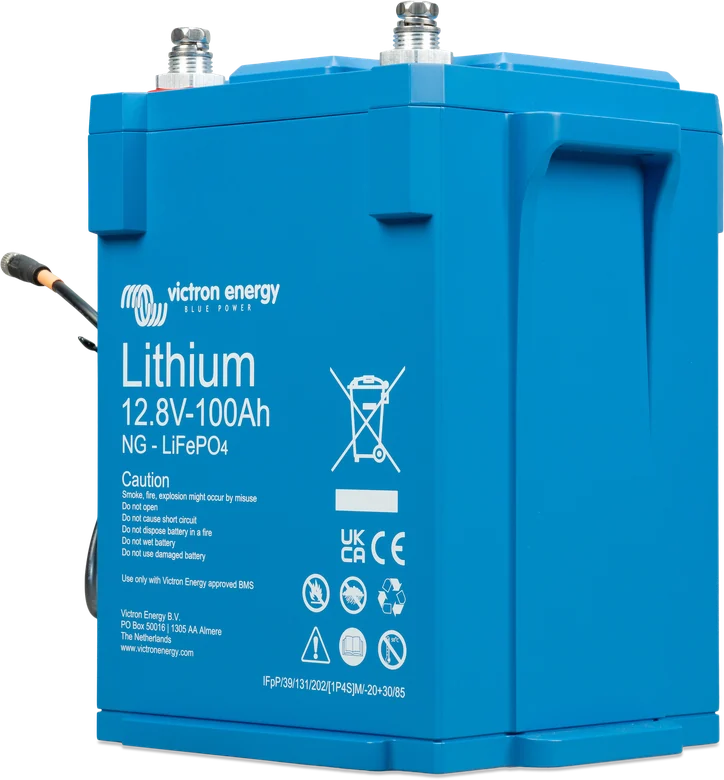
Lithium NG
Built-in current measurement, IP65 enclosure and NG BMS units that recognise the system themselves. For banks that will be expanded in future and monitored systems.
12.8–51.2 V · 100–300 AhLiFePO4 Smart
Battery with Bluetooth, without built-in current measurement; works with previous-generation BMS units (VE.Bus BMS V2, Lynx Smart BMS, Smart BMS 12/200). LiFePO4 Smart sheet.
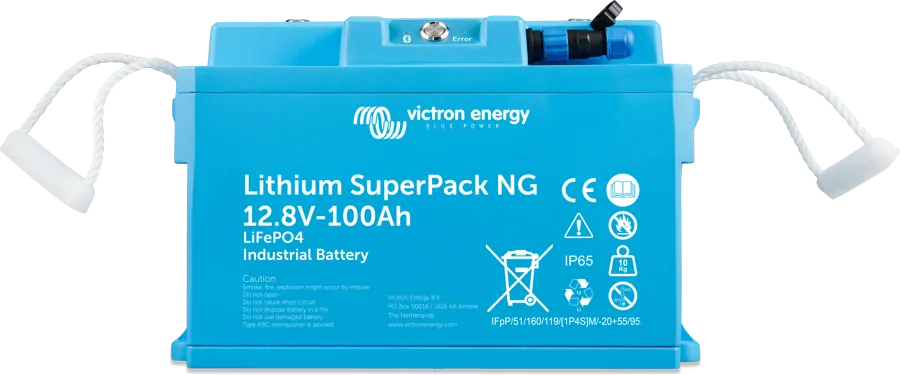
12.8 / 25.6 V · 50–330 AhLithium SuperPack NG
Battery with a BMS built into the enclosure — works without an external BMS, so it is suitable for simple installations. SuperPack NG sheet.
no separate BMSOnly BMS units marked NG are compatible with Lithium NG batteries — the three models are listed in the BMS NG section.
Charger settings
| Parameter | 12.8 V | 25.6 V | 51.2 V |
|---|---|---|---|
| Absorption | 14.2 V | 28.4 V | 56.8 V |
| Absorption time | 2 h | ||
| Float | 13.5 V | 27 V | 54 V |
| Storage (if the charger has it) | same as float | ||
| Bulk (if the charger has it) | same as absorption | ||
| Temperature compensation | off (0 mV/°C) | ||
- Recommended charge current: 0.5C — a discharged battery will charge in about 2 hours (maximum continuous 1C).
- Absorption: at least 2 h per month in lightly cycled systems (standby, UPS) and 4–8 h per month in heavily cycled systems (off-grid, ESS) — this allows cell balancing.
- All Victron chargers have a ready-made LiFePO4 profile — you should select it.
Temperature, mounting, storage
Discharge is permitted from −20 to +50 °C (at 0 °C and below, up to 0.5C; above 35 °C the current must also be reduced), but charging only from +5 to +50 °C, and below 15 °C at up to 0.3C. Capacity at 0 °C is about 20% lower, and at −20 °C about 50% lower. More: LiFePO₄ in winter.
The enclosure is dust-tight and protected against low-pressure water jets, but the battery is intended for indoor installation in a dry location — it is not waterproof or suitable for outdoor use. IP65 means a dust-tight enclosure protected against water jets (IEC 60529) — it is not submersible waterproofing.
The battery is marked as repairable (the cover is held by screws), but the user should not open or dismantle it — only qualified personnel should work on it.
- Mounting: with the brackets supplied or a strap, securely and permanently. The battery may stand upright or lie on its side, but never with the terminals facing down. In a vehicle it must be secured so it cannot move in a crash.
- Clearance: the manual recommends 20 mm of free space on each side — batteries heat up during charging and discharging.
- Storage: from −45 to +70 °C, with self-discharge of no more than 3% per month at 25 °C. After the BMS has disconnected loads due to low voltage, the battery must be charged immediately and not left in the system with residual currents.
How to build a system with Lithium NG batteries
Lithium NG batteries do not disconnect charging or loads themselves — that is done by the NG BMS, which receives cell voltages, temperatures and current from them. Without a BMS the battery cannot operate. Conceptual diagram.
- Batteries in a chainBattery BMS cables in a chain, two free ends to the BMS NG.
- BMS NGLynx Smart BMS NG, VE.Bus BMS NG or smallBMS NG — the BMS is mandatory.
- ChargersControlled by the Charge disconnect output; set the LiFePO4 profile (absorption 14.2 V, float 13.5 V for 12.8 V).
- LoadsControlled by the Load disconnect output — via BatteryProtect or a contactor.
- MonitoringThe GX device shows state of charge and alarms, including in the VRM portal.
Frequently asked questions about Lithium NG batteries
Can I use a Lithium NG battery without a BMS?
No. The battery measures cell voltages and temperatures and current, but it does not disconnect charging or loads itself — that is done by the mandatory BMS NG, which is sold separately.
Which BMS should I choose?
Lynx Smart BMS NG for medium and large systems with DC and AC loads (it has a contactor that disconnects the DC system), VE.Bus BMS NG for systems with an inverter or VE.Bus inverter/charger, smallBMS NG for smaller installations.
How does Lithium NG differ from Lithium Smart batteries?
Lithium NG has built-in current measurement and an IP65 enclosure, and NG-marked BMS units recognise the system voltage and the number of batteries themselves and update their firmware. Only NG BMS units are compatible with NG batteries.
Which charger settings?
For 12.8 V: absorption 14.2 V for 2 hours, float 13.5 V, temperature compensation off. For 25.6 V and 51.2 V the values are two and four times higher respectively. All Victron chargers have a ready-made LiFePO4 profile.
Will the battery handle frost?
Discharge is allowed from −20 °C (at 0 °C and below, up to 0.5C), but charging is only allowed from +5 °C, and below 15 °C at up to 0.3C. Capacity at 0 °C is about 20% lower, and at −20 °C about 50% lower.
How many batteries can I connect in one bank?
Per BMS: up to 50 12.8 V batteries (maximum 192 kWh), up to 50 25.6 V batteries (384 kWh) or up to 25 51.2 V batteries (128 kWh). The BMS automatically recognises the system voltage and the number of batteries and updates their firmware.
At what current should I charge, and how long should absorption be held?
The recommended current is 0.5C — a discharged battery will then charge in about two hours (maximum continuous current is 1C). Absorption should last at least 2 hours per month in lightly cycled systems and 4–8 hours per month in heavily cycled systems, because this is when cell balancing takes place.
How do I mount the battery?
Using the supplied brackets or a strap — secure and permanent, with 20 mm clearance on each side. The battery may stand upright or lie on its side, but never with the terminals facing down; in a vehicle it must be secured against movement.
Can the battery be installed outside?
No. The case is rated IP65 (dust-tight, resistant to low-pressure water jets), but the manufacturer specifies indoor installation only, in a dry place.
Manufacturer documentation
Content checked against Victron Energy documentation (datasheets and manuals) — as of 22 September 2026. Report a content error · Revision log