
Victron Energy systems. Finally understandable.
Product cards, fault diagnosis, error codes, diagrams, guides and calculators — every figure compared with the manufacturer’s documentation.
Node-RED Flow GeneratorDescribe the automation in English — download a ready-made flows.json for Cerbo GX NewWhere do you start?
Choose your installation. We will show you a diagram with the equipment list, fuses and cable cross-sections — based on Victron Energy system drawings.

Campervans and vans
Charging from the alternator, solar panels and campsite hook-up. 230 V supply without a generator.
See diagram
Yachts and boats
Shore power, galvanic isolation, starter battery and house battery.
See diagram
Home and energy storage
Self-consumption from solar, backup power, operation with the grid.
See diagram
Cabins and plots
Without the grid: panels, energy storage and a generator in one system.
See diagram
Special vehicles
Ambulances, service vehicles, food trucks — 230 V supply when parked with the engine off.
See diagramHow does a typical system work?
Example: a campervan or cabin with solar panels, a lithium battery and 230 V supply. Hover over a diagram element or tap it to see its role.
- PV panels and isolatorSource of energy. Voc rises in frost — choose the controller with a margin.
- MPPT solar charge controllerCharges the battery with energy from the panels; on the battery cable — fuse.
- LiFePO4 battery with BMSThe BMS monitors the cells and switches off charging or loads. At the + terminal: main fuse and switch.
- SmartShuntIn the negative cable — it measures how much energy flows in and out.
- DC busbarIt distributes the current; each outgoing circuit has its own fuse.
- 12 V loadsThrough Smart BatteryProtect (controlled by the BMS) and circuit fuses.
- MultiPlus-IIConverts battery power to 230 V, and charges the battery from mains or a generator. RCD and breaker on the output.
- Cerbo GX · VRMView and control the whole system remotely over the internet.
Lithium battery only with BMS · fuses according to the device manuals · voltage drop on DC cables up to 2.5% · RCD on the 230 V output · PV module Voc calculated for frost. Details: cables and fuses, earthing and RCD, MPPT calculator.
Product families
All device groups. Click a group to see all the models described.
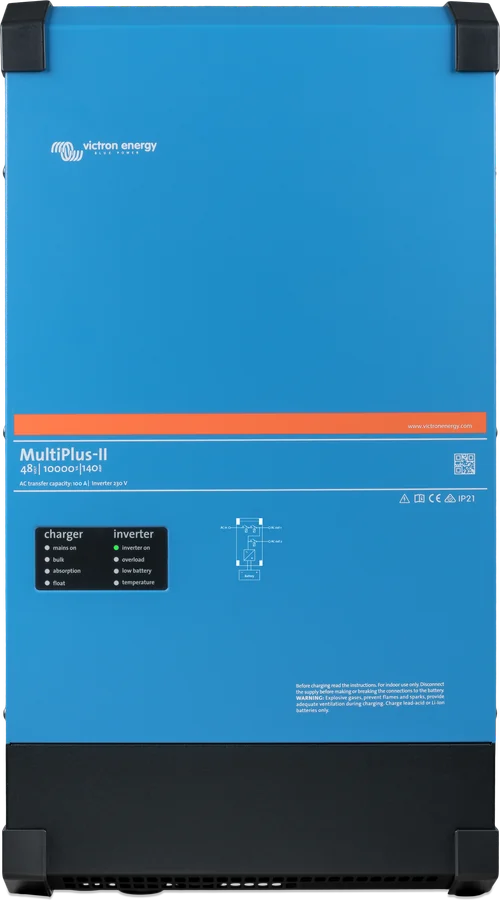
Inverters and inverter/chargers
MultiPlus-II, Quattro-II, Multi RS, Phoenix
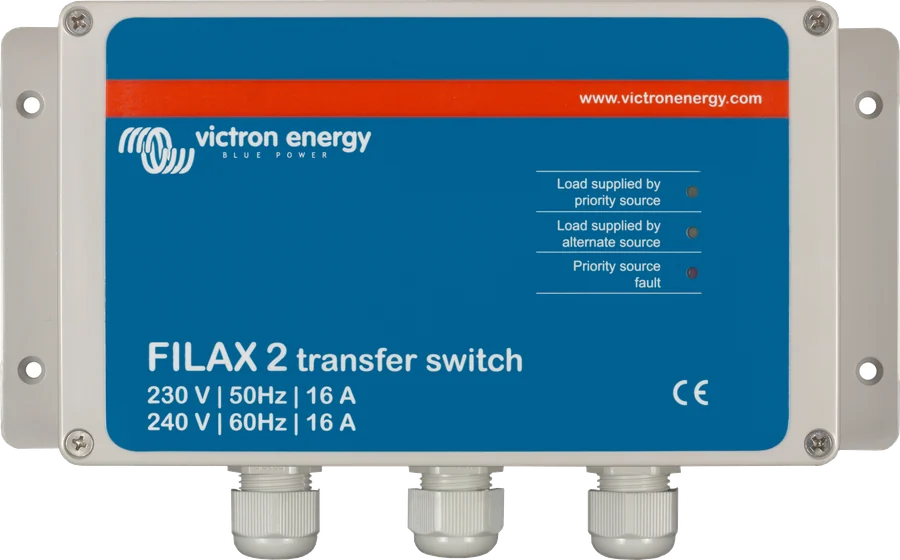
AC connection and protection
Filax 2, galvanic isolator, isolation transformer
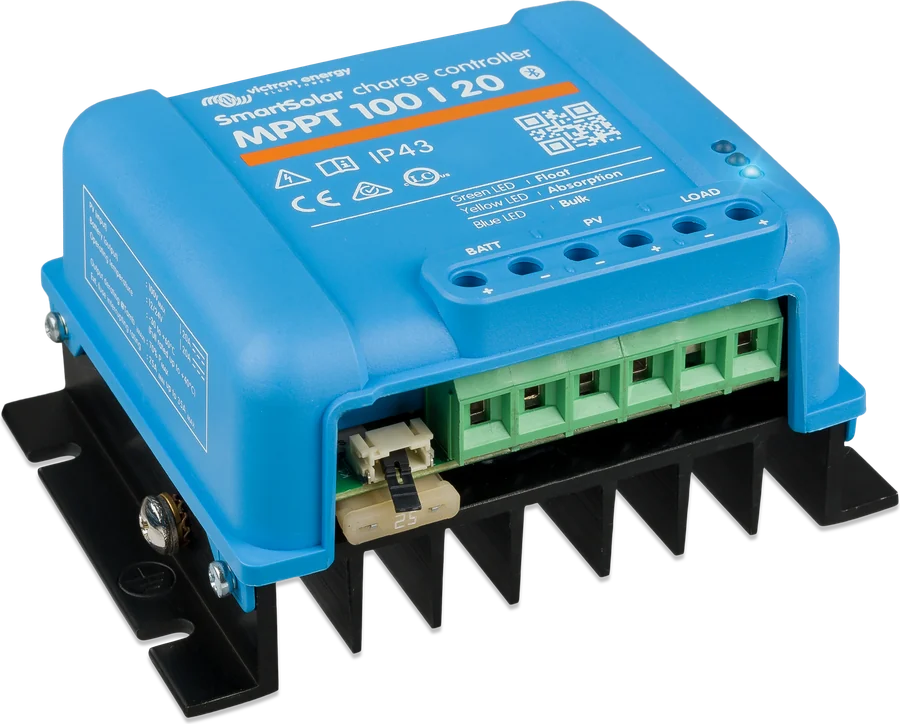
Solar charge controllers (MPPT and PWM)
SmartSolar, BlueSolar MPPT and PWM, MPPT RS 450
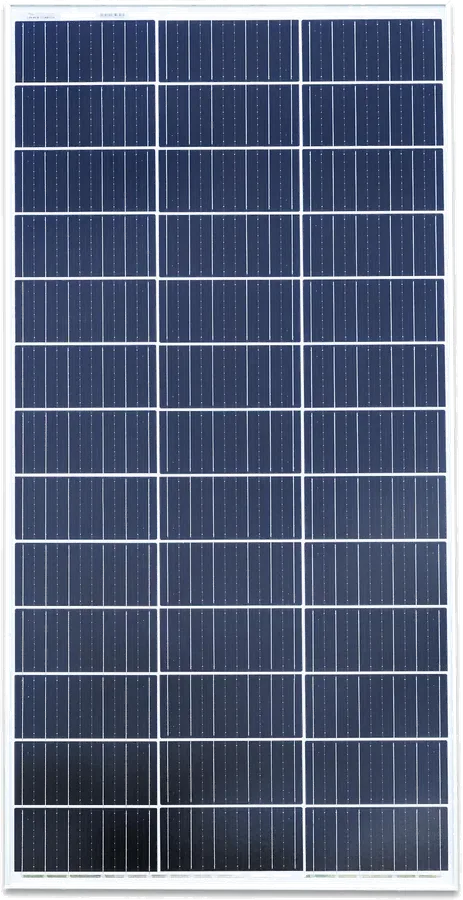
Solar panels
BlueSolar panels 20–365 W
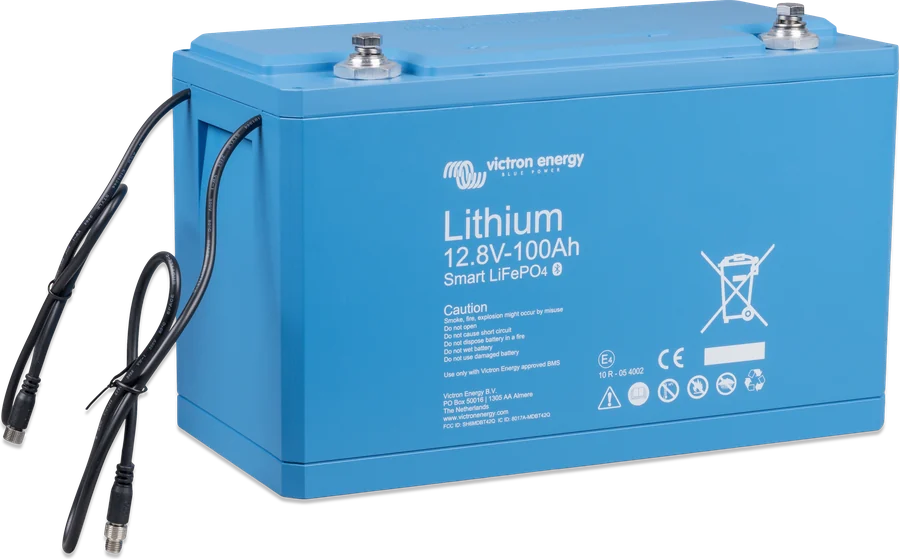
Batteries
LiFePO4 Smart, Lithium NG, AGM and Gel
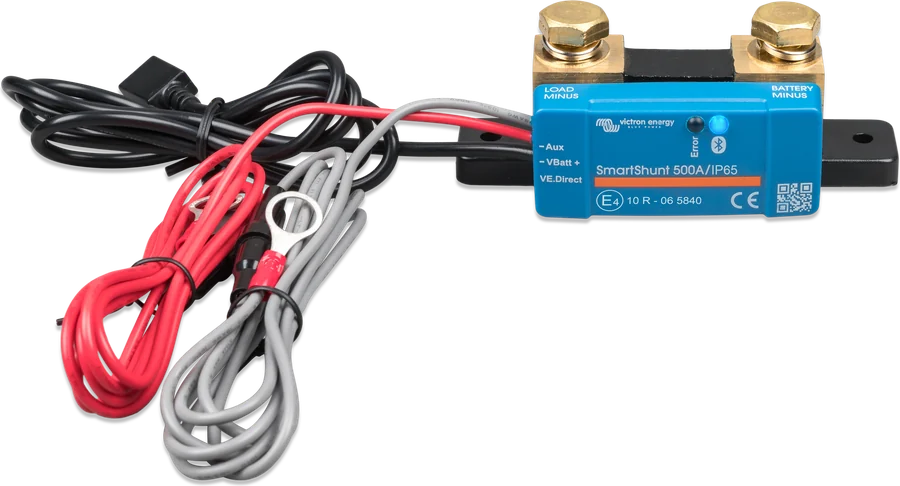
Battery monitoring
SmartShunt, BMV-712, Smart Battery Sense
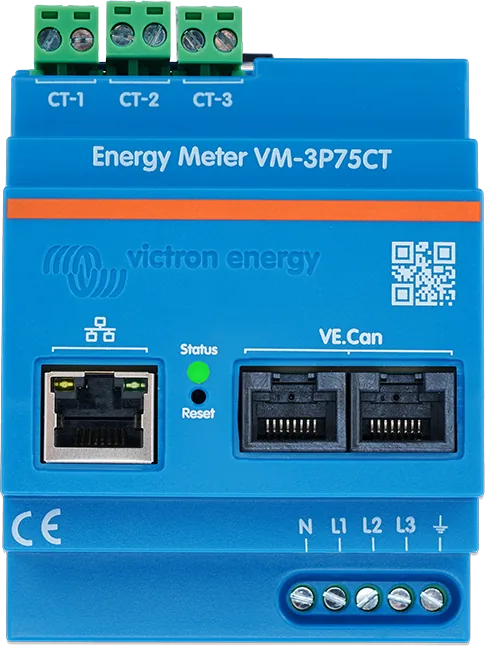
AC energy meters
VM-3P75CT, Carlo Gavazzi, current transformer
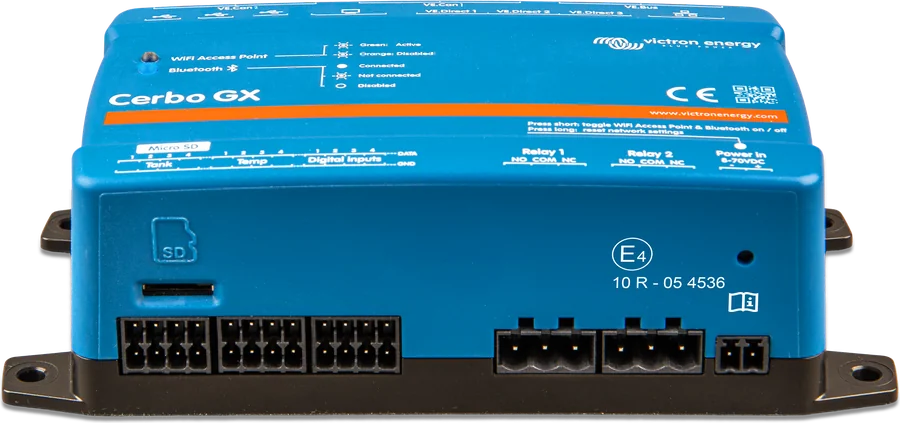
GX centres and displays
Cerbo GX, Ekrano GX, GX Touch, GlobalLink
Interfaces and communication
MK3-USB, VE.Direct–USB, Bluetooth dongles, NMEA 2000
DC-DC chargers and converters
Orion XS, Orion-Tr Smart, Buck-Boost
DC distribution and splitters
Lynx Distributor, Cyrix, Argofet
Mains chargers
Blue Smart, Smart IP43, Skylla, Centaur
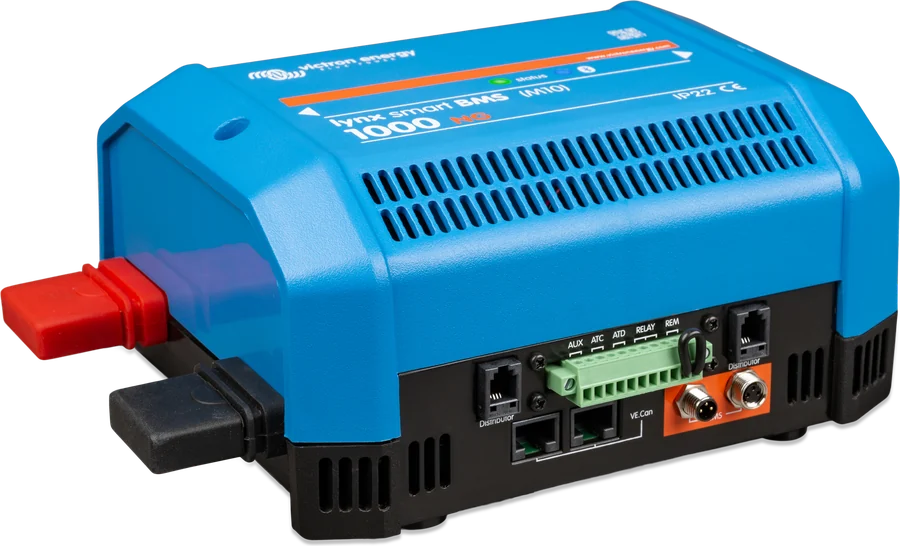
BMS and battery protection
Lynx Smart BMS, VE.Bus BMS, Smart BatteryProtect
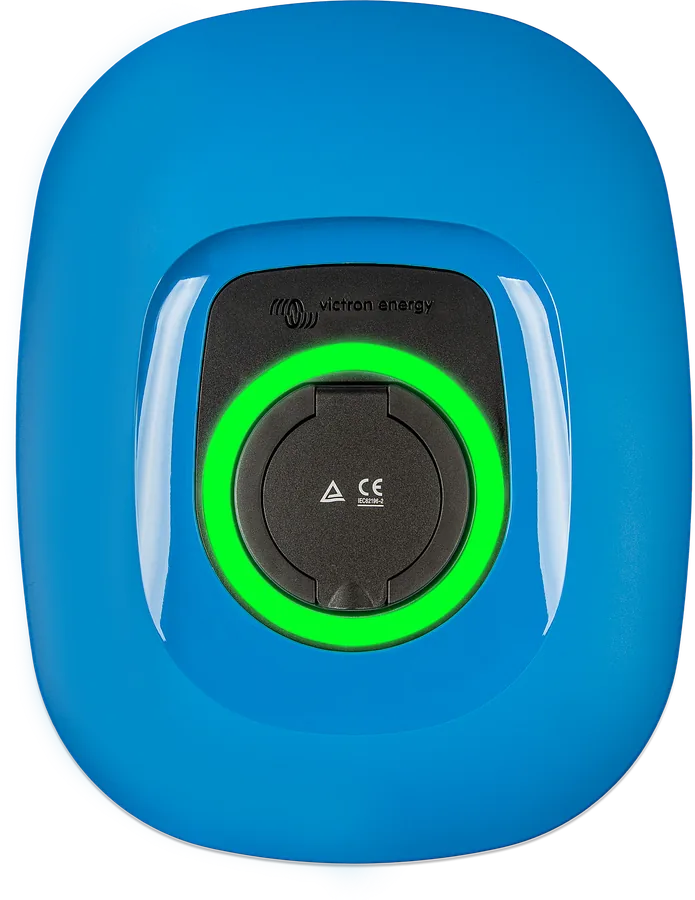
EV charging
EV Charging Station NS
77All products
device cards with data from Victron documentation
Go to catalogueKey system components
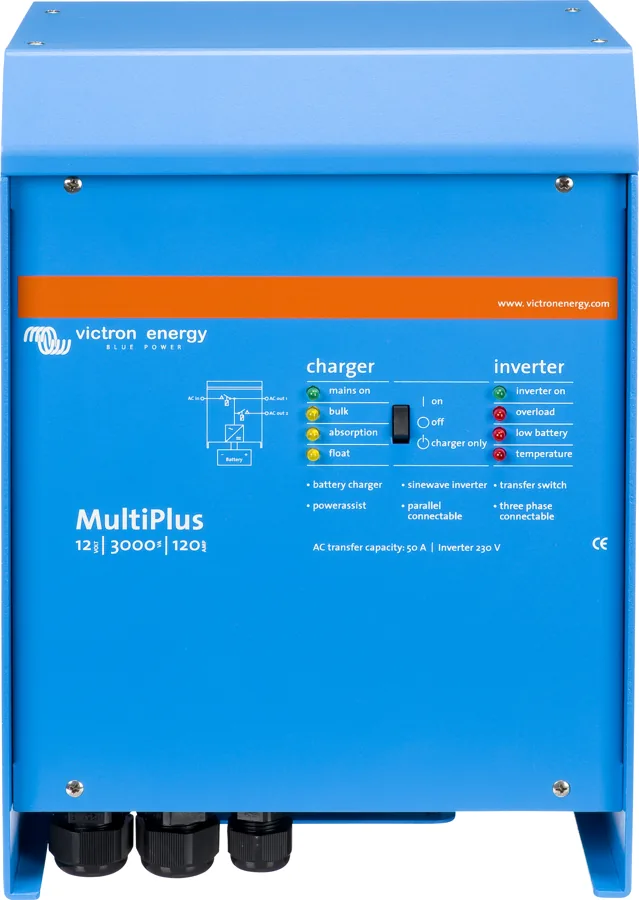
MultiPlus
Inverter/charger 800 VA–20 kW: PowerAssist, UPS under 20 ms, parallel and three-phase operation.
- PowerAssist
- VE.Bus
- 800 VA–20 kW
- 12/24/48 V

Quattro
Inverter/charger 3–15 kVA with two AC inputs — mains and generator without an external changeover switch.
- 2 AC inputs
- 3–15 kVA
- 12/24/48 V
- VE.Bus
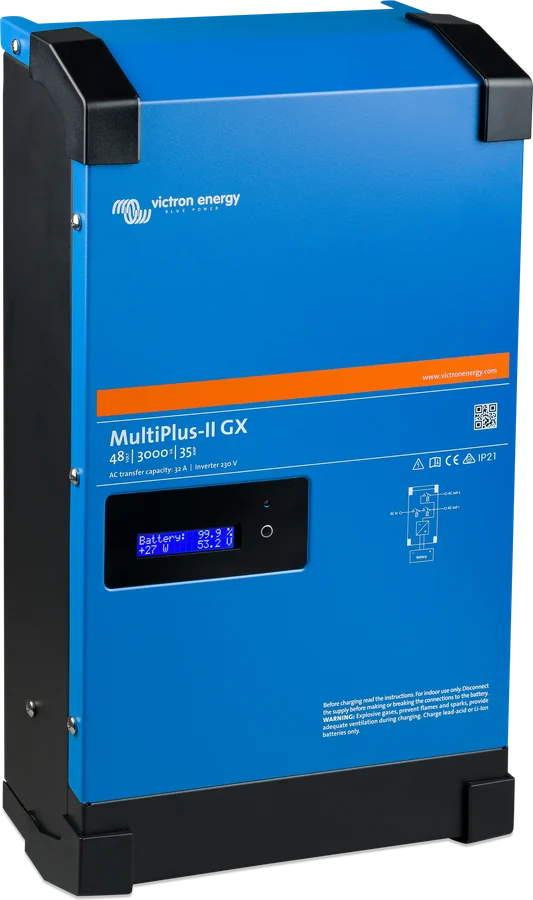
MultiPlus-II GX
MultiPlus-II with built-in GX device, display and Wi-Fi — VRM without a separate Cerbo.
- 3 kVA / 5 kVA and 4 / 6 kW
- 24/48 V
- built-in GX
- Wi-Fi
- BMS-Can
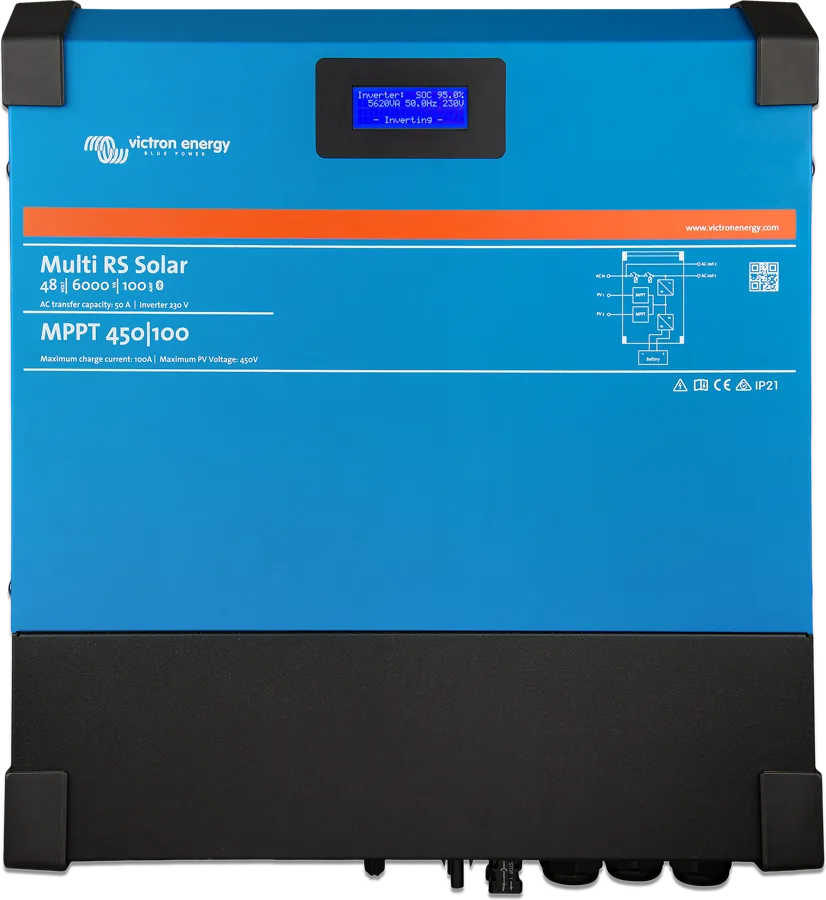
Multi RS Solar
Inverter/charger 48 V, 6 kVA, with two 450 V MPPT trackers — a hybrid for an off-grid cabin and 48 V systems.
- 48 V
- 6 kVA
- 2 × 450 V MPPT
- 100 A charging
- VE.Can

Multi HS19 Solar
Three-phase 15 kW hybrid inverter with four MPPTs (32 kW PV) and a 650–1000 V high-voltage battery — 19" enclosure for a cabinet.
- 3 phases 400 V
- 15 kW
- 4 × 600 V MPPT
- 650–1000 V HV battery
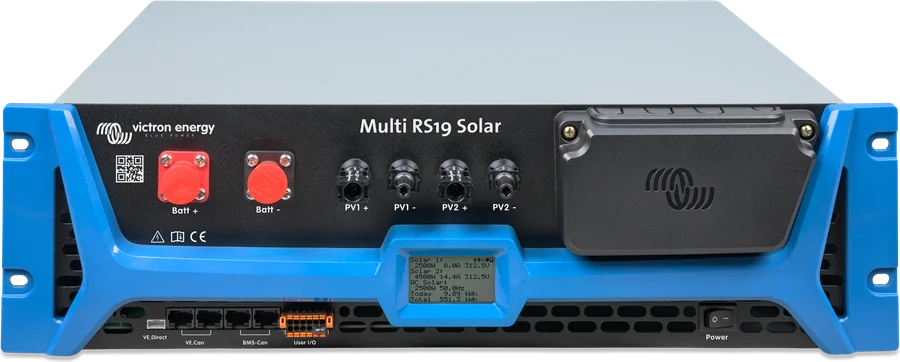
Multi RS19 Solar
Inverter/charger 48 V, 6 kVA, with two 450 V MPPTs in a 19" enclosure — for a rack cabinet together with batteries.
- 48 V
- 6 kVA
- 2 × 450 V MPPT
- 19" enclosure
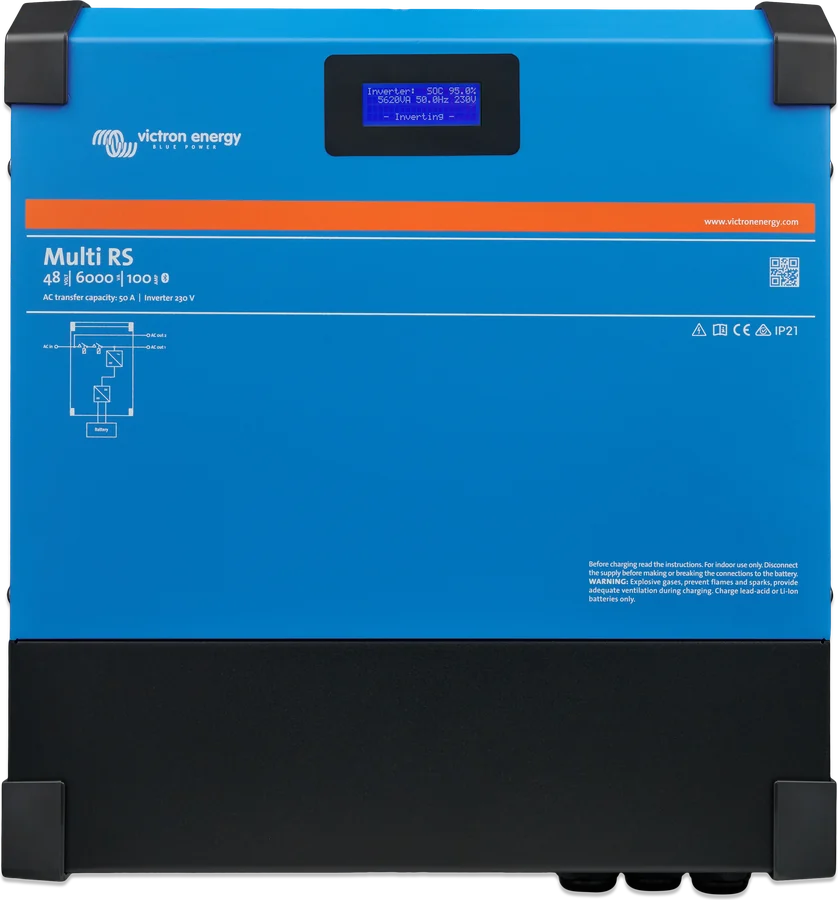
Multi RS
Inverter/charger 48 V, 6 kVA, without a built-in MPPT — PV via separate solar charge controllers or a PV inverter on the AC output.
- 48 V
- 6 kVA
- 88 A from AC
- VE.Can

Inverter RS Smart Solar
48 V off-grid inverter, 6 kVA, with built-in 450 V MPPT — panels straight into the inverter, without a mains charger.
- 48 V
- 6 kVA
- 450 V MPPT
- up to 12 units in parallel
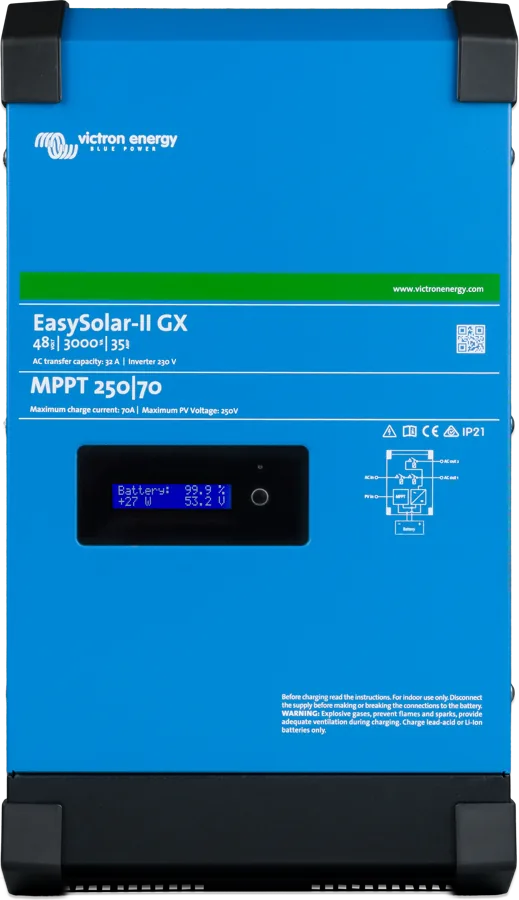
EasySolar-II GX
MultiPlus-II, 250 V MPPT controller and GX device factory-connected in one enclosure — 3 or 5 kVA.
- 24/48 V
- 3 / 5 kVA
- MPPT 250/70 or 250/100
- built-in GX
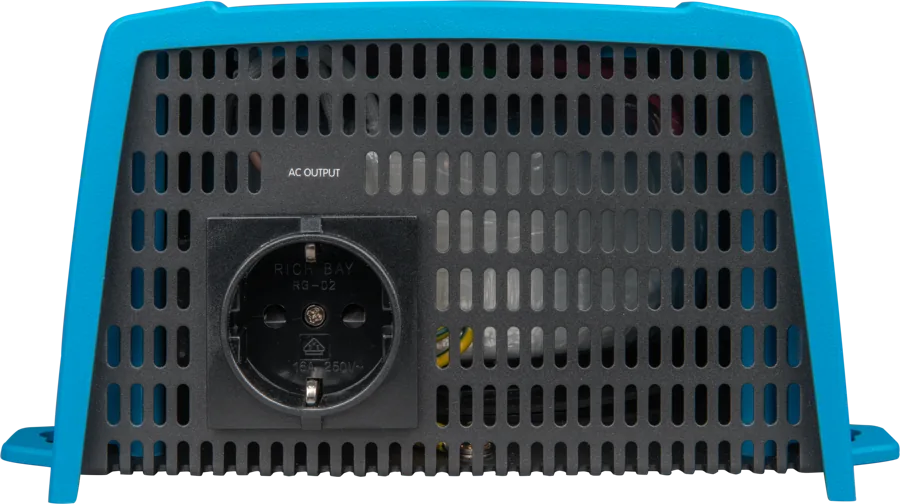
Phoenix Inverter VE.Direct
Small 230 V inverter 250–1600 VA — without a charger, with ECO mode and a VE.Direct port.
- 250–1600 VA
- 12/24/48 V
- ECO
- VE.Direct

Phoenix Inverter (VE.Bus)
230 V inverter with VE.Bus port, 1200–5000 VA — parallel operation of up to 6 units and three-phase, high SinusMax surge power.
- 12/24/48 V
- 1200–5000 VA
- VE.Bus
- parallel and 3 phases
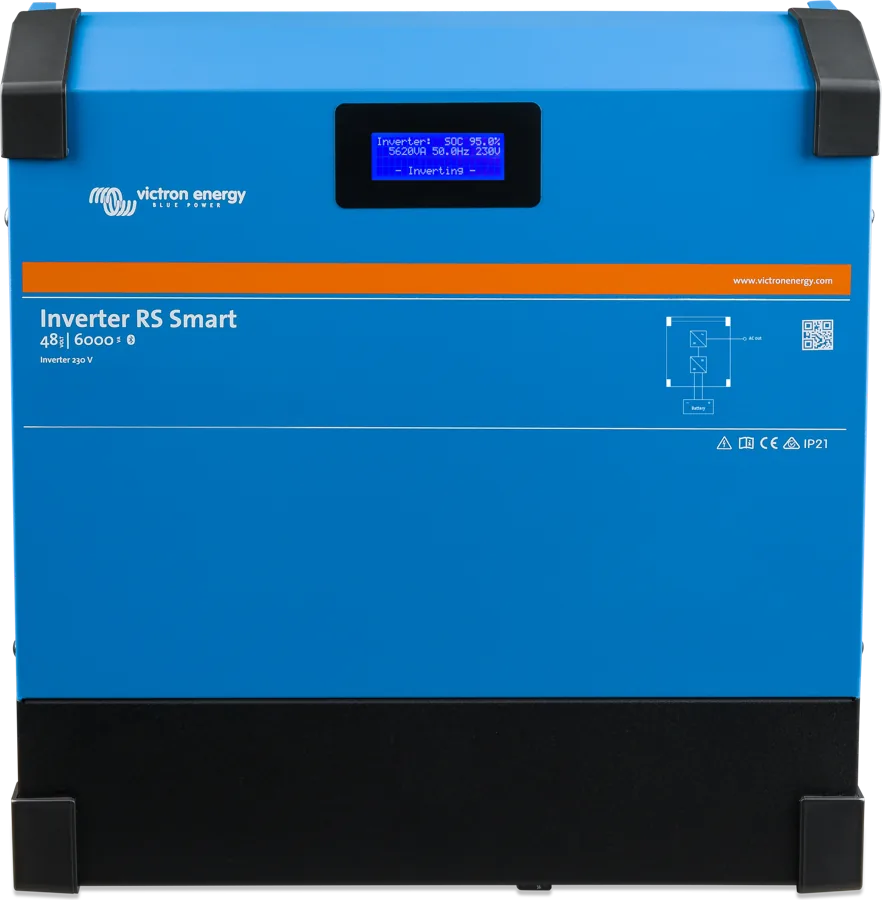
Inverter RS Smart
48 V to 230 V inverter with Bluetooth and VE.Can; charging from an external PV inverter on the AC output.
- 48 V DC
- 230 V AC
- Bluetooth
- VE.Can
- AC-coupled PV
MultiPlus-II
Inverter/charger with UPS function: pure 230 V sine wave, PowerAssist supports a weak shore connection.
- 12 / 24 / 48 V DC
- 3–15 kVA
- 230 V · 50 Hz
- switch-over < 20 ms
- IP22
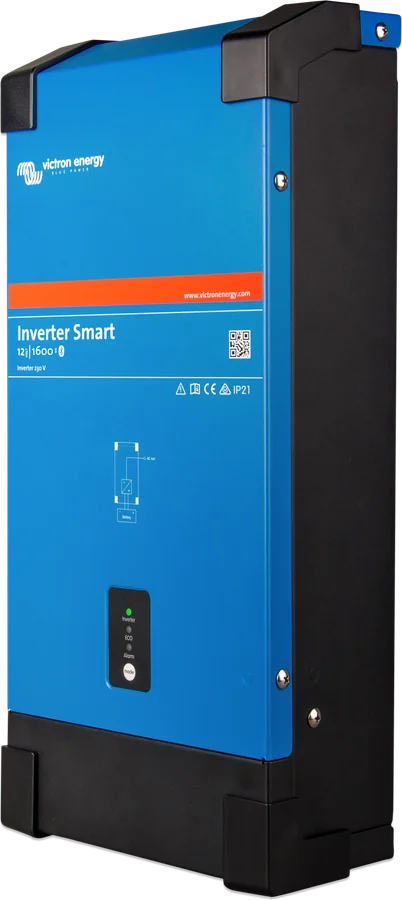
Inverter Smart (Phoenix)
Stand-alone 1600–5000 VA inverter with Bluetooth and ECO mode — without a charger.
- 12 / 24 / 48 V DC
- 1600–5000 VA
- 230 V · 50/60 Hz
- Bluetooth
- ECO mode
- IP21
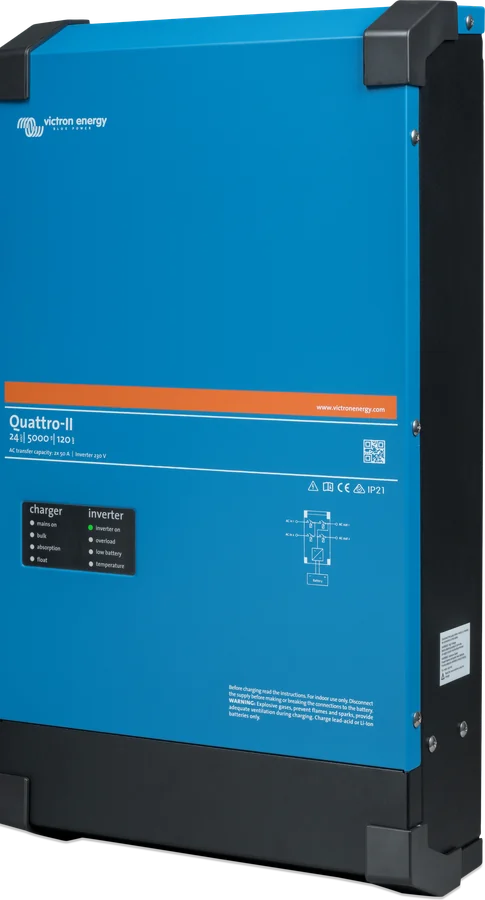
Quattro-II
Inverter/charger with two AC inputs — mains and generator without an external changeover switch.
- 24 / 48 V DC
- 5000 VA
- 2 × 50 A AC input
- 230 V · 50 Hz
- switch-over < 20 ms
Filax 2
Ultra-fast AC source transfer switch — switches loads between mains and the inverter in less than 16 ms.
- 16 A
- switching < 16 ms
- return after 30 s
- IP65
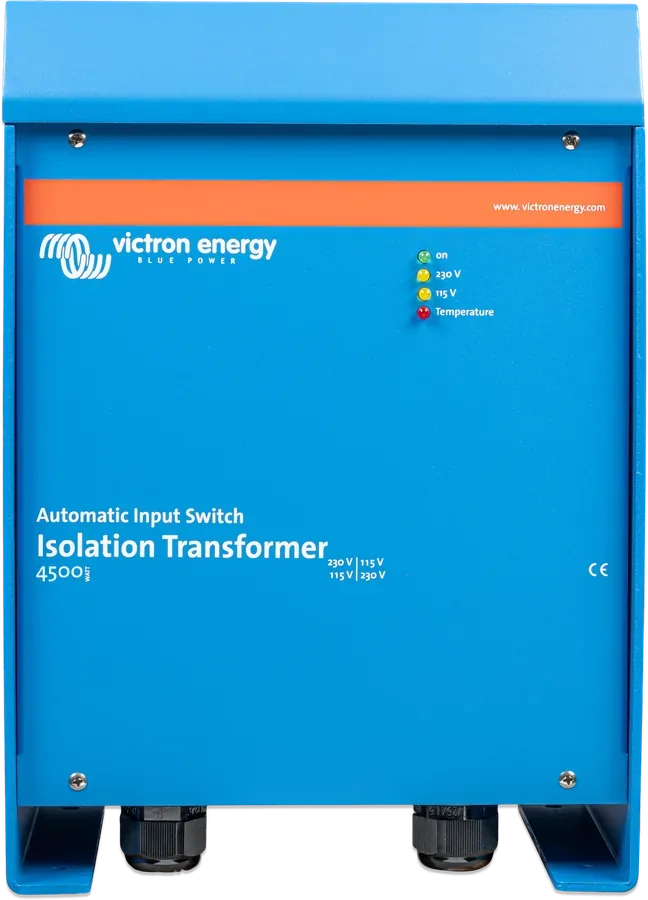
Isolation transformer
Isolation transformer for shore power connection in harbour: separates the boat from shore ground and stops galvanic corrosion, while maintaining RCD operation. 2500–8000 W, 115 or 230 V.
- 2500 / 4500 / 8000 W
- 115 or 230 V
- soft start
- 1:1.05
- IP21
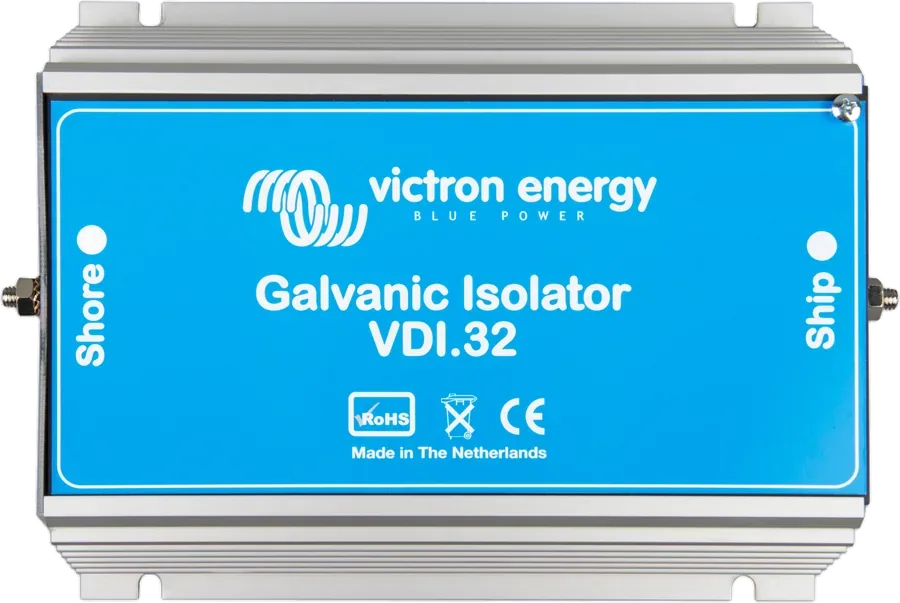
Galvanic isolator VDI
Galvanic isolator in the shore power protective earth conductor: blocks low DC voltages that cause corrosion of the shaft, propeller and anodes, while allowing fault current to trip the RCD.
- 16 / 32 / 64 A
- surge current up to 6000 A (20 ms)
- IP67
- M6
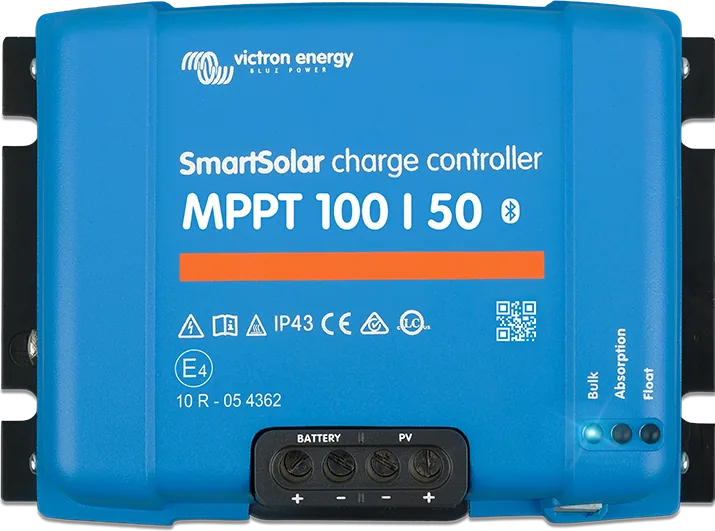
SmartSolar MPPT 100/30 and 100/50
30 and 50 A controllers for up to 100 V from panels — at 12 V for about 440 and 700 W of panels.
- 100 V
- 30 / 50 A
- 12/24 V
- Bluetooth
- VE.Direct
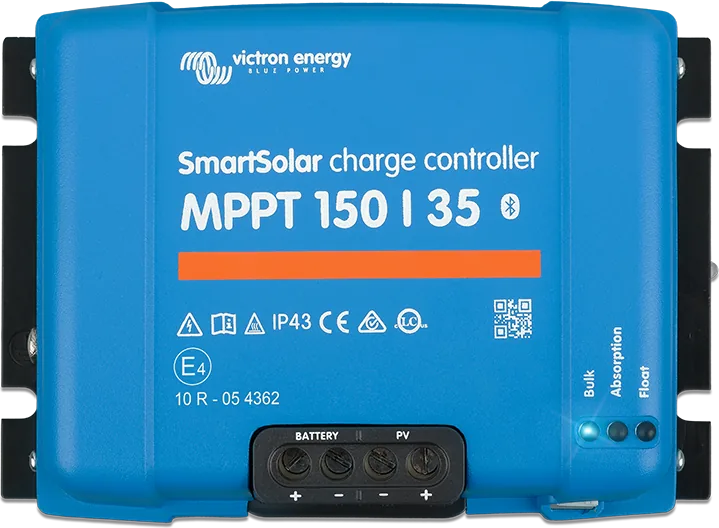
SmartSolar MPPT 150 and 250 V
35–100 A controllers for higher panel voltages: 150 V and 250 V, Tr, MC4 and VE.Can versions.
- 150 / 250 V
- 35–100 A
- 12/24/36/48 V
- Bluetooth
- VE.Direct or VE.Can
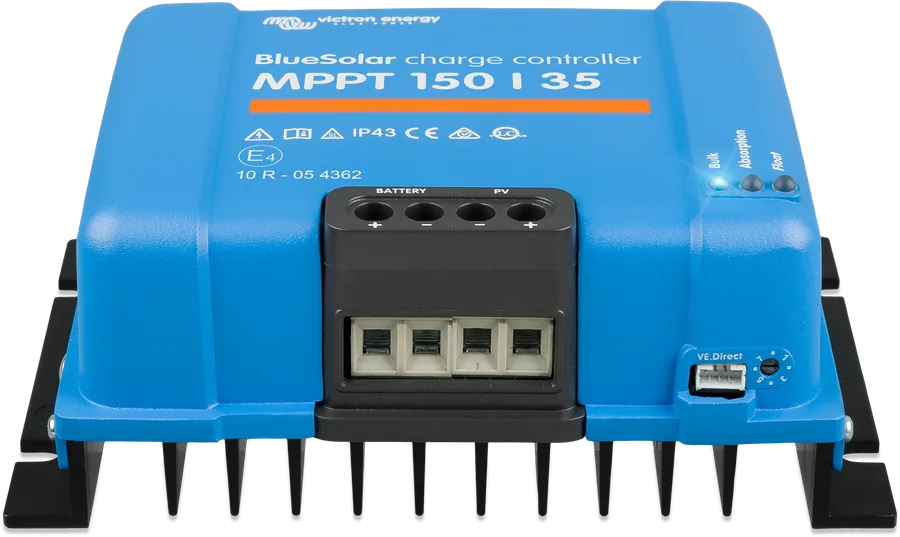
BlueSolar MPPT 150/35–250/100
MPPT controllers without built-in Bluetooth: 35–100 A, panels up to 150 or 250 V, rotary switch with 8 charging algorithms; VE.Can versions with relay.
- 12/24/36/48 V
- 35–100 A
- PV up to 150 V or 250 V
- VE.Direct
- VE.Can (Tr VE.Can models)
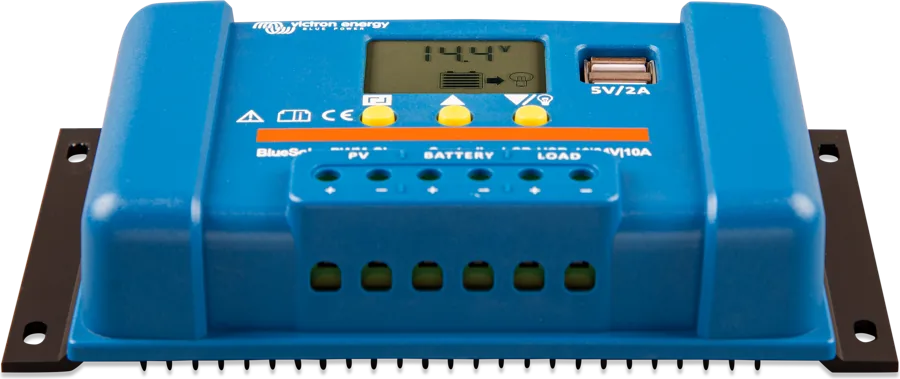
BlueSolar PWM
12/24 V PWM controllers (5–30 A) with load output, lighting timer and low-voltage disconnect.
- 12/24 V auto
- PWM 5–30 A
- IP20
- load output
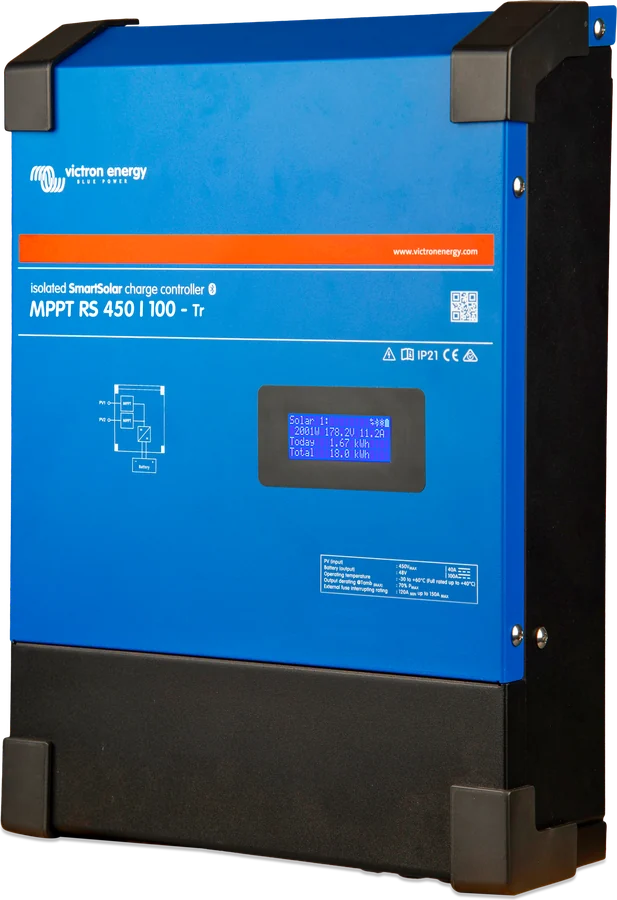
SmartSolar MPPT RS 450
Isolated controller for up to 450 V from panels for 48 V battery banks.
- 48 V battery
- up to 450 V PV
- 100 / 200 A
- 2 / 4 trackers
- isolated
- VE.Can · Bluetooth
SmartSolar MPPT 75/10–100/20
Small solar controllers with Bluetooth for campervans, boats and cabins.
- 12 / 24 V (100/20: also 48 V)
- 75 V or 100 V PV
- 10–20 A
- Bluetooth
- VE.Direct

BlueSolar panels
Victron monocrystalline panels from 20 to 365 W — small ones for campervans and boats (36 cells) and large ones for cabins (68–72 cells), with bypass diodes and an aluminium frame.
- 20–365 W
- monocrystalline
- 36–72 cells
- efficiency up to approx. 21%
- aluminium frame
- MC4 on larger models
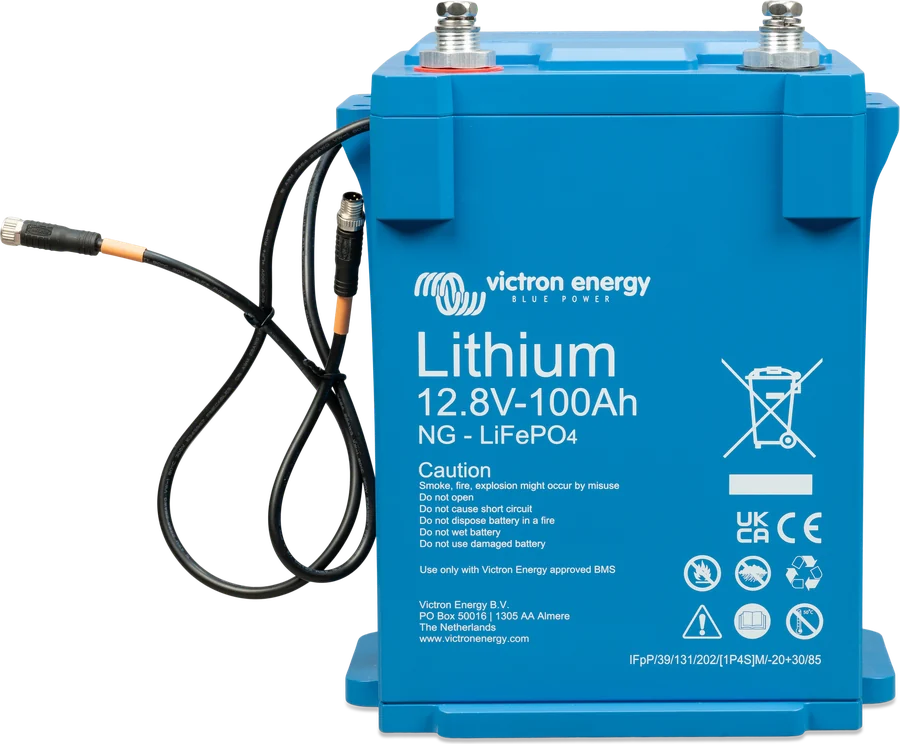
Lithium NG
Victron’s new generation of LiFePO4 batteries: 12.8/25.6/51.2 V, IP65, built-in current measurement — only with BMS NG.
- 12.8 / 25.6 / 51.2 V
- 100–300 Ah
- IP65
- BMS NG
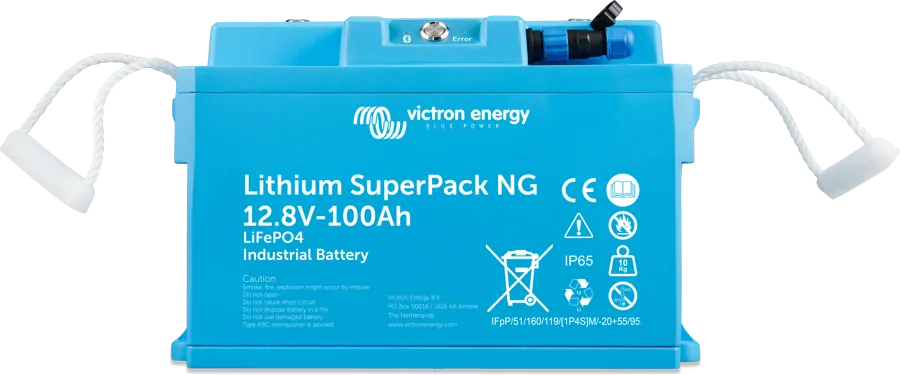
Lithium SuperPack NG
Drop-in LiFePO4 battery with built-in BMS, heater and IP65 — a simple replacement for a lead-acid battery in a campervan.
- 12.8 / 25.6 / 51.2 V
- 100–200 Ah
- built-in BMS
- heater
- IP65
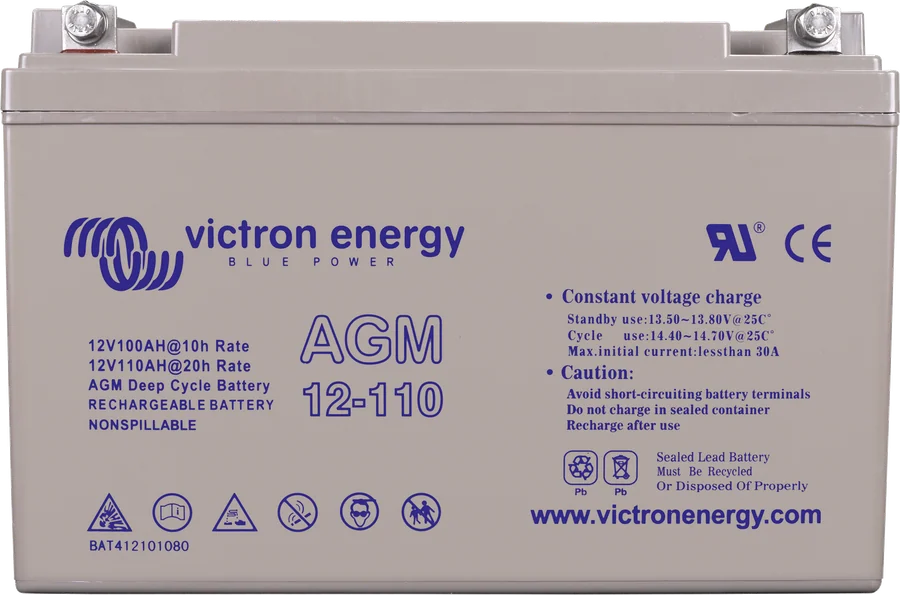
AGM and Gel batteries
Victron’s four families of lead-acid batteries — they differ in cycle life, resistance to deep discharge and charging voltages.
- AGM
- Gel
- Super Cycle
- Lead Carbon

AGM Telecom batteries
Narrow 12 V AGM batteries (115, 165 and 200 Ah) with front terminals — for rack cabinets, and on a boat or in a vehicle where there is no room on the floor.
- 12 V
- 115 / 165 / 200 Ah
- AGM VRLA
- front terminals
- 12 years float service
- 500 cycles at 80% DoD
LiFePO4 Smart 12,8/25,6 V
Lithium iron phosphate batteries with Bluetooth — work only with an external BMS.
- 12.8 V (also 25.6 V)
- 50–330 Ah
- Bluetooth
- charging 5–50 °C
- IP22

Peak Power Pack
12.8 V LiFePO4 battery (20–40 Ah) with built-in charger and two protected outputs: 150 A for the caravan mover and 30 A for lighting, pump or fridge.
- 12.8 V
- 20 / 30 / 40 Ah
- 150 A mover output
- 30 A domestic output
- 11–25 V input
- 3 A power supply
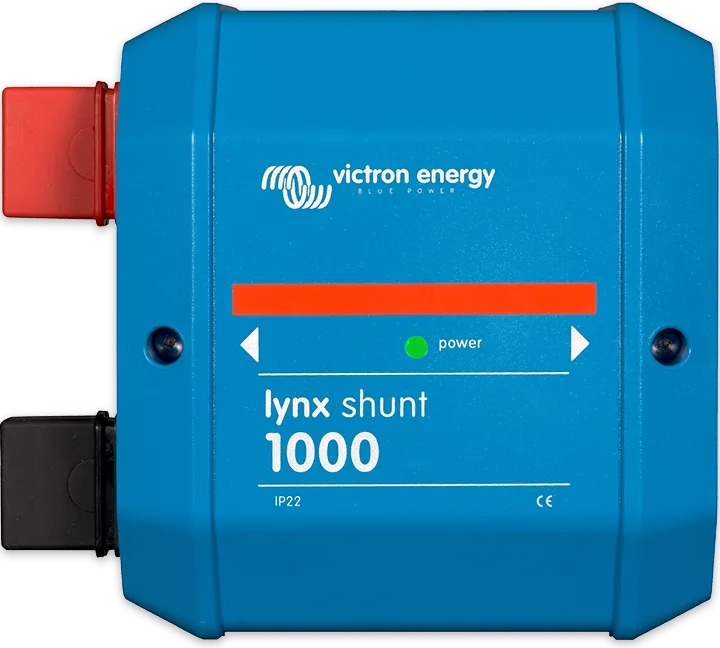
Lynx Shunt VE.Can
1000 A battery monitor with main fuse holder in the Lynx system — read via a GX device.
- 1000 A
- 12/24/48 V
- VE.Can
- relay
- temperature sensor
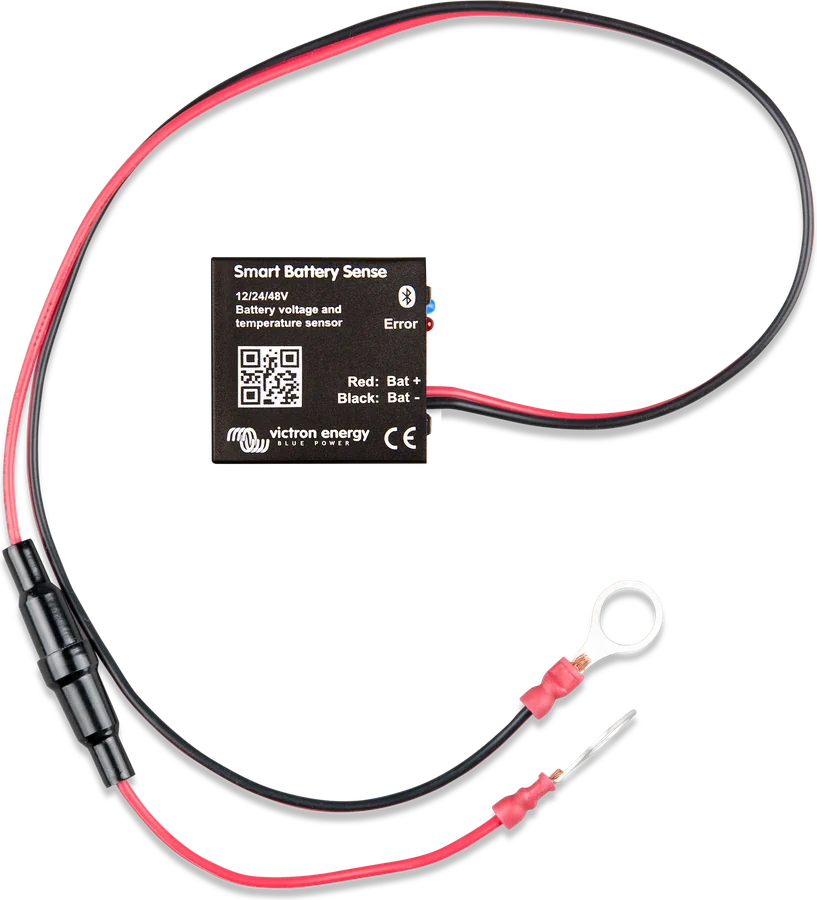
Smart Battery Sense
Wireless battery voltage and temperature sensor for controllers and chargers via VE.Smart.
- 8–60 V
- VE.Smart Bluetooth
- 1 A fuse
- M10

Temperature sensors
Wired battery and room temperature sensors — four types for different devices, not interchangeable.
- ASS000001000
- ASS000100000
- ASS000020000
- ASS000200100; GX −40…+70 °C

BMV-700 and BMV-702
Battery monitors with display and 500 A shunt, without built-in Bluetooth; the BMV-702 has an extra input for a second battery, midpoint or temperature.
- 6.5–95 V
- 500 A / 50 mV shunt (up to 9999 A)
- 60 V / 1 A relay
- VE.Direct
- BMV-702: Aux input
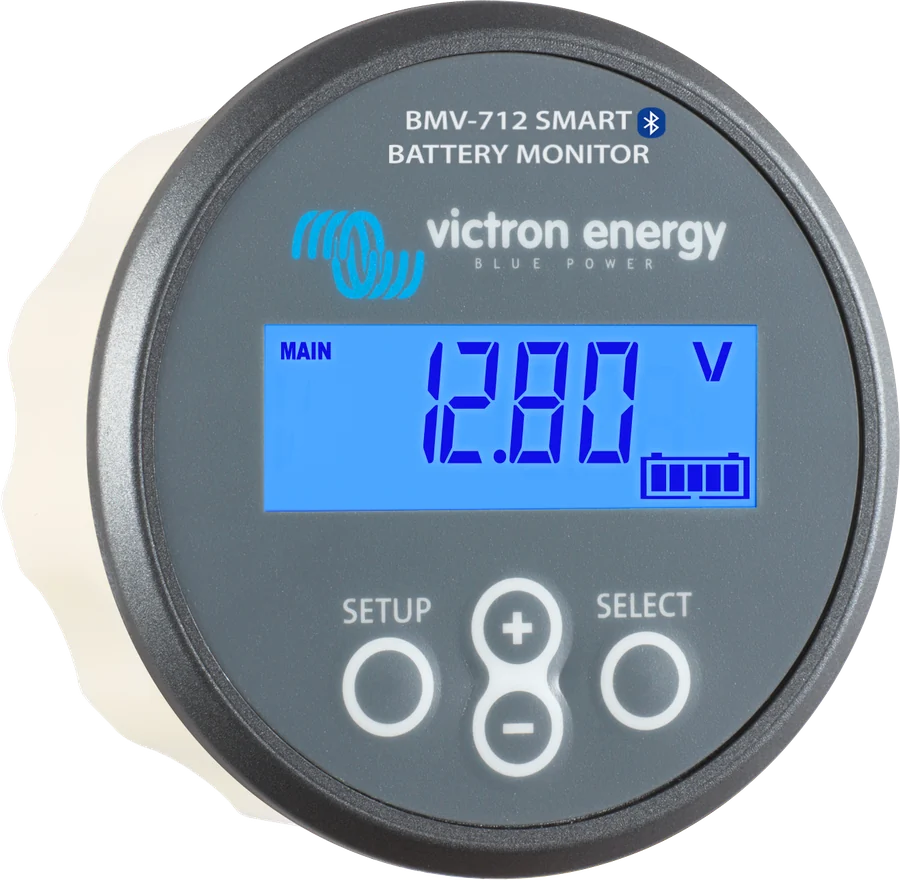
BMV-712 Smart
Battery monitor with display, alarm and programmable relay.
- 6.5–70 V
- 500 A shunt included
- Bluetooth
- VE.Direct
- 60 V / 1 A relay
SmartShunt
Battery monitor with 300–2000 A shunt, read on your phone or on a GX device.
- 300 / 500 / 1000 / 2000 A
- 6.5–70 V
- Bluetooth
- VE.Direct
- IP21 or IP65
Energy Meter VM-3P75CT
Energy meter for ESS and AC circuit measurement: 3 x 75 A current transformers included, VE.Can and Ethernet, refresh every 100 ms.
- 1 phase / split-phase / 3 phase
- 75 A per phase
- VE.Can
- Ethernet (Modbus UDP)

ET112, ET340, EM540, EM24 meters
Energy meters with direct measurement for ESS and measurement of a PV inverter, generator or AC circuit — single-phase up to 100 A and three-phase up to 65 A per phase.
- 1 phase up to 100 A / 3 phase up to 65 A
- direct measurement
- RS485 or Ethernet
- Zigbee optional
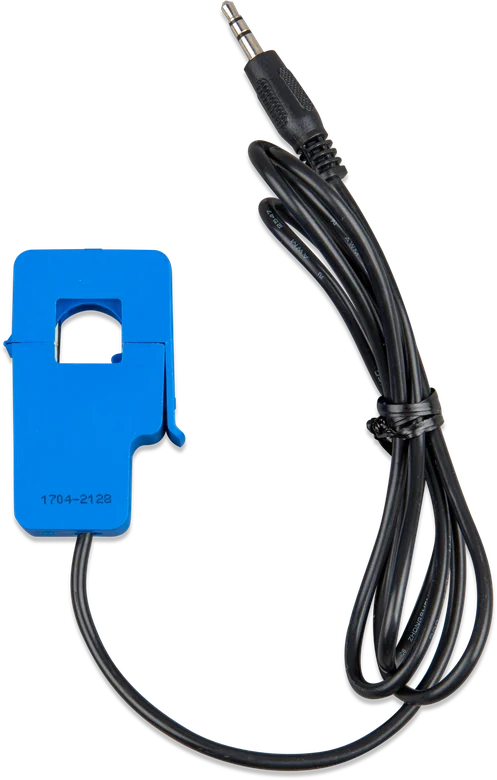
Current transformer
Split-core current transformer clipped onto the phase conductor — gives MultiPlus-II grid current measurement without an energy meter.
- 100 A or 400 A
- 50 mV
- 1/5/20 m cables
- single phase
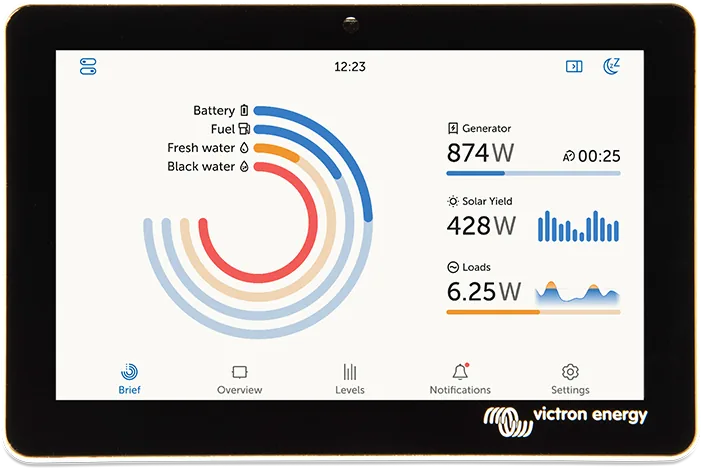
GX Touch 50/70
Optional 5- or 7-inch display for Cerbo GX: system overview, settings, surface or flush mounting.
- 5 inches / 7 inches
- HDMI + USB
- IP54 / IP65
- 2 m cable
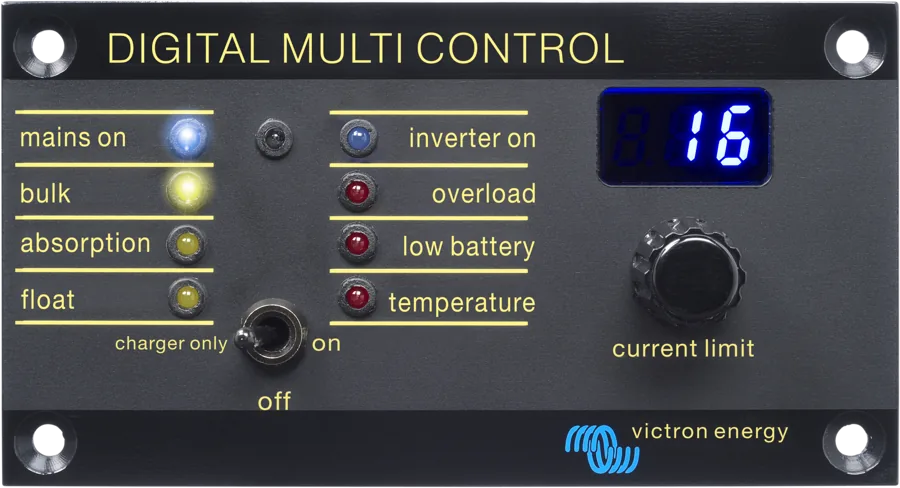
Digital Multi Control
Wall panel for MultiPlus and Quattro: switch, shore or generator current-limit knob, LEDs and error codes.
- VE.Bus
- current-limit knob
- 8 LEDs
- display
- GEN input
Cerbo GX
System control centre and gateway to the VRM portal.
- 8–70 V DC
- VE.Bus · VE.Direct · VE.Can
- Wi-Fi · Ethernet
- Bluetooth
- 2 relays
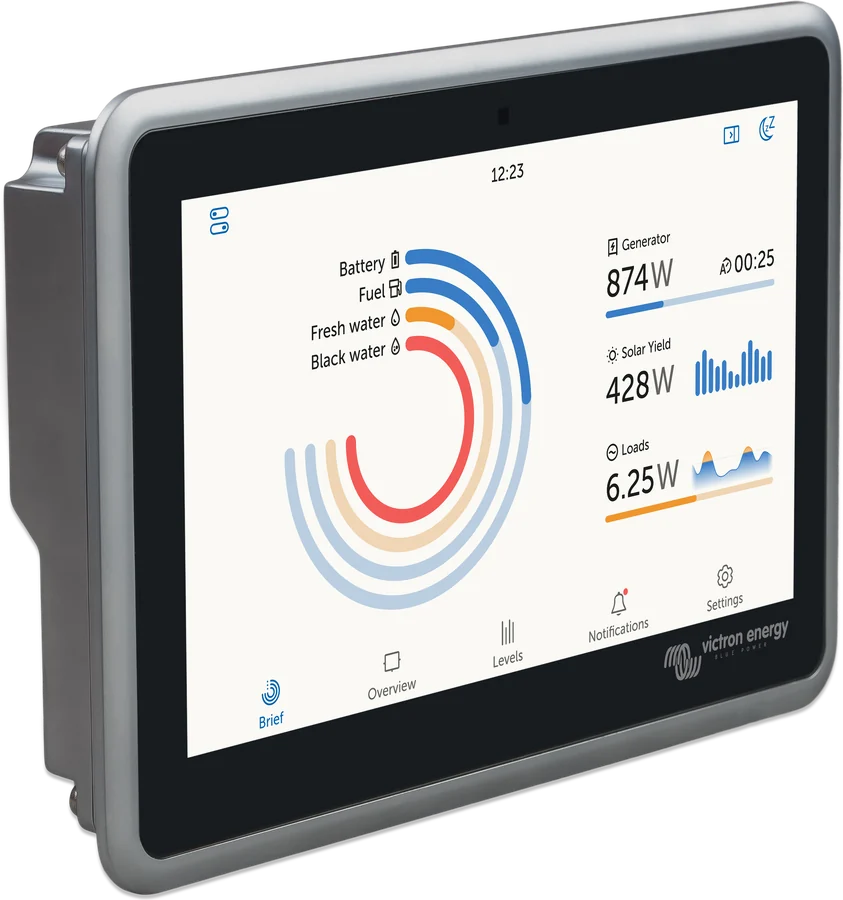
Ekrano GX
GX centre with built-in 7″ touchscreen.
- 8–70 V DC
- 7" · 1024 × 600
- VE.Bus · VE.Direct · 2× VE.Can
- Wi-Fi · Ethernet
- IP54 front
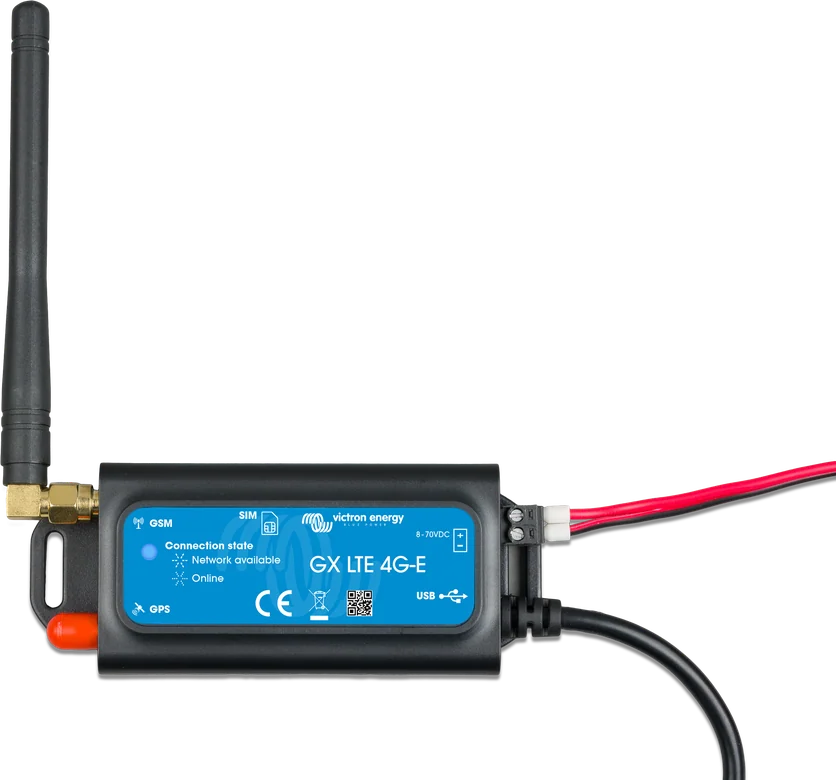
GX LTE 4G
2G/3G/4G modem for GX devices — internet and the VRM portal where there is no Wi-Fi.
- 2G/3G/4G
- Mini-SIM
- SMA antenna
- GPS
- 8–70 V DC
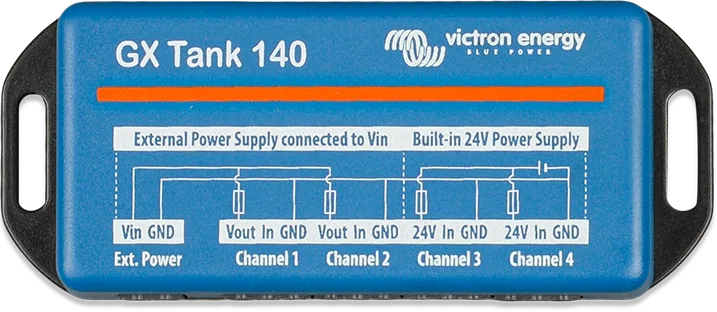
GX Tank 140
USB module for a GX device with four tank level sensors — 4–20 mA current or 0–10 V voltage, two channels with their own 24 V supply.
- 4 channels
- 4–20 mA or 0–10 V
- 24 V for channels 3 and 4
- USB-powered
- pump control
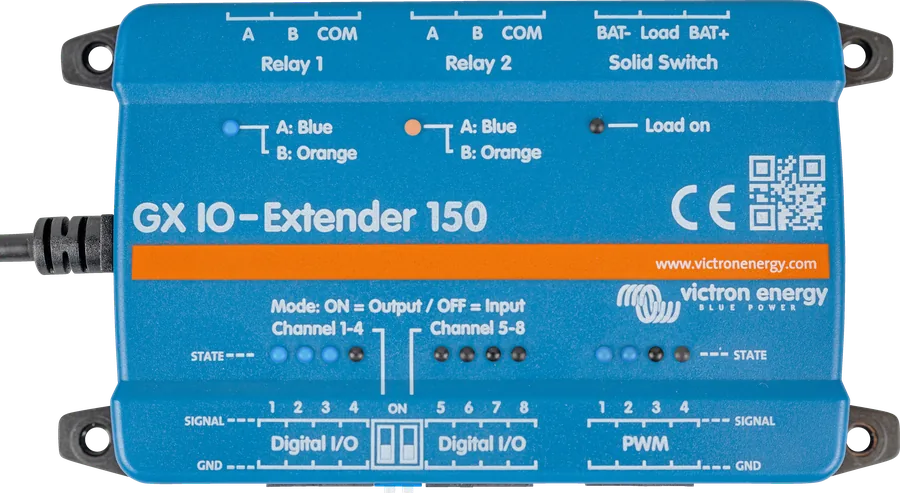
GX IO-Extender 150
USB module for a GX device: 8 digital inputs or outputs, 4 PWM outputs, 2 latching relays and a DC switch — for signalling and automation in Node-RED.
- 8 × digital I/O
- 4 × PWM
- 2 latching relays
- 4 A / 70 V DC switch
- USB-powered

GlobalLink 520 and 530
Cellular module with SIM card for 5 years: sends data from an MPPT solar charge controller, battery monitor or charger to the VRM portal without a GX device and without Wi-Fi.
- 2 × VE.Direct
- up to 10 devices via Bluetooth
- 5-year 1NCE SIM
- 8–70 V
- relay
- 2 digital inputs
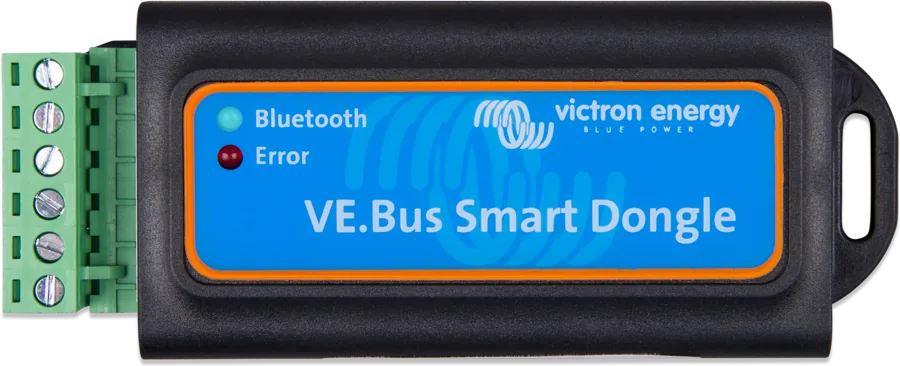
VE.Bus Smart dongle
Bluetooth for a VE.Bus inverter/charger — view, switch on and set the campsite current limit on your phone, plus a battery sensor.
- Bluetooth
- VE.Bus
- 8–70 V
- voltage and temperature sensor
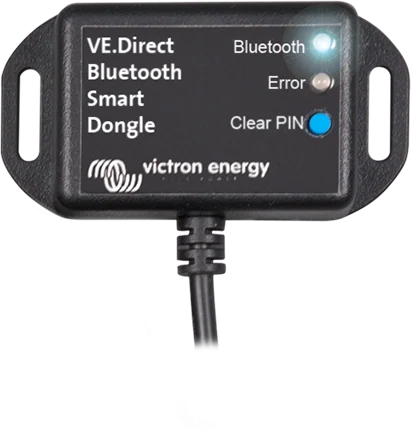
VE.Direct Bluetooth dongle
Bluetooth dongle for the VE.Direct port — gives view and settings on your phone for devices without built-in Bluetooth.
- VE.Direct
- Bluetooth
- 1.5 m cable
- Instant Readout

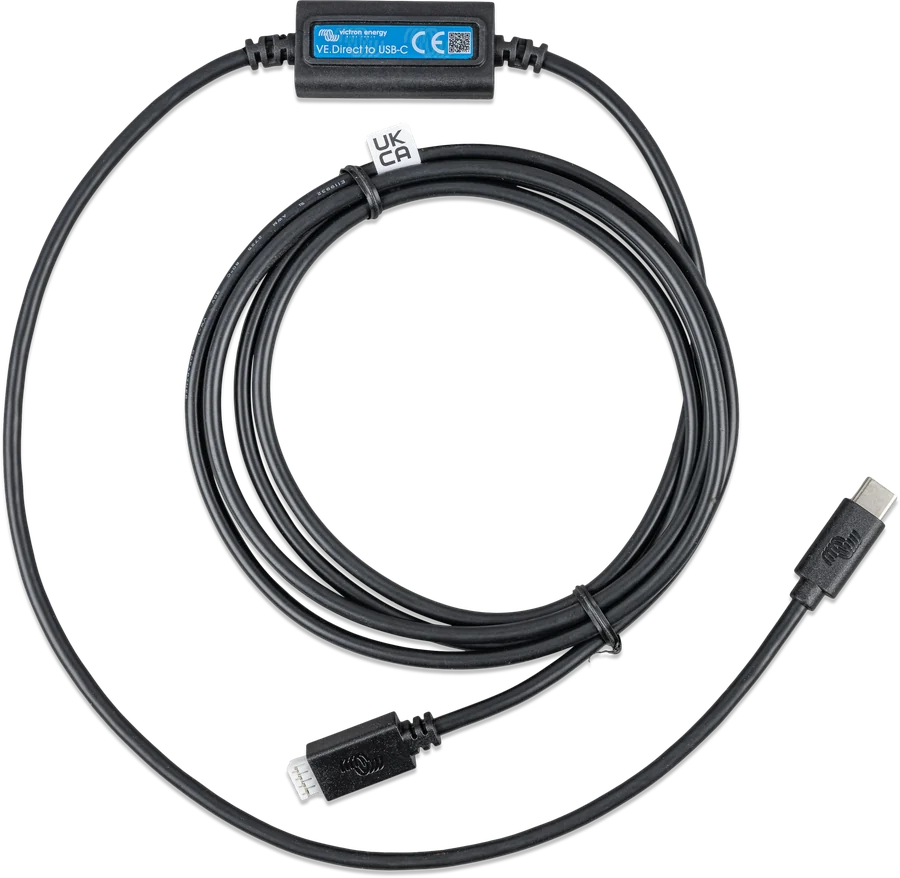
VE.Direct–USB interface
Cable from the VE.Direct port to USB — settings and updates from a computer, and a way to connect more devices to GX than there are VE.Direct ports.
- VE.Direct
- USB-A or USB-C
- VictronConnect
- GX

VE.Can – NMEA 2000 cable
Cable from the VE.Can socket (RJ45) to the NMEA 2000 network (micro-C) — data from GX and Victron devices on the chart plotter.
- VE.Can RJ45 → NMEA 2000 micro-C male
- removable power fuse
- 250 kbit/s
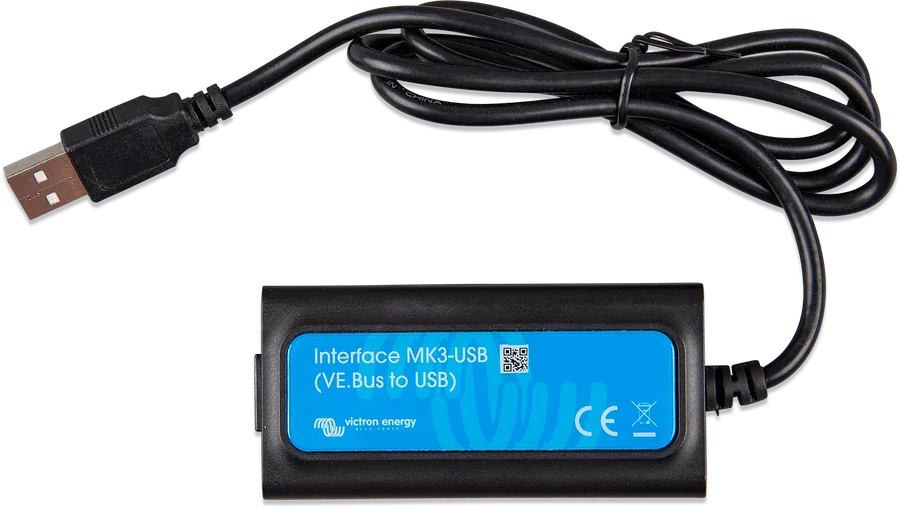
MK3-USB interface
Cable between the VE.Bus port and a computer — without it you cannot change settings or update the MultiPlus.
- VE.Bus
- USB
- VictronConnect
- VEConfigure
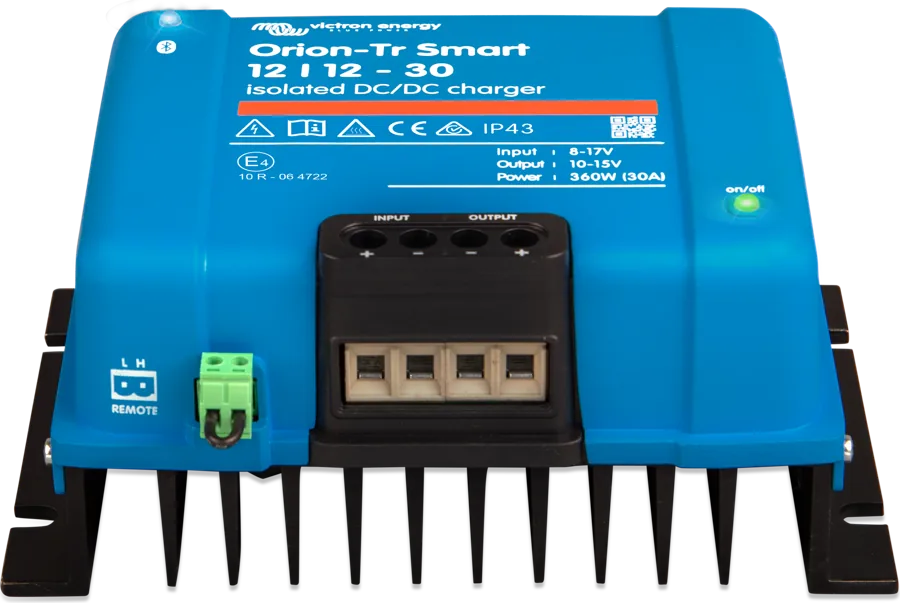
Orion-Tr Smart
DC-DC charger or converter 12/24/48 V up to about 400 W, in isolated and non-isolated versions; can be connected in parallel.
- 12/24/48 V
- 8–30 A
- isolated or non-isolated
- Bluetooth
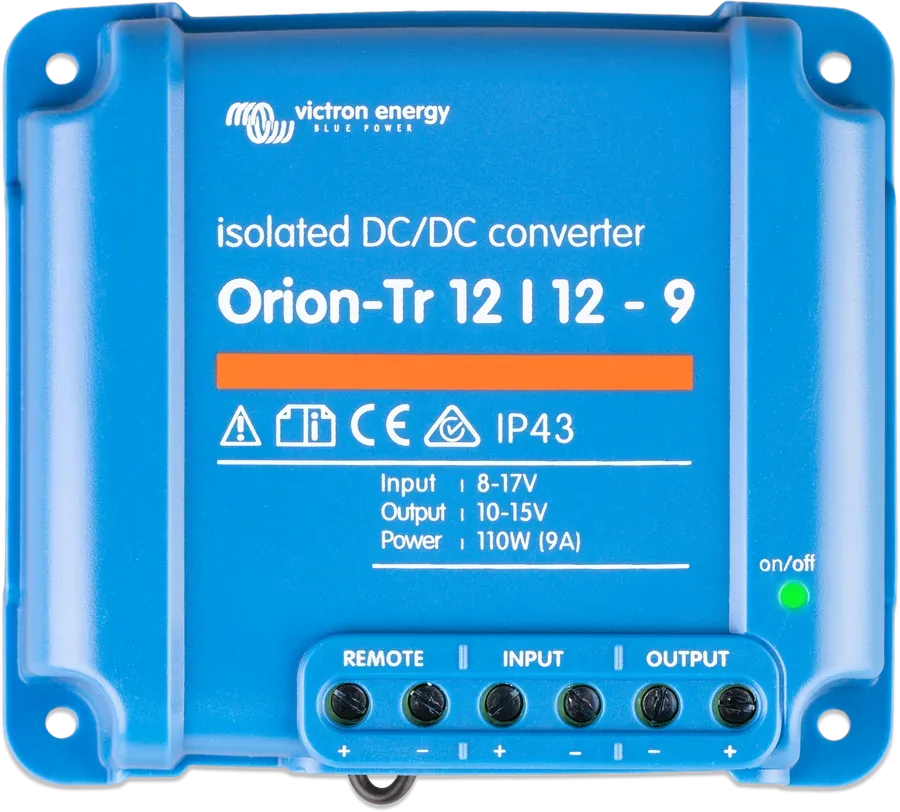
Orion-Tr (isolated and non-isolated)
DC-DC converters for powering loads from a different voltage, e.g. a 12 V radio from a 24 V battery — isolated 110–400 W and non-isolated 24/12 up to 20 A; not for charging batteries.
- 12/24/48 V
- 110–400 W (isolated)
- 24/12 5–20 A (non-isolated)
- remote on/off
- parallel operation
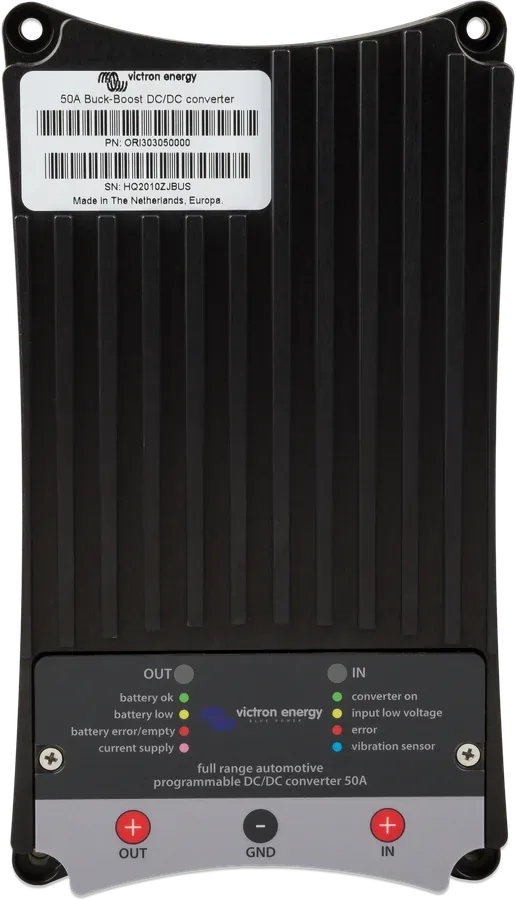
Buck-Boost DC-DC 25/50/100 A
DC-DC chargers up to 100 A from the alternator (including Euro 5 and 6) to a 12 or 24 V house battery — with engine running detection, configured with TSConfig software.
- 10–30 V input and output
- 25 / 50 / 100 A at 12 V
- engine running detection
- USB (TSConfig)
- CAN (50 and 100 A)
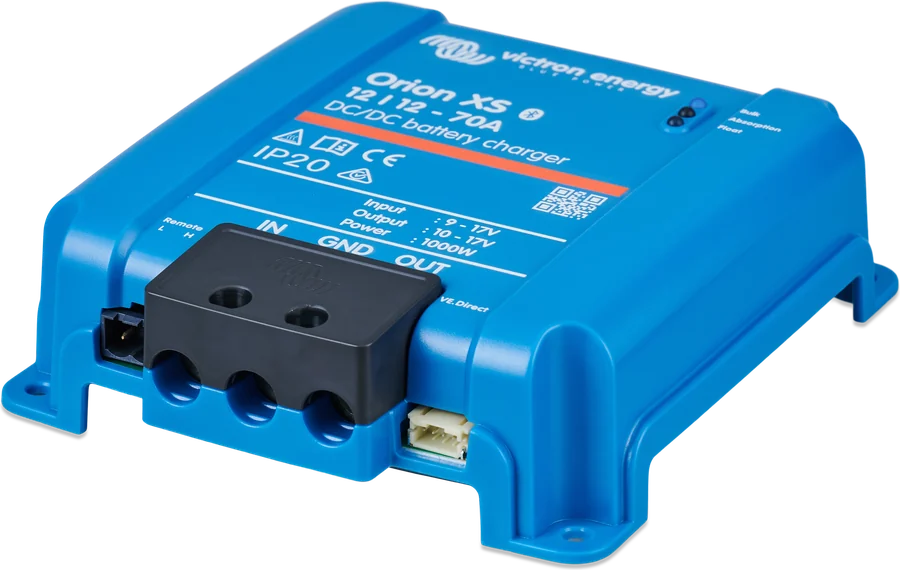
Orion XS
DC-DC charger 50/70 A from the alternator, including with a smart alternator.
- 12/12 V · 50 A or 70 A
- XS 1400: 12 and 24 V
- 98.5%
- Bluetooth
- VE.Direct
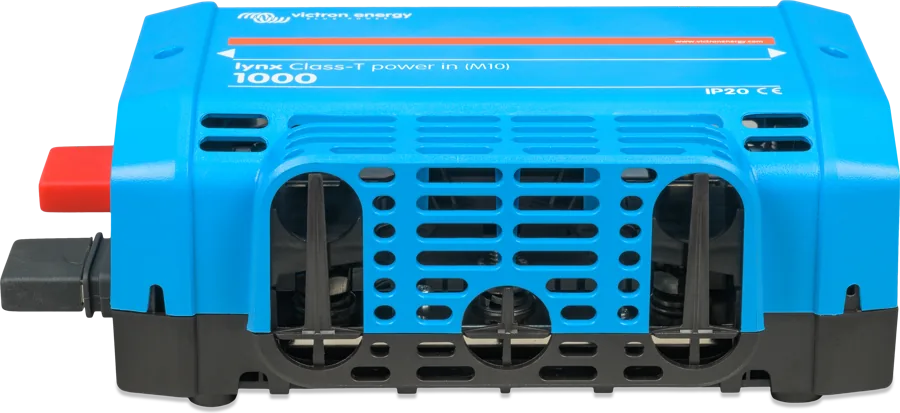
Lynx Power In
1000 A DC busbars: Power In without fuses (4 connections) and Class-T Power In for two lithium battery strings.
- 1000 A DC
- 9–60 V
- M8/M10
- Class-T
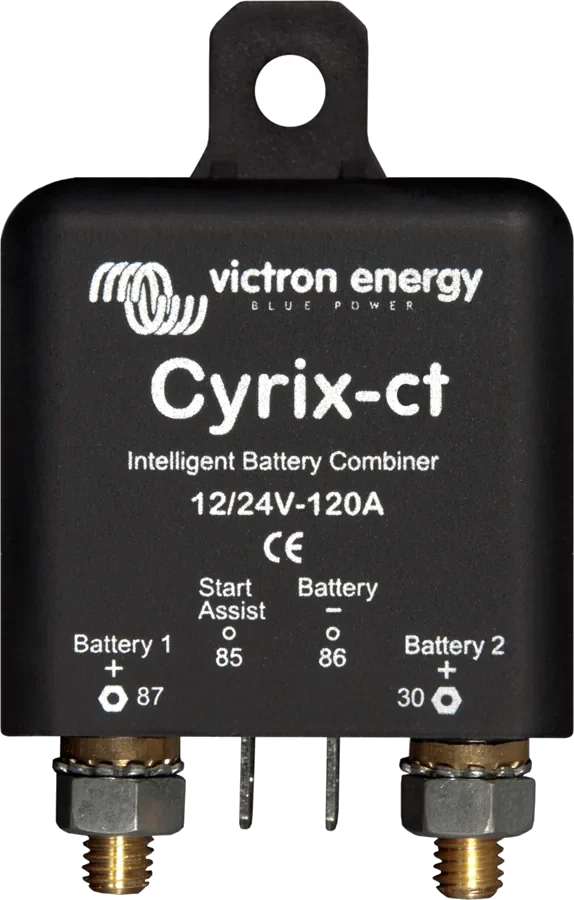
Cyrix-ct
Smart battery isolator for 12/24 V starter and house batteries, 120 or 230 A.
- 12/24 V
- 120 / 230 A
- emergency start
- IP54
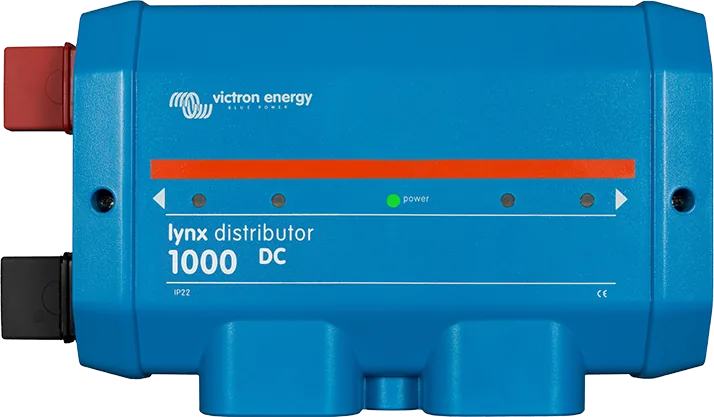
Lynx Distributor
Modular 1000 A DC busbars: fused distribution with MEGA fuses and monitoring, battery connection, Class-T fuses.
- 1000 A
- 12/24/48 V
- M8 or M10
- Distributor: 4 × MEGA with monitoring
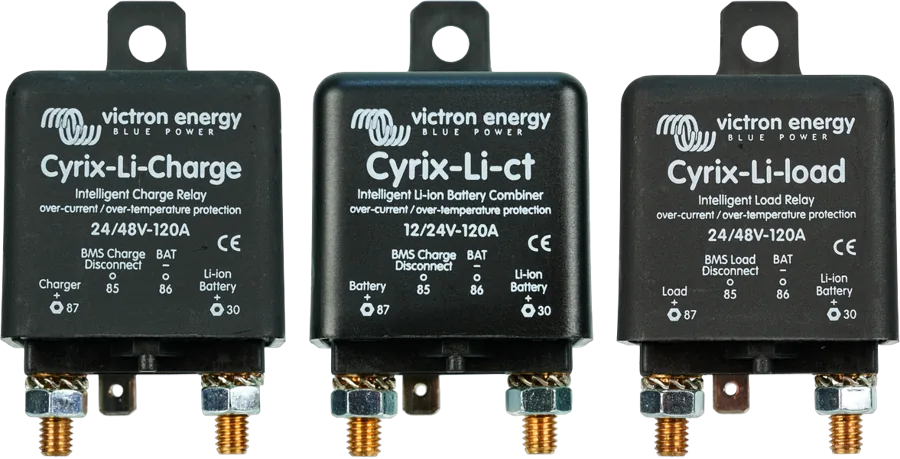
Cyrix-Li (ct, Charge, load)
Contactors controlled by a LiFePO4 battery BMS signal — disconnect the charger, loads or starter battery that the BMS cannot switch off itself. 120 A or 230 A.
- 120 / 230 A
- 12/24 or 24/48 V
- BMS control
- IP54
- status LED

Argofet and Argodiode
12/24 V battery isolators: one alternator charges two or three batteries, and discharging the house battery does not discharge the starter battery. Argofet without voltage drop, Argodiode with diodes.
- 12/24 V
- 2 or 3 batteries
- Argofet 100–200 A
- Argodiode 80–180 A
- energize input
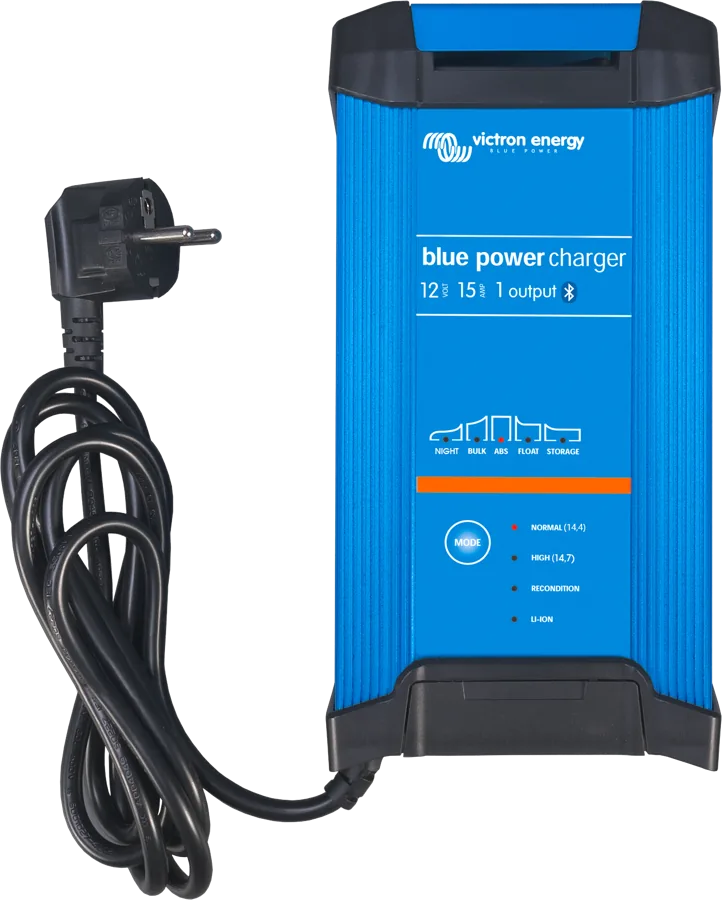
Blue Smart IP22 Charger
230 V charger, 8–30 A, for indoor use, with Bluetooth, night mode and an option for three outputs.
- 12/24 V
- 8–30 A
- 1 or 3 outputs
- Bluetooth
- IP22
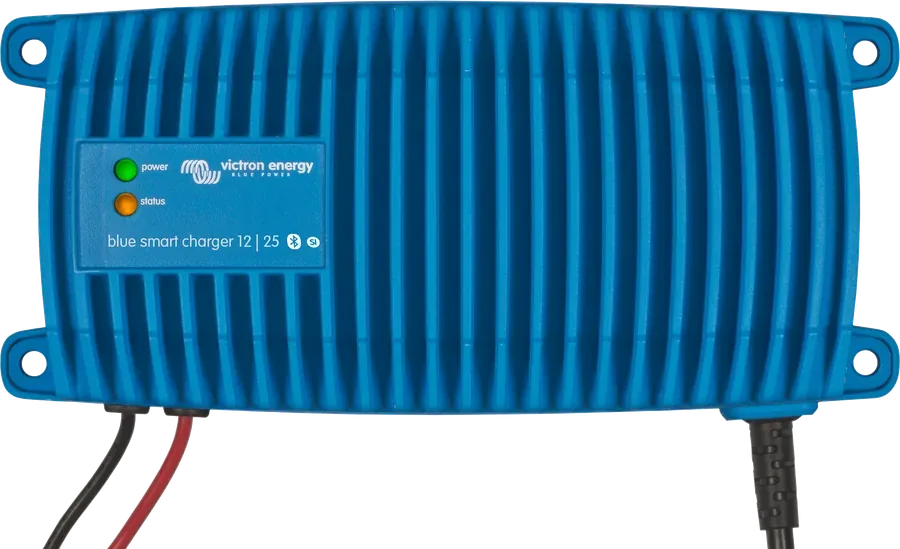
Blue Smart IP67 Charger
230 V charger in an IP67 enclosure, up to 25 A, with Bluetooth — resin-potted electronics in an aluminium housing, for permanent installation on a boat, vehicle or in an engine room.
- 12 V: 7–25 A
- 24 V: 5–12 A
- IP67
- Bluetooth
- LiFePO4 mode
- power supply mode
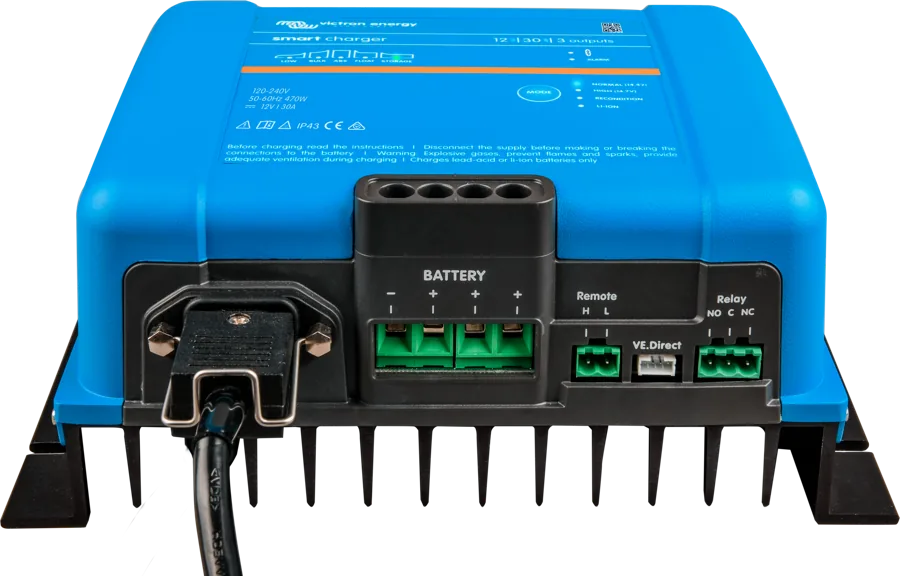
Smart IP43 Charger
Fixed 230 V charger up to 50 A, fanless, with VE.Direct, relay and power supply mode.
- 12/24/36/48 V
- 13–50 A
- 1
- 1+1 or 3 outputs
- Bluetooth
- VE.Direct
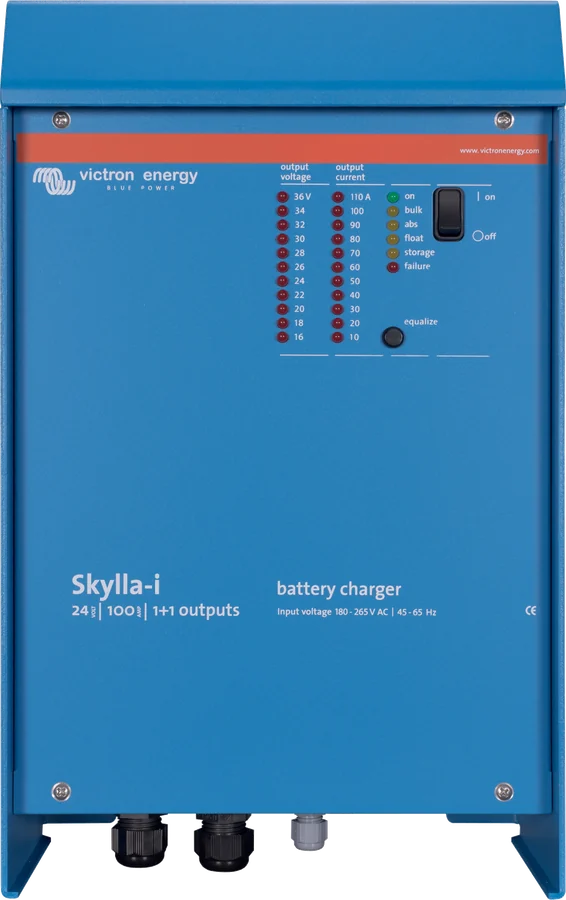
Skylla-i, Skylla-TG, Skylla-IP65
Professional 24 and 48 V chargers up to 100 A (Skylla-IP65 also 12 V) — for boats and ships, vehicles and use as a power supply.
- 12/24/48 V
- 25–100 A
- 1+1 or 3 outputs
- VE.Can (and
- IP65)
- IP21 or IP65
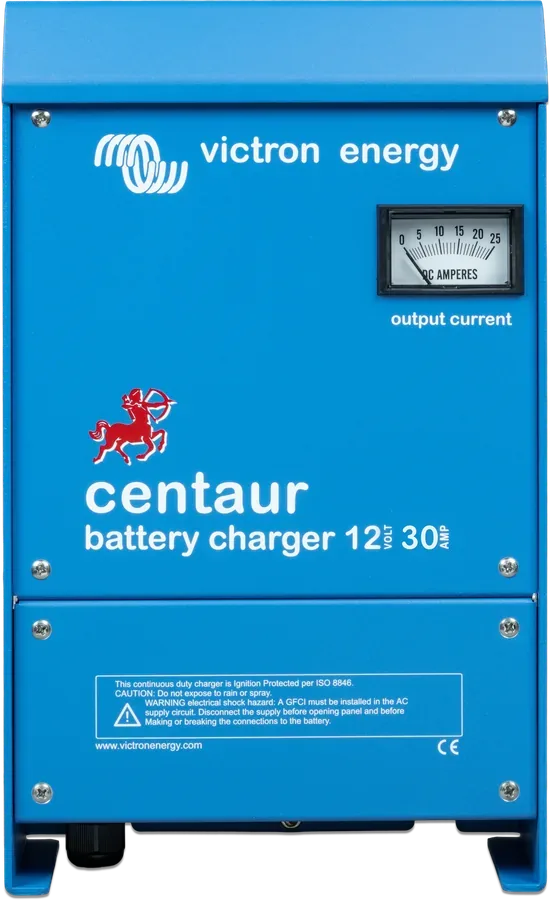
Centaur Charger
Simple, robust charger for three lead-acid battery banks: 12 V up to 100 A, 24 V up to 60 A, powered from any 90–265 V AC or 90–400 V DC supply.
- 12 V: 20–100 A
- 24 V: 16–60 A
- 3 outputs
- 90–265 V AC / 90–400 V DC
- IP20
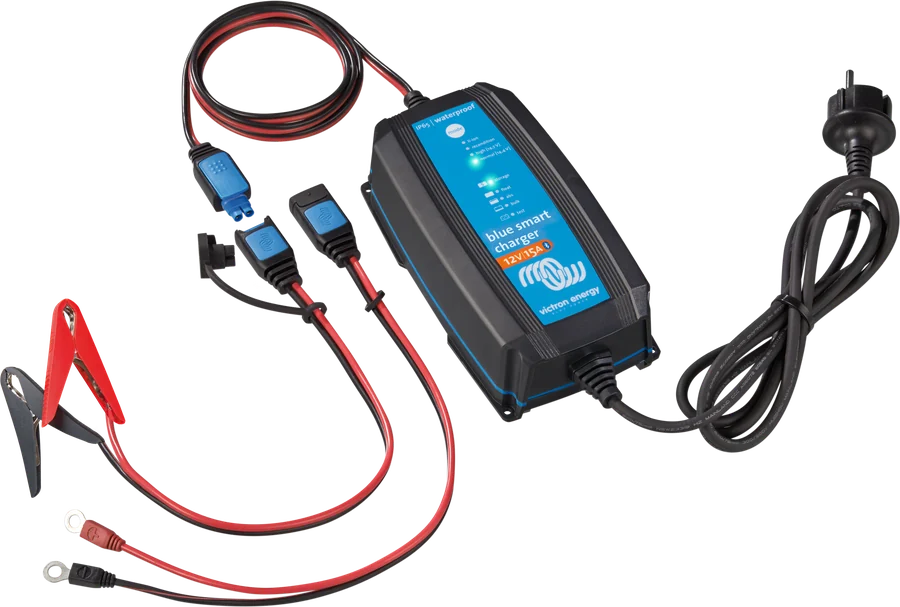
Blue Smart IP65
Mains charger for 12/24 V with Bluetooth and Li-ion mode, IP65 enclosure.
- 12 V: 4–25 A
- 24 V: 5–13 A
- IP65
- Bluetooth
- fanless
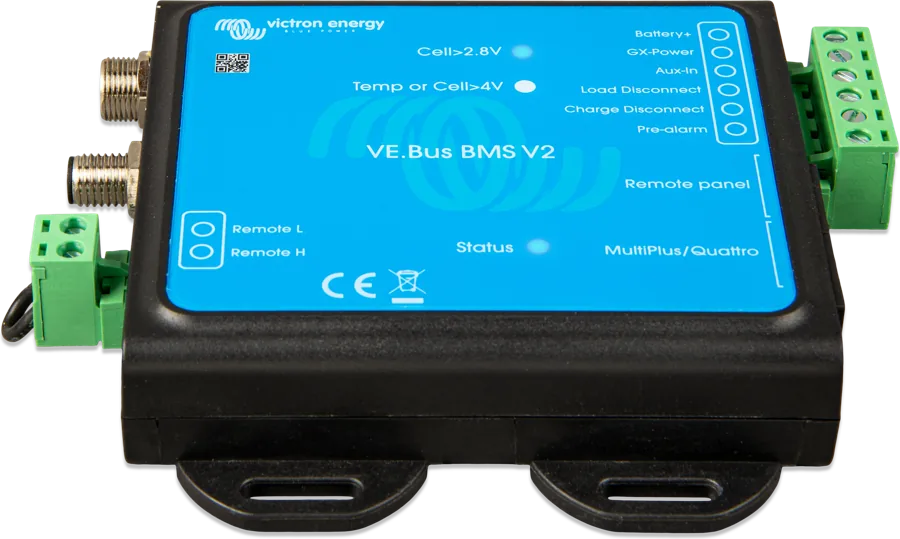
VE.Bus BMS V2
BMS for Lithium Smart batteries in a system with MultiPlus or Quattro — controls the inverter, chargers and loads.
- 12/24/48 V
- up to 20 batteries
- VE.Bus
- control outputs
- GX power supply
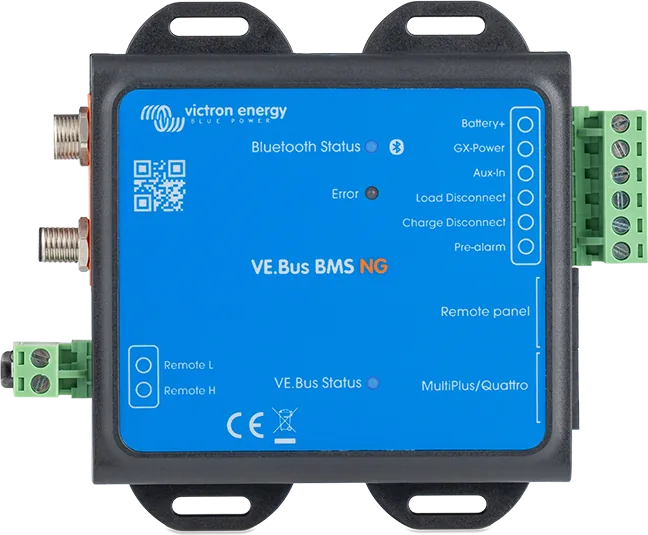
VE.Bus BMS NG
BMS for Lithium NG batteries in a system with MultiPlus or Quattro — Bluetooth, SoC on GX, discharge floor.
- 12/24/48 V
- Lithium NG
- VE.Bus
- Bluetooth
- Load/Charge disconnect
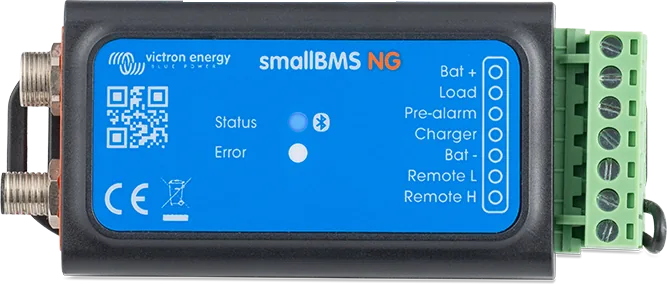
smallBMS NG
Simple BMS for Lithium NG batteries without VE.Bus — controls chargers and loads via outputs, with Bluetooth.
- 12/24/48 V
- Lithium NG
- Bluetooth
- Load/Charge disconnect
- pre-alarm
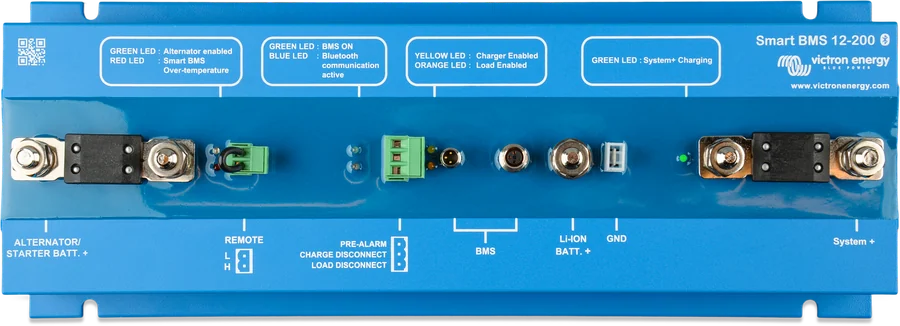
Smart BMS 12/200
BMS for 12.8 V Smart lithium batteries in vehicles and on boats — safely connects the alternator to the lithium battery and monitors each cell.
- 12.8 V
- 100 A alternator
- System+ 200 A
- Bluetooth

Smart BMS CL 12/100
BMS for 12.8 V Lithium Battery Smart batteries with an alternator input that limits charging current and protects the alternator from overload. Load and Charge disconnect outputs, pre-alarm, Bluetooth.
- 12 V
- alternator up to 100 A (125 A fuse)
- up to 20 batteries
- Load/Charge disconnect
- pre-alarm
- Bluetooth
- IP65
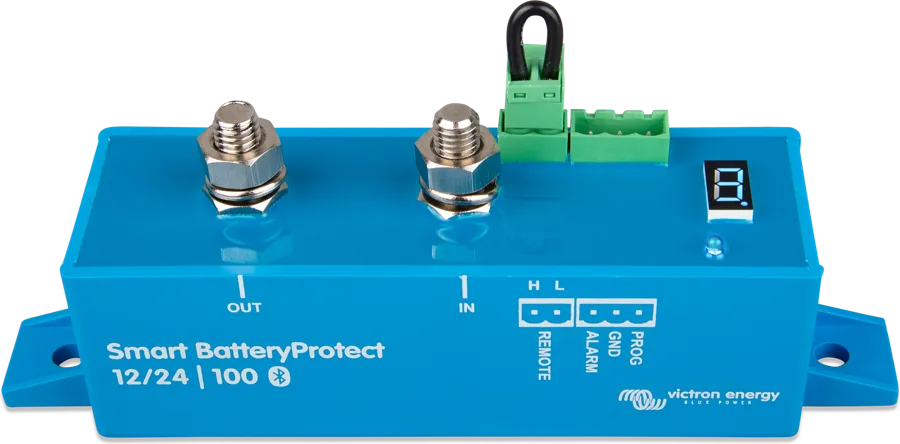
Smart BatteryProtect
Disconnects DC loads before the battery is discharged; in Li-ion mode controlled by the BMS.
- 65 / 100 / 220 A
- 12/24 V
- Bluetooth
- Li-ion mode
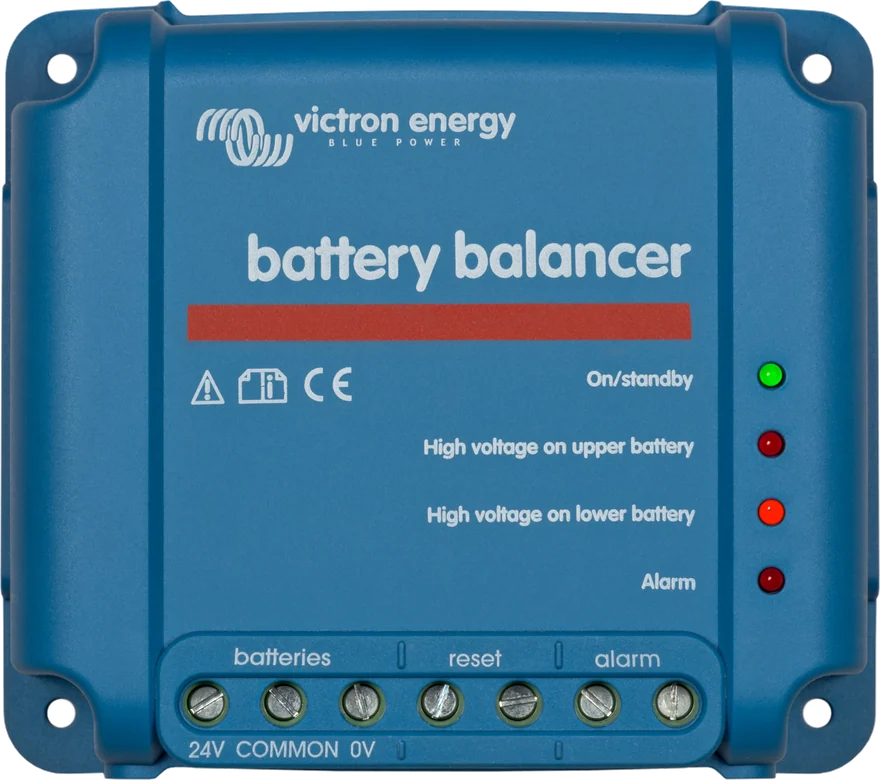
Battery Balancer
Balances the state of charge of two 12 V batteries connected in series — saves 24 V and 48 V banks from voltage imbalance.
- 24 V i 48 V
- 0.7 A
- 200 mV alarm
- relay
Lynx Smart BMS / NG
BMS with contactor and current measurement for Smart LiFePO4 or Lithium NG banks.
- 12 / 24 / 48 V
- 500 or 1,000 A contactor
- M10 busbars
- Bluetooth
- VE.Can · NMEA 2000
EV Charging Station NS
22 kW electric vehicle charging station (7.3 kW on one phase) — in automatic mode, it charges the car from excess energy from the solar panels.
- 22 kW 3 phase / 7.3 kW 1 phase
- 6–32 A
- Type 2 socket
- Wi-Fi and Bluetooth
- IP44
Knowledge you’ll actually use
Straight to the point: with calculations, fuse and cable cross-section tables, and settings from VictronConnect.
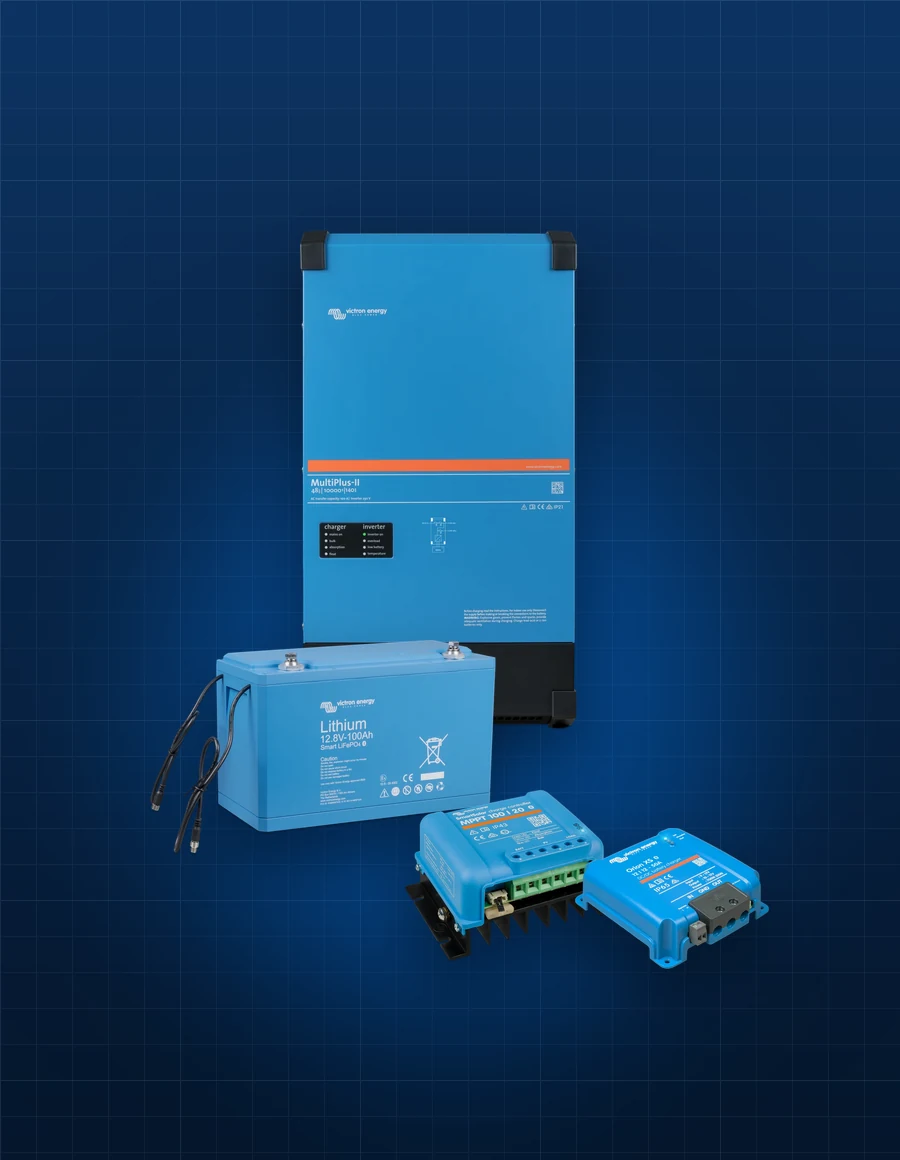
Campervan installation — work sequence
A checklist from design to commissioning: what to plan before buying, what to install first and how to bring the system into service safely — with links to calculators and a campervan schematic.
Read the guideRead more
- Campervan installation — work sequence and checklist from design to commissioningChecklist: what to plan, install and check — in order, from design to first commissioning.
- How to choose an MPPT solar charge controller for panels — Voc in frost, current, power, examplesVoc in frost, short-circuit current, rated power and oversizing — with two worked examples.
- How to choose an inverter/charger — continuous power, surge power, battery and PowerAssistContinuous and surge power, system voltage, bank and fuse for the model, plus PowerAssist for a weak hook-up.
- DC cable cross-sections and fuses — how to choose for 12, 24 and 48 V batteriesVoltage drop, cross-section table, I/3 rule, fuses for lithium batteries and common installation mistakes.
- Earthing and residual current device (RCD) with a Victron inverterRCD after the inverter, N–PE connection, earthing relay, campervan and boat, galvanic isolator.
- Connecting batteries into a bank — series, parallel, fuses and BMSSeries or parallel, how many batteries in one bank, fuse on each battery, diagonal connection and choosing a BMS.
- DVCC — how the GX device controls charging: CVL, CCL, DCL, current limit, SVS, STS and SCSHow GX takes over charger control: battery limits, shared current limit, SVS, STS and SCS, what is controlled and what is not.
- LiFePO4 battery in winter — charging in frost, capacity, winter storageCharging only above +5 °C, capacity in frost, charging lockout in MPPT and Orion, winter storage.
- Monitoring in VRM — GX, internet, alarms and remote viewing of your Victron installationHow to connect GX to the internet, add the installation to VRM, set alarms and remote access — with Wi-Fi, LTE and hotspot pitfalls.
Calculate before you buy
Each calculator shows the formulae and assumptions. We have checked the results against examples from Victron documentation.
MPPT calculator
Enter the panels and wiring method — we’ll check whether the controller can withstand the frost voltage and how much power it will use.
02Cables and fuses
DC cable cross-section for the current and length, with acceptable voltage drop, plus fuse selection.
03Energy balance
List the loads — we’ll calculate daily consumption, battery capacity and panel power for Polish solar irradiation.
Frequently asked questions
What is the difference between MultiPlus-II and Quattro-II?
Both are inverter/chargers with UPS function. Quattro-II has two AC inputs and chooses the source automatically: when voltage is present on both inputs, it uses AC-in-1 — that is why the generator is usually connected to AC-in-1, and the shore supply or marina hook-up to AC-in-2. MultiPlus-II has one AC input, so with two sources you need an external transfer switch. More in the Quattro-II datasheet.
SmartShunt or BMV-712 Smart?
Both measure current in a shunt, calculate state of charge, have Bluetooth and an additional input (starter battery, midpoint or temperature via a sensor). BMV-712 has a display, audible alarm and programmable relay (for example, to start a generator). SmartShunt has no display, alarm or relay — you read it on your phone or on the GX device screen. More in the SmartShunt datasheet.
Do Victron LiFePO4 Smart batteries need a BMS?
Yes. LiFePO4 Smart batteries (12.8 V and 25.6 V) may only be used with an external BMS approved by Victron — the battery itself does not disconnect charging or loads. Compatible options include smallBMS, VE.Bus BMS V2, Smart BMS CL 12/100 and Lynx Smart BMS — the choice depends on whether the installation has an inverter/charger and a GX device. More in the LiFePO4 Smart datasheet.
What do the numbers in the controller name mean, for example MPPT 100/20?
The first number is the maximum open-circuit voltage of the panels (Voc) — 100 V, the second is the maximum battery charge current — 20 A. Open-circuit voltage (Voc) rises when the temperature falls below 25 °C — by the percentage per degree stated by the Voc temperature coefficient in the panel datasheet. With Victron BlueSolar panels (−0.35%/°C), at −20 °C that is about 16% more than in the catalogue. Check in the MPPT calculator.
Why do I need a Cerbo GX if the devices have Bluetooth?
VictronConnect shows the key data from several devices at once (Instant Readout), but only within Bluetooth range. Cerbo GX collects data from the whole system via wired connections, lets you control it (for example start a generator, control charging via DVCC) and sends everything to the free VRM portal — with internet access, you can see the installation from anywhere. More in Cerbo GX data sheet.
Where can you get help with a fault?
Start with Troubleshooting — the diagnostics guide you from the symptom to the cause — and with Error codes and the LED decoder. For warranty and repairs, contact the dealer or installer from whom you bought the device.