
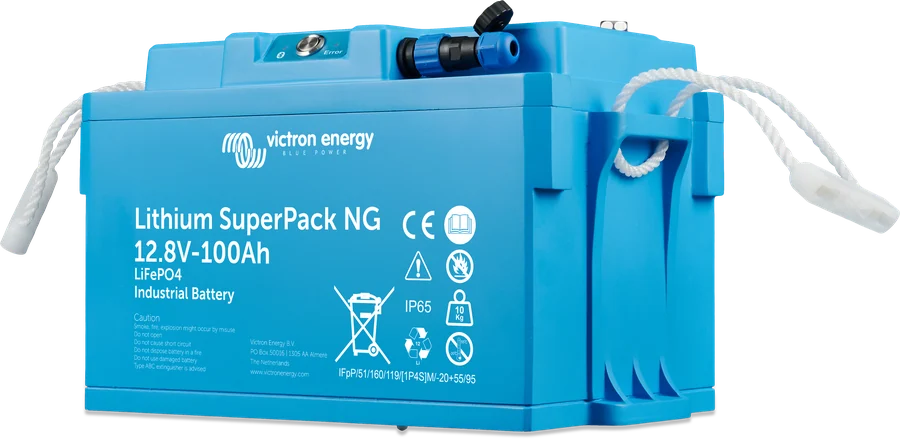
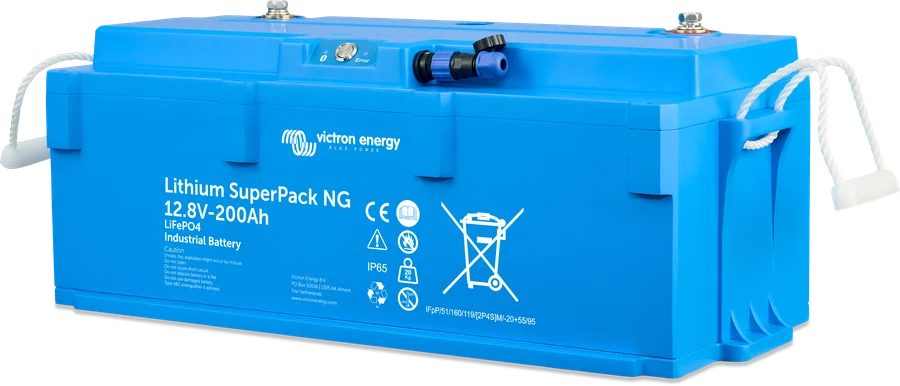
Lithium SuperPack NG 12.8 V / 100 Ah — case with handles and built-in BMS
Lithium SuperPack NG
Drop-in lithium iron phosphate battery — a replacement for a lead-acid battery in a recreational vehicle. The BMS, cell balancing, protections and heater are built in, so unlike Lithium NG no external BMS is needed. IP65 enclosure, Bluetooth, on/off button. The official Victron campervan diagram includes this battery (3 × 100 Ah).
- 12.8 / 25.6 / 51.2 V
- 100–200 Ah
- Built-in BMS
- self-heating
- IP65
Lead-acid battery replacement, without adding a BMS
SuperPack NG is a drop-in battery: the BMS, cell balancing, protections and heater are inside. Unlike Lithium NG, you do not need to buy a separate BMS or run communication cables — just connect plus and minus.
That is why it most often ends up in a campervan or boat in place of a lead-acid battery. The smallest model has BCI group 49 dimensions, and the whole unit is controlled by the button on the case and the app via Bluetooth.
- 12.8, 25.6 and 51.2 V voltages and 100 and 200 Ah capacities,
- built-in heater — in frost, the battery warms itself before charging,
- 2,500 cycles at 80% depth of discharge and 93% energy efficiency.

What’s inside the SuperPack NG
Built-in BMS
Cell balancing, voltage, current and temperature protection, and an internal low-side switch on the negative side. No external BMS is needed.
Self-heating
A heater rated from 65 to 260 W depending on the model. At the factory it switches on only when a charger is connected; frost-protection mode also heats without one, at the expense of battery energy.
Bluetooth and button
State of charge, voltages, alarms and settings in the VictronConnect app. The button on the case turns the battery on and off and clears some lockout states.
Currents
Recommended discharge 0.5C, peak up to 2C for a limited time; recommended charging 0.3C, maximum 1C. Short-circuit protection trips above 800 A.
Parallel only
Series connection is not supported by the manufacturer. The bank may have any energy capacity, but its current must not exceed 800 A — and that is the maximum main fuse size.
EFS output
Instead of ATC/ATD outputs, the battery has one signal output: EDS (diagnostic, always active) or ECS (constant signal at low state of charge). Current rating up to 250 mA.
IP65 enclosure
Protects against splashes, but the battery is not suitable for immersion or for being left in sun and rain. The 3/4" thread is for venting gases only.
Storage
Switch the battery off with the button (switching off from the app leaves Bluetooth active). Best at 10–35 °C, up to a year at 25 °C with state of charge above 50%. Self-discharge below 3% per month.
Capacities and currents
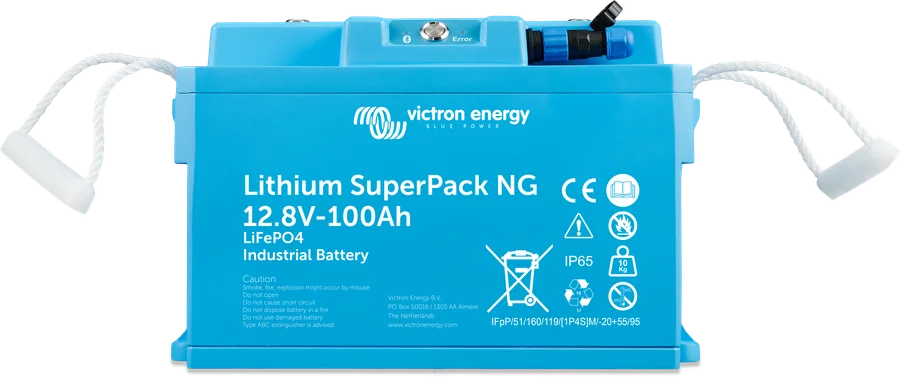
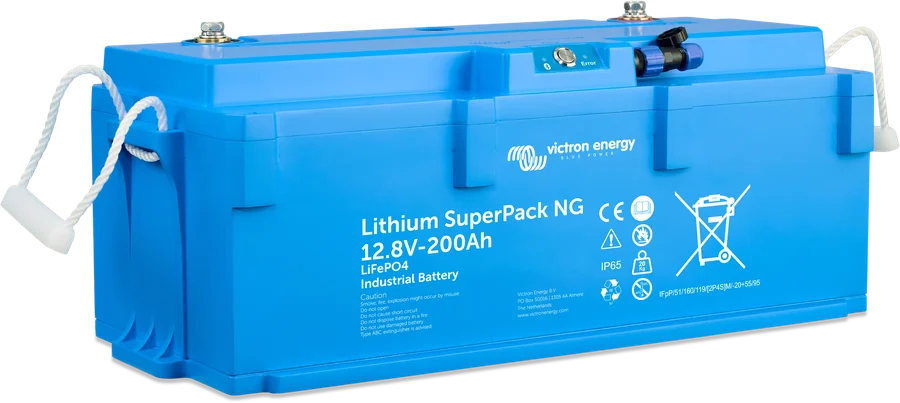
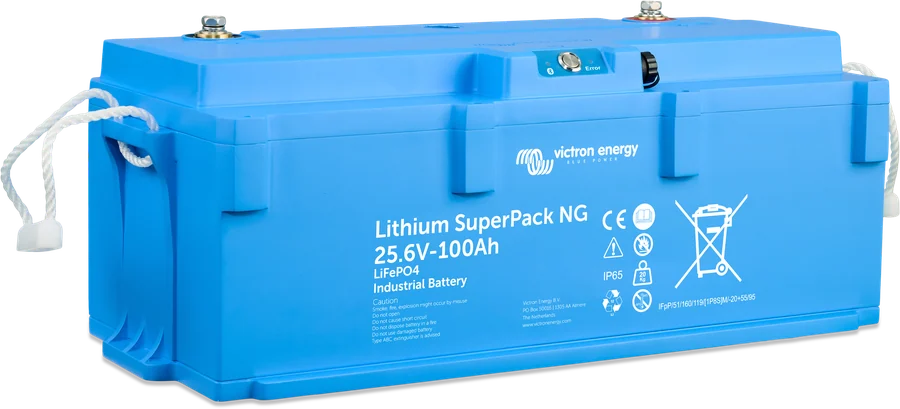
| Model | Energy | Recommended discharge / max continuous | Recommended charging / max continuous | Max heater | Dimensions (L × W × H), weight |
|---|---|---|---|---|---|
| 12.8 V / 100 Ah | 1,280 Wh | 50 / 200 A | 30 / 100 A | 65 W | 273 × 173 × 173 mm, 10.7 kg |
| 12.8 V / 200 Ah | 2,560 Wh | 100 / 400 A | 60 / 200 A | 130 W | 466 × 198 × 173 mm, 20.5 kg |
| 25.6 V / 100 Ah | 2,560 Wh | 50 / 200 A | 30 / 100 A | 130 W | 466 × 198 × 173 mm, 20.5 kg |
| 25.6 V / 200 Ah | 5,120 Wh | 100 / 400 A | 60 / 200 A | 260 W | 871 × 198 × 173 mm, 41 kg |
| 51.2 V / 100 Ah | 5,120 Wh | 50 / 200 A | 30 / 100 A | 260 W | 871 × 198 × 173 mm, 41 kg |
The 12.8 V / 100 Ah model has BCI Group 49 dimensions; add 15 mm to the height for the terminal bolts. The 51.2 V / 100 Ah model (and, according to the manual, also 25.6 V / 200 Ah) will reach the market after Q1 2026. Service life (capacity ≥ 80%, 25 °C, 0.5C cycles): 2,500 cycles at 80% DoD, 3,000 at 70%, 5,000 at 50%. End-of-discharge voltage 11.2 / 22.4 / 44.8 V.
SuperPack NG, Lithium NG or LiFePO4 Smart
Lithium SuperPack NG
BMS, protections and heater inside — you only connect plus and minus. For campervans, boats and anywhere you are replacing a lead-acid battery.
100–200 Ah · parallel onlyLithium NG
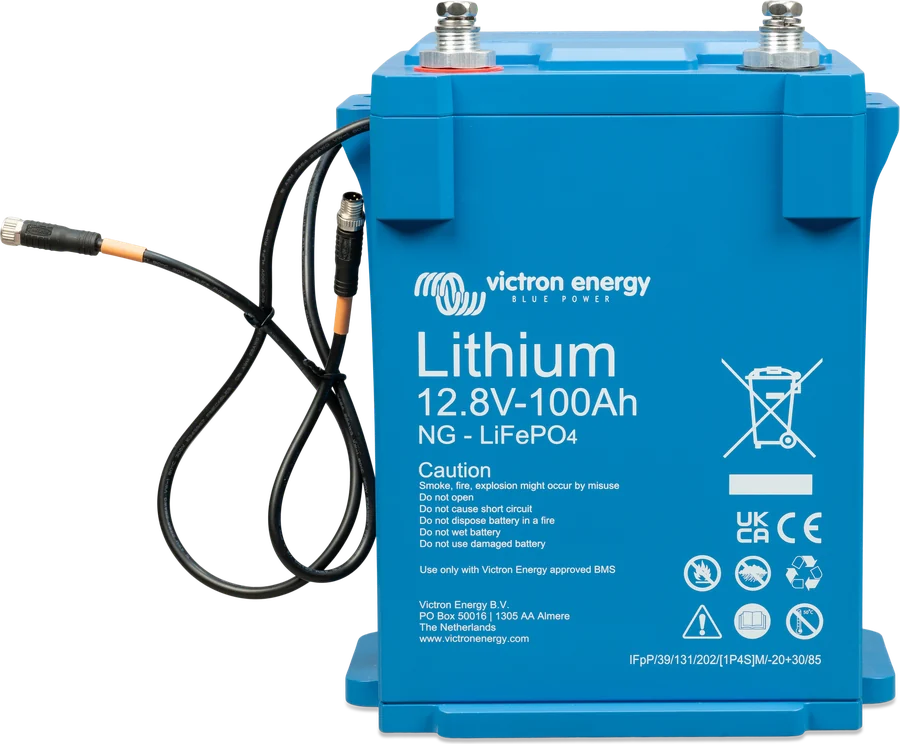
The battery also measures current, but it requires an external NG BMS. Choose it for battery banks you plan to expand in future and systems with full monitoring. Lithium NG datasheet.
100–300 Ah · separate BMSLiFePO4 Smart
Bluetooth battery without an integrated BMS, compatible with previous-generation BMS units. LiFePO4 Smart datasheet.
50–330 Ah · separate BMSSuperPack NG has no ATC and ATD outputs — instead it has an EFS signal, described in the EFS signal section.
How to connect SuperPack NG
SuperPack NG has a BMS, balancing, protections and a heater inside, so you connect it like a lead-acid battery — through the main fuse to the DC busbar. Batteries are connected in parallel only. Simplified diagram.
- Batteries in parallelA series configuration is not intended; bank current up to 800 A.
- Main fuseMRBF or Class T, breaking capacity ≥ 10 kA, as close to the positive terminal as possible.
- DC busbarThe circuits branch from here, each with its own fuse.
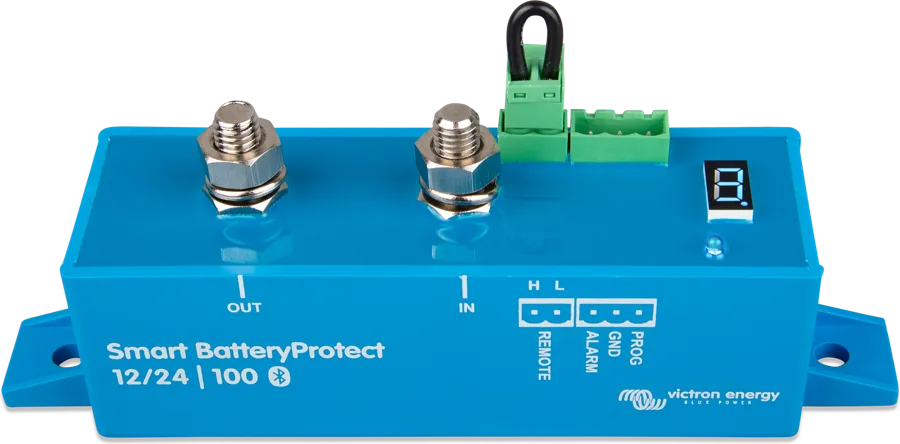
- Inverter directlyNever through BatteryProtect — control only via the remote input.
- MountingUpright or on its long side, never upside down; in a vehicle with the supplied brackets.
Connections, fuses, torque values
- Parallel only — a series configuration is not intended. You can connect in parallel without an energy limit, but the current of the whole bank must not exceed 800 A (one battery can safely interrupt this current) — main fuse for the bank up to 800 A.
- Main fuse of MRBF or Class T type with a breaking capacity of at least 10 kA, as close to the battery positive as possible. Why this matters: breaking capacity.
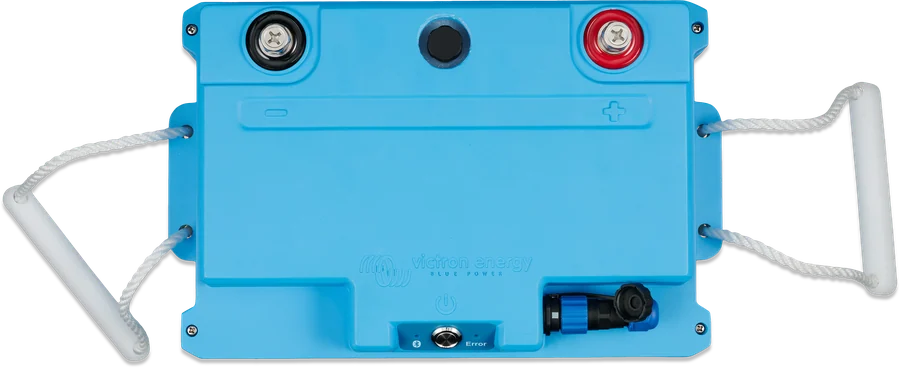
- M8 terminals, torque 4 Nm. Order on the terminal: bolt – spring washer – washer – cable lug – terminal. Connect plus first, then minus; disconnect in reverse order. Loose connections risk overheating and fire — check tightness.
- Upright or on its long side, never upside down; at least 10 mm clearance on each side. Lift by the handles, not by the terminals. In a vehicle, secure it with the supplied brackets — in a collision the battery must not become a projectile.
- IP65 protects against splashing water, but the battery is not suitable for immersion and should not be left in sun or rain. The 3/4" thread is only for venting gases.
- Only people familiar with lithium battery systems may work on the battery. Before working, switch the battery off with the button; use insulated tools, goggles and protective clothing, with no metal jewellery. The battery has an internal switch on the negative side — after switch-off or a protection trip, the negative terminal may be electronically disconnected. Voltage drop on the cables must not exceed 2% of the system voltage.
Charger settings
| 12.8 V | 25.6 V | 51.2 V | |
|---|---|---|---|
| Recommended charge voltage | 14 V | 28 V | 56 V |
| Charge voltage range | 13.5–14.2 V | 27–28.4 V | 54–56.8 V |
| Float | 13.5 V | 27 V | 54 V |
- LiFePO4 profile — not lead-acid. No “recondition” or equalisation (voltages too high for LFP). Max charge current 1C, for service life 0.3C recommended. The battery will sustain 2C discharge current only for a limited time (depending on temperature and cell voltage) — treat it as peak current; for continuous operation the manufacturer recommends 0.5C.
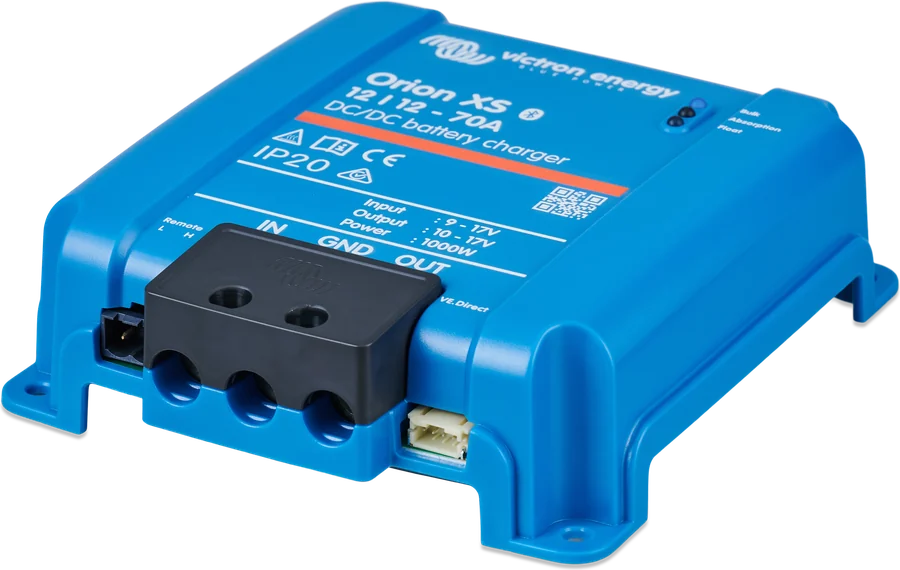
- Charge from the alternator through a DC-DC charger (e.g. Orion XS), which limits current and voltage.
- First start: a new battery is charged to no more than 30% — before use, carry out a full charge cycle (this also initialises the SoC reading). Before a firmware update, charge the battery fully.
- Temperature: according to the manual, charging is allowed when battery temperature is 0–60 °C, discharge at −30…+60 °C; below 0 °C charging is suspended until the cells warm up. However, VictronConnect shows charging blocked (ATC = No) already below 5 °C — the documentation is inconsistent here.
- Heater: in factory mode it switches on only when a charger is connected. The anti-freeze mode also heats without a charger, using battery energy until the low SoC threshold is reached.
- Discharge floor limits deep discharge (setting 0 disables protection — not recommended); the manufacturer advises, where possible, not to go below 10% SoC. Tail current 4%, charge-detected time 3 min (adjustable).
- Storage: switch the battery off with the button (switching off in the app leaves Bluetooth active). Best stored at 10–35 °C, for up to a year at 25 °C with SoC above 50%. More: LiFePO₄ in winter.
External protection signal
The battery has no ATC/ATD outputs, unlike external BMS units — it has one EFS output (External Feedback Signal, connector included). In the normal state it is free (0 V); in the active state it outputs the battery positive voltage relative to its negative, up to 250 mA. External devices must use the battery negative as the common reference point.
- EDS (always on) — diagnostic signal. The manufacturer recommends an external safety relay working with the EFS signal as additional protection alongside the internal BMS. The EDS signal is square-wave — you must not drive a relay directly from it; you need an external logic circuit or signal-conditioning circuit.
- ECS (enabled in VictronConnect, factory disabled) — a constant signal at low SoC (pre-alarm threshold), e.g. to start charging.
- Use at least 0.75 mm² cable for EFS with a 315 mA fast fuse (DC, min. 32 V, 5 × 20 mm). Do not connect EFS directly to inductive or capacitive loads or high-current loads; with a relay, fit a flyback diode. In a parallel bank, outputs configured as ECS can be connected in parallel — then any battery can trigger the signal.
LEDs, protections, codes
- Blue: on — Bluetooth connected; flashing — active, not connected; off — battery switched off or Bluetooth off. Red: flashing — warning; on — alarm or error. Both flashing together — firmware update. VictronConnect shows the code and cause (the “i” icon next to ATC/ATD). All codes and shutdown causes with descriptions: Lithium SuperPack NG error codes.
- Codes: W-B01 cell under-voltage — if it does not clear within 30 s, the battery disconnects the loads (A-B01); W-B07 low state of charge (SoC); A-B06 loads disconnected (charge the battery); E-B25 pre-charge error — load resistance too low (up to three attempts every 30 s; disconnect or reduce DC loads); E-B44 low-voltage safety lockout — does not clear automatically; after removing the cause, switch the battery off and on again; E-B119 settings lost (factory reset also clears Bluetooth pairing); E-B11 and E-B116 — contact your dealer.
- Overcurrent protection retries after up to 5 minutes; temperature protections clear automatically when the temperature returns to the range. The on/off button clears some lockout states.
- Deep discharge: dropping below 10 V (20 V / 40 V) or cell voltage dropping below 2.5 V can permanently damage the battery and void the warranty. Recovery must be carried out only on a single battery and under supervision — see discharged lithium battery.
- Do not clear the battery history — it is needed for diagnostics.
Most common questions about SuperPack NG
How does SuperPack NG differ from Lithium NG?
SuperPack NG has a BMS, cell balancing, protections and a heater built in, so it does not need an external BMS. It is a drop-in battery — a lead-acid battery replacement.
Can I connect batteries in series?
No. Only parallel connection is intended. The bank may have any energy capacity, but its current must not exceed 800 A — that is what a single battery can safely interrupt, so the main fuse must also be rated at no more than 800 A.
What main fuse?
MRBF or Class T type, with a breaking capacity of at least 10 kA, mounted as close as possible to the battery positive terminal.
How do I mount the battery in a campervan?
Upright or on its long side, never upside down, with at least 10 mm clearance on each side. In a vehicle it must be fixed with the supplied brackets — in a collision the battery must not become a projectile. Lift it by the handles, not by the terminals.
What tightening torque for the terminals?
M8 terminals are tightened to 4 Nm, in this order: bolt – spring washer – washer – cable lug – terminal. Connect positive first, then negative; disconnect in reverse. Loose connections can cause overheating and fire.
How do I charge the battery and at what current?
Use the LiFePO4 profile — absorption 14.2 V for 2 hours, then 13.5 V, with no temperature compensation (for 25.6 and 51.2 V the values are two and four times higher respectively). Maximum charging current is 1C, but for long life 0.3C is recommended. Do not use an acid profile or the “recondition” and equalisation functions.
Can I charge it from the alternator?
Only through a DC-DC charger, for example Orion XS, which limits current and voltage. Direct connection of the battery to the alternator is not intended.
What do I need to do with a new battery?
A new battery is charged to no more than 30% — before use, carry out a full charge cycle; this also initialises the state-of-charge indication. Before a firmware update, charge it fully as well.
How does the heater work and from what temperature is charging allowed?
From the factory, the heater switches on only when a charger is connected; anti-freeze mode also heats without one, using battery energy. The manual states permissible charging from 0 to 60 °C (below 0 °C it is paused until the cells warm up), but the app shows a charge lock already below 5 °C — the manufacturer’s documentation is inconsistent here.
How do I prepare the battery for storage?
Switch it off with the button on the case — switching it off in the app leaves Bluetooth active. The best temperature is 10–35 °C; at 25 °C the battery can be stored for up to a year with a state of charge above 50%.
Manufacturer documentation
Content checked against Victron Energy documentation (datasheets and manuals) — as of 19 September 2026. Report a content error · Revision log