
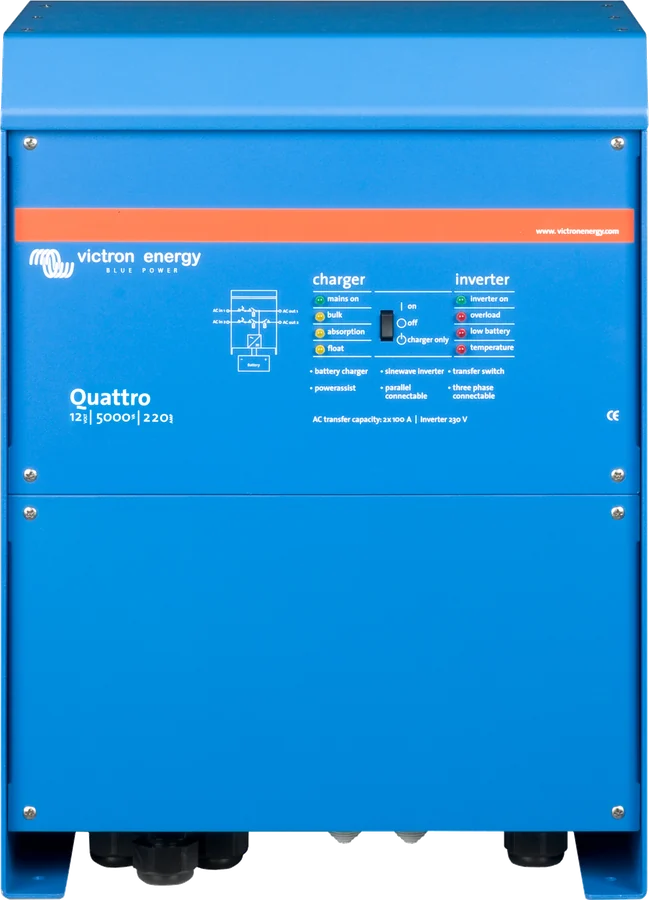
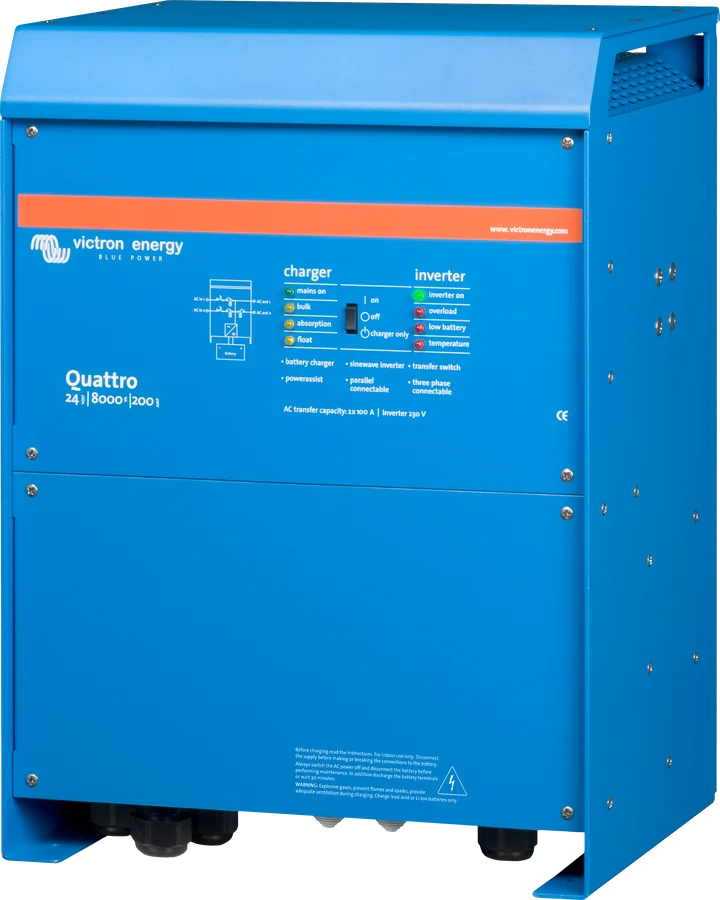
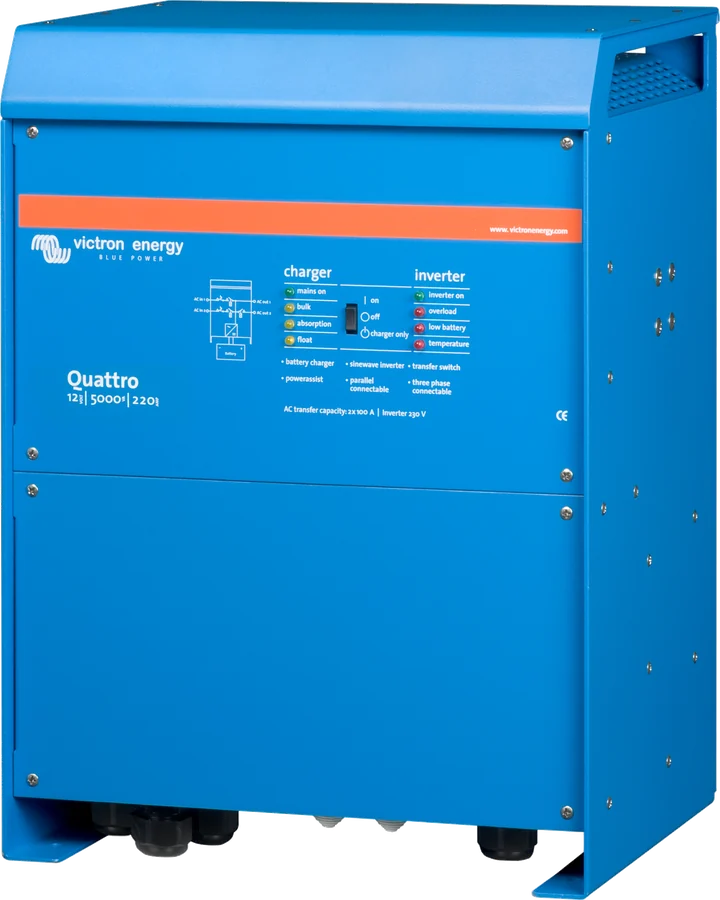
Quattro 12|5000|220 — front with charger and inverter LED panel
Quattro 3–15 kVA
Sine-wave inverter, battery charger and automatic transfer switch in one enclosure — with two AC inputs. Grid and generator (or two generators) are hard-wired to the Quattro, and it selects the source that has voltage. When power fails, it takes over the loads in less than 20 ms.
- 2 AC inputs
- 2 AC outputs
- 3–15 kVA
- 12 / 24 / 48 V
- VE.Bus
Grid and generator hard-wired
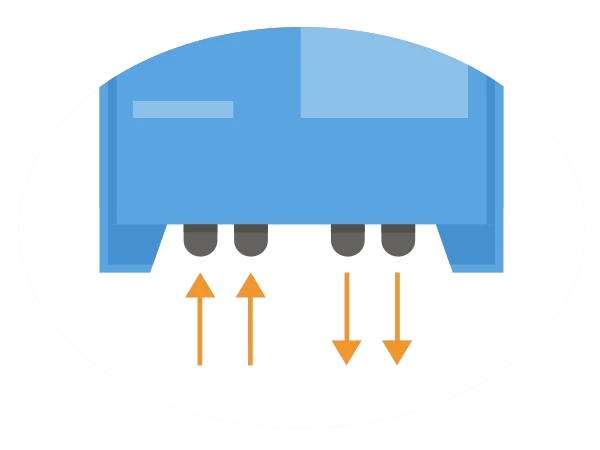
The Quattro has two AC inputs — AC-in-1 and AC-in-2 — for two independent sources: grid and generator, shore power and generator, or two generators. It selects the input that has voltage. When both have voltage, AC-in-1 has priority — so the generator is usually connected there, and the grid or shore power to AC-in-2.
When power disappears or the generator switches off, the Quattro changes to battery operation so quickly — in less than 20 ms — that computers and other electronics keep running without interruption.
- two AC inputs with a built-in transfer switch — no separate transfer box,
- two outputs: uninterrupted AC-out-1 and AC-out-2 only with external power,
- nine 230 V models: from 3 kVA at 12 V to 15 kVA at 48 V.

What the Quattro can do
Two AC inputs
Automatic selection of the source with voltage. When both inputs have voltage, the Quattro selects AC-in-1 — the input intended for the generator.
UPS under 20 ms
The main AC-out-1 output is uninterrupted: when the grid fails or the generator switches off, the Quattro takes over the loads in less than 20 ms.
Second AC-out-2 output
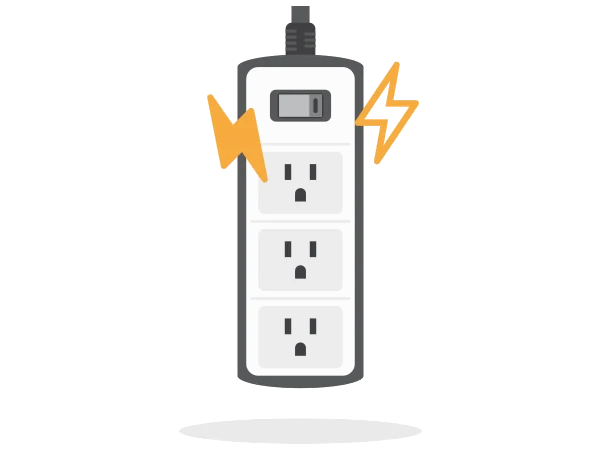
Live only with external power — for a water heater or air conditioner. When it switches to battery power, it turns off immediately, and when AC returns it switches on after about 2 minutes.
PowerControl
The current limit is set separately for each input. The Quattro takes other AC loads into account and uses only the surplus for charging — the generator and shore power are not overloaded.
PowerAssist
When the loads need more than the source can supply, the battery adds the missing power. When the load drops, the surplus goes back into charging the battery.
Parallel and three-phase
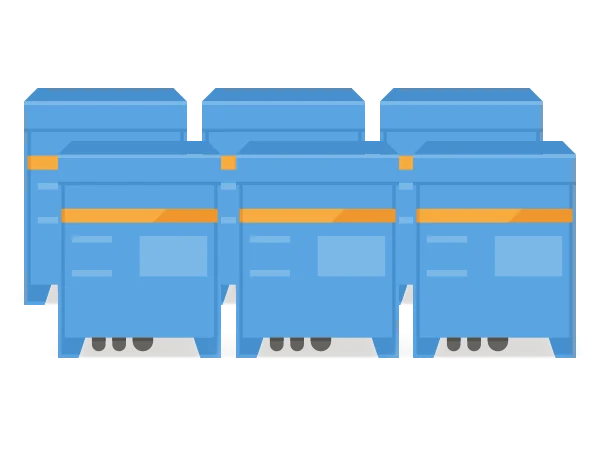
Up to six identical units in parallel; three make a three-phase star (Y) system. Delta (Δ) is not supported.
Three relays, two ports
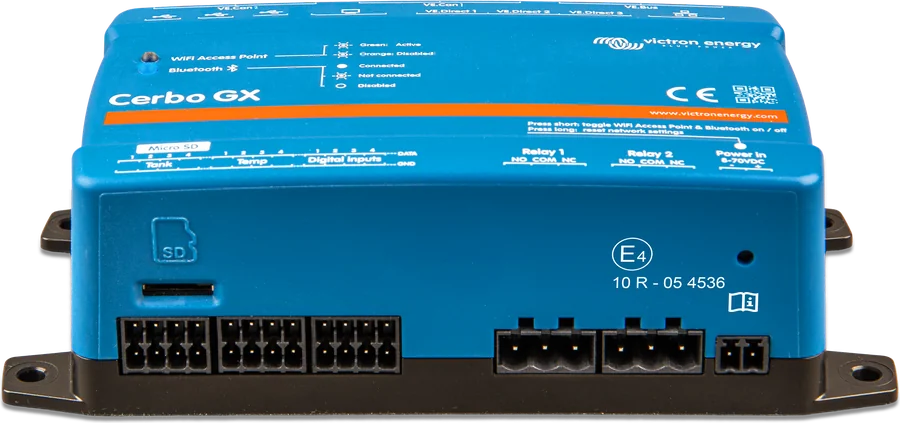
Three programmable relays (alarm function by default, can be set e.g. to start a generator) and two analogue-digital ports — one use is communication with a lithium battery BMS.
Adaptive charger
Bulk – absorption – float – storage with BatterySafe. Storage after 24 h without discharge reduces the voltage to 2.2 V per cell (13.2 V at 12 V). A separate 4 A output charges the starter battery (12 and 24 V models).
Solar PV on the AC side
Surplus from PV inverters on the output charges the battery. After absorption is reached, the Quattro turns the PV inverter off by shifting the frequency by 1 Hz (for example, from 50 to 51 Hz).
Nine 230 V models
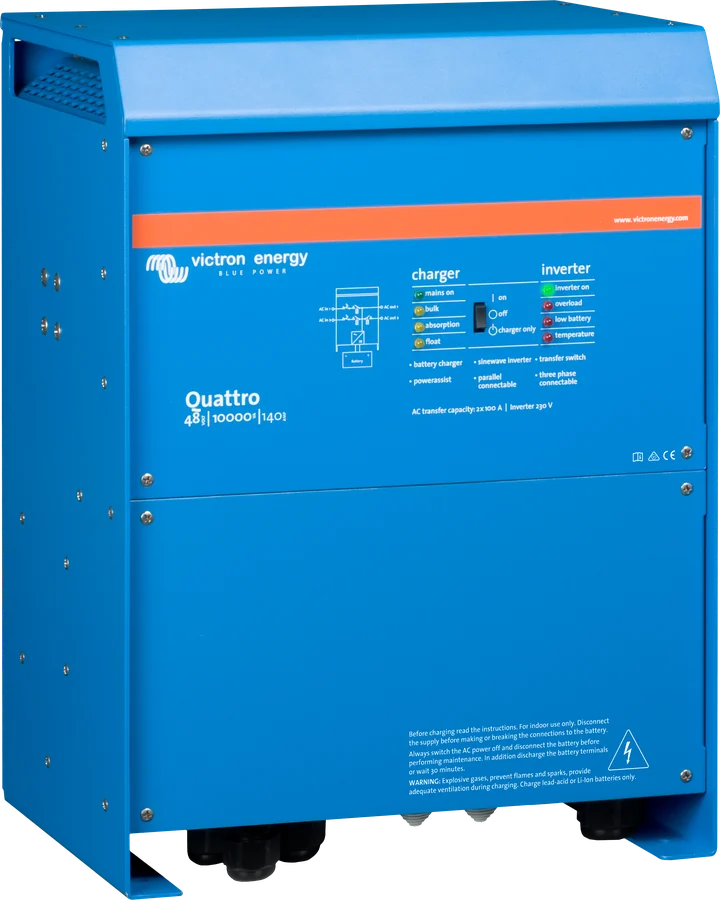
The designation is read as follows: battery voltage / power in VA / charging current — transfer-switch current on each of the two inputs. For example, 24/8000/200-100/100 means a 24 V battery, 8,000 VA, a 200 A charger and two 100 A inputs.
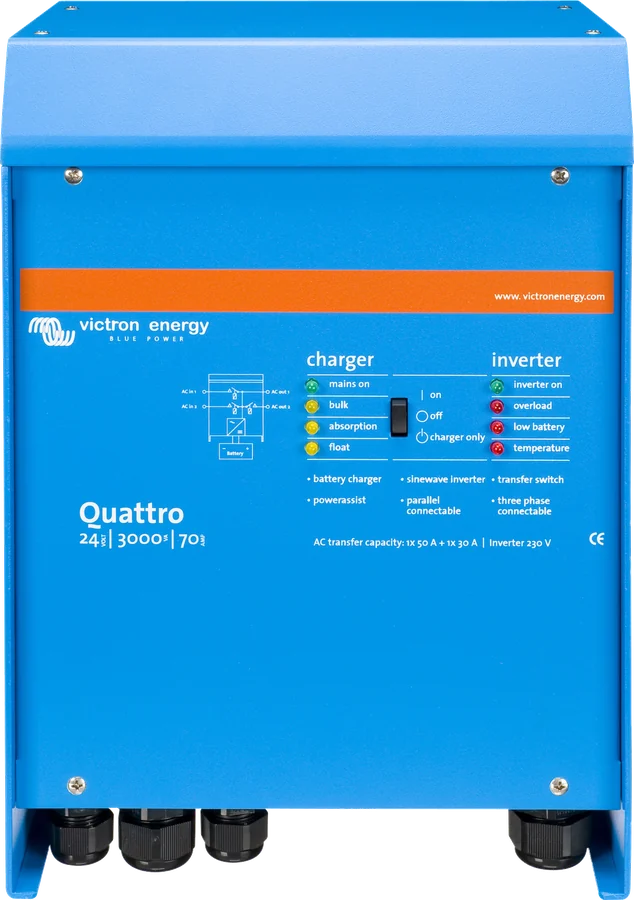
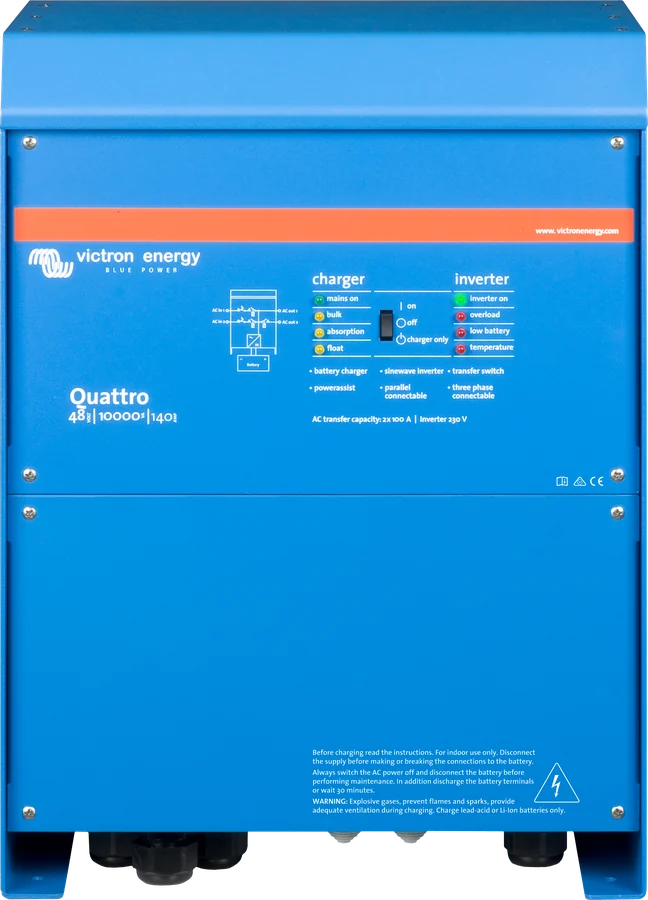
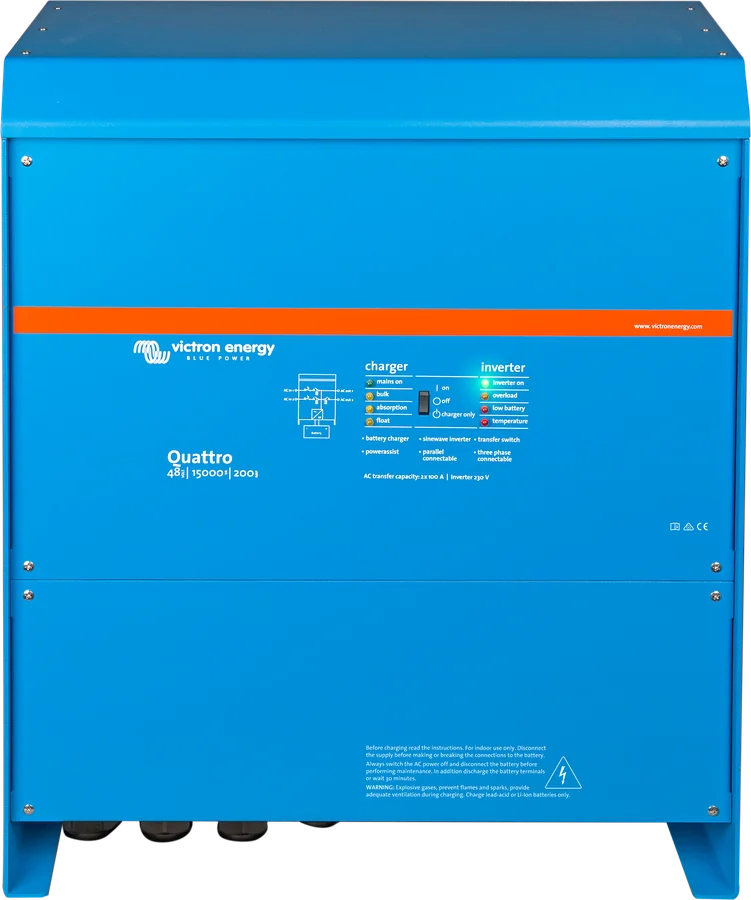
| Model | Battery | Power at 25 °C | Power at 40 °C | Power at 65 °C | Peak | Charging | Transfer | Weight |
|---|---|---|---|---|---|---|---|---|
| 12/3000/120-50/50 | 12 V | 3000 VA / 2400 W | 2200 W | 1700 W | 6000 W | 120 A | 2 × 50 A | 19 kg |
| 24/3000/70-50/50 | 24 V | 3000 VA / 2400 W | 2200 W | 1700 W | 6000 W | 70 A | 2 × 50 A | 19 kg |
| 12/5000/220-100/100 | 12 V | 5000 VA / 4000 W | 3700 W | 3000 W | 10 000 W | 220 A | 2 × 100 A | 34 kg |
| 24/5000/120-100/100 | 24 V | 5000 VA / 4000 W | 3700 W | 3000 W | 10 000 W | 120 A | 2 × 100 A | 30 kg |
| 48/5000/70-100/100 | 48 V | 5000 VA / 4000 W | 3700 W | 3000 W | 10 000 W | 70 A | 2 × 100 A | 30 kg |
| 24/8000/200-100/100 | 24 V | 8000 VA / 6400 W | 5500 W | 3600 W | 16 000 W | 200 A | 2 × 100 A | 45 kg |
| 48/8000/110-100/100 | 48 V | 8000 VA / 6400 W | 5500 W | 3600 W | 16 000 W | 110 A | 2 × 100 A | 41 kg |
| 48/10000/140-100/100 | 48 V | 10,000 VA / 8000 W | 6500 W | 4500 W | 20 000 W | 140 A | 2 × 100 A | 51 kg |
| 48/15000/200-100/100 | 48 V | 15,000 VA / 12,000 W | 10 000 W | 7000 W | 25 000 W | 200 A | 2 × 100 A | 72 kg |
The VA power is given for a non-linear load with a crest factor of 3:1, and the charging current is given for ambient temperatures up to 25 °C. Dimensions (h × w × d): 3 kVA 364 × 295 × 221 mm; 12/5000 470 × 350 × 280 mm, 24/5000 and 48/5000 444 × 328 × 240 mm; 8 and 10 kVA 470 × 350 × 280 mm; 15 kVA 572 × 488 × 344 mm. 120 V models are available to order.
- Inverter output
- 230 VAC ±2%, 50 Hz ±0.1% (60 Hz possible)
- AC inputs
- 187–250 VAC, 50/60 Hz, cos φ > 0.8
- DC range (datasheet)
- 9.5–17 V · 19–33 V · 38–60 V
- Absorption / float / storage
- 14.4 / 13.8 / 13.2 V (×2 i ×4)
- Starter battery
- 4 A, 12 V and 24 V models only
- Maximum efficiency
- 93–96% depending on model
- No-load consumption (datasheet)
- 20–110 W; in Search mode 8–20 W
- Enclosure
- aluminium, IP20, −20 to +60 °C, up to 2000 m
Battery current draw
| Power | 12 V | 24 V | 48 V |
|---|---|---|---|
| 3 kVA | 250 A | 125 A | — |
| 5 kVA | 458 A | 238 A | 118 A |
| 8 kVA | — | 381 A | 188 A |
| 10 kVA | — | — | 235 A |
| 15 kVA | — | — | 350 A |
- Programmable relays: AC 230 V / 4 A, DC 4 A up to 35 V and 1 A up to 60 V.
- AES mode: no-load consumption 15–75 W depending on model.
- Lithium batteries: the datasheet states compatibility; connecting batteries from other manufacturers is described in a separate Victron manual (in the sources).
The 5–15 kVA manual gives some values differently from the datasheet: no-load consumption 45–80 W, DC range for 48 V models 38–66 V, weight of the 48/10000 is 45 kg. In the tables on this page, we follow the datasheet.
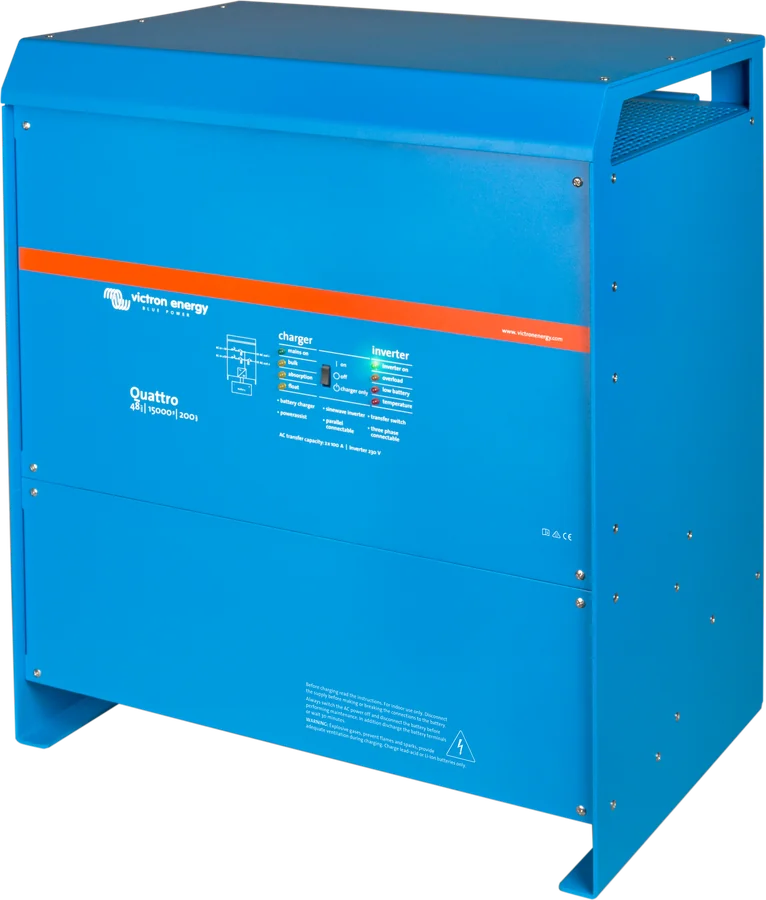
Grid, generator and battery in one system
Generator on AC-in-1, grid or shore power on AC-in-2, loads on the two outputs. Hover over or tap an element in the diagram. Indicative diagram.
- Generator → AC-in-1Priority input. Protected by a 100 A fuse (3 kVA: 50 A).
- Grid → AC-in-2Used when AC-in-1 has no voltage. The current limit can be changed from the panel.
- AC-out-1 → loadsAlways powered — from grid, generator or battery. Switchover under 20 ms.
- AC-out-2 → water heaterOnly with external power, so the battery is not discharged.
- Battery → DC fuseExternal fuse — the Quattro does not have one inside.
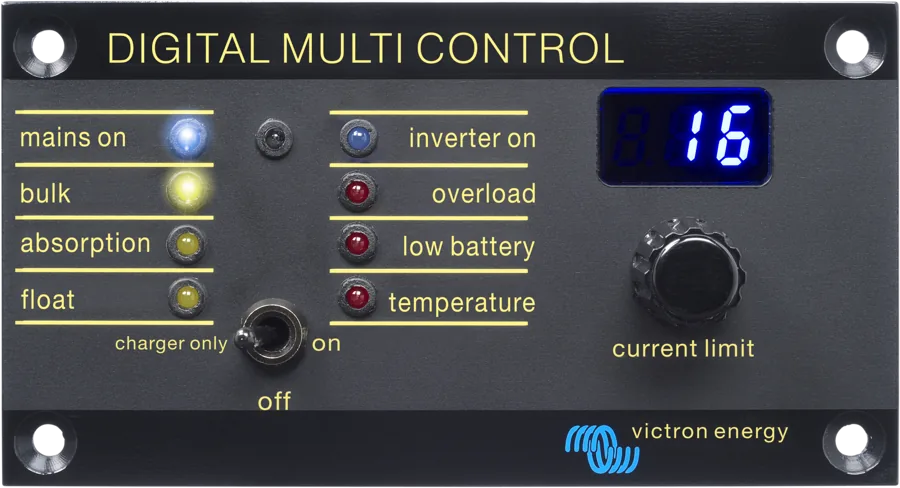
- Panel (VE.Bus)Digital Multi Control or GX device.
Quattro, Quattro-II or MultiPlus?
Quattro
Two AC inputs, two outputs, three relays and a wide power range — from 3 kVA at 12 V to 15 kVA at 48 V. A choice for large yachts, houses with a generator and backup power.
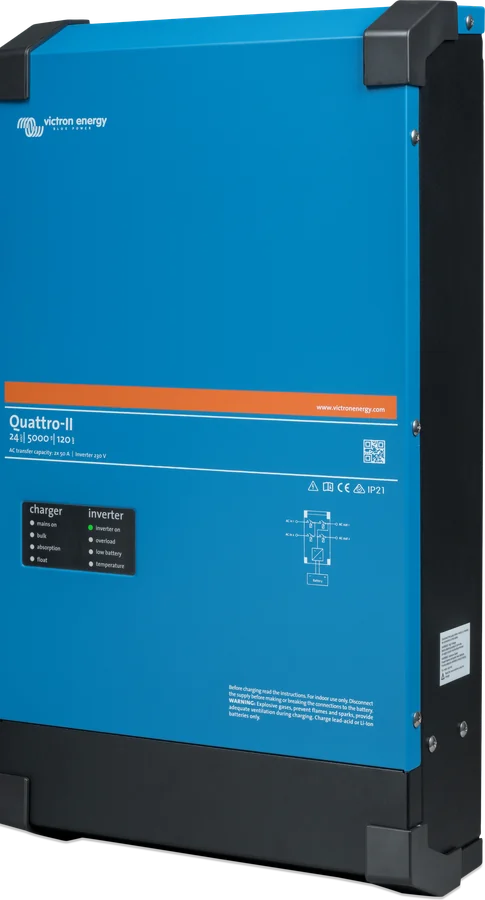
3–15 kVA · 12 / 24 / 48 VQuattro-II
The same two AC inputs in a newer version. The 230 V datasheet covers only the 24/5000 and 48/5000 models. Quattro-II datasheet.
5 kVA · 24 / 48 VMultiPlus
If you have only grid power or only a generator, one AC input is enough — with the same PowerControl and PowerAssist functions. MultiPlus datasheet and MultiPlus-II.
800 VA – 5 kVAWith one AC source and a need for very fast switching between grid power and a separate inverter, you can use the Filax 2 switch instead of a Quattro (up to 16 A). How to size the inverter and set PowerAssist: sizing guide.
Where and how to mount the Quattro
Even when switched off, the unit may have dangerous voltage at the terminals — the battery is a permanent energy source. Before working on it, switch off AC, disconnect the battery and wait 30 minutes, or discharge the terminals. There are no user-serviceable parts inside. Do not use the unit where there is a risk of gas or dust explosion, or in a damp or dusty place.
The Quattro does not have an internal DC fuse. There must be a fuse and isolator of the correct rating between the battery and the unit. On 5–15 kVA models, fit the fuse only after the entire installation has been completed.
- A dry, well-ventilated place as close to the battery as possible, with at least 10 cm of free space all round. Never directly above batteries.
- On a wall made of solid material (concrete, brickwork) — there is a hook and two holes on the back. Vertically or horizontally; it cools better when mounted vertically.
- A heat-resistant environment: no chemicals, plastics, curtains or fabrics nearby. Excessive temperature shortens service life and reduces charge current and peak power.
- In the same enclosure as a generator set (hybrid generator sets), vibration mounts matched to the generator’s vibration frequency and the unit’s mass are mandatory.
Class I protection device; the 5–15 kVA manual permits only a TN-S system. The earth relay connects the output N to the enclosure when there is no external supply. In a mobile installation, connect the enclosure to the chassis or hull; on a boat, use an isolation transformer instead of shore earthing (galvanic corrosion). If earth fault is suspected, the unit must be switched off and secured against being switched on again. More: earthing and RCD.
The Quattro has a mains transformer, so no DC current appears on the AC ports and Type A residual current devices (IEC 61008-1 or IEC 61009-1) are sufficient.
Up to six identical units. DC cables of the same length and cross-section, UTP cables directly from unit to unit — no splitters. One temperature sensor is enough for a single unit, voltage sense is connected to the master unit, and there can only be one panel or remote switch in the system.
How to connect the Quattro
Values from the 230 V manual. “2×” means two positive conductors and two negative conductors. Battery cables must not be routed in a closed conduit, and local regulations take precedence. General rules: cable cross-sections and DC fuses.
| Model | DC fuse | 0–5 m | 5–10 m | Battery capacity |
|---|---|---|---|---|
| 12/3000/120 | 400 A | 2 × 50 mm² | 2 × 70 mm² | 400–1200 Ah |
| 24/3000/70 | 300 A | 50 mm² | 2 × 50 mm² | 200–700 Ah |
| 12/5000/220 | 800 A | 2 × 120 mm² | — | 800–2400 Ah |
| 24/5000/120 | 400 A | 2 × 50 mm² | 2 × 95 mm² | 400–1400 Ah |
| 48/5000/70 | 200 A | 1 × 70 mm² | 2 × 70 mm² | 200–800 Ah |
| 24/8000/200 | 500 A | 2 × 70 mm² | 2 × 120 mm² | 400–1400 Ah |
| 48/8000/110 | 300 A | 2 × 50 mm² | 2 × 95 mm² | 200–800 Ah |
| 48/10000/140 | 400 A | 2 × 50 mm² | 2 × 95 mm² | 250–1000 Ah |
| 48/15000/200 | 600 A | 2 × 95 mm² | 2 × 150 mm² | 400–1500 Ah |
For the 12/5000, the manual does not specify the cross-section for 5–10 m. Battery terminals: 5–15 kVA models use M8 cable lugs and torque up to 14 Nm, 3 kVA models up to 9 Nm; always use a torque wrench with an insulated socket. Plus (red) to the right terminal, minus (black) to the left.
| AC circuit | 3 kVA | 5–15 kVA |
|---|---|---|
| AC-in-1 and AC-in-2 | fuse or circuit breaker up to 50 A | up to 100 A; terminals to 7 Nm, M6 lugs; in a fixed installation, an easily accessible isolator |
| AC-out-1 | RCD and protection up to 63 A (50 A input + 13 A from PowerAssist) | RCD and protection up to 125 A (5 kVA), 135 A (8 kVA), 143 A (10 kVA), 165 A (15 kVA) |
| AC-out-2 | up to 25 A, RCD and fuse up to 25 A | up to 50 A, RCD and fuse up to 50 A |
If the AC source has a lower permissible rating, the input protection must be reduced accordingly, and the cable cross-section selected to suit the protection device. Use three-core cable for AC connections (PE, N, L). Voltage sense wires: at least 0.75 mm², compensation for voltage drop up to 1 V per pole.
What the Quattro comes with from the factory
Factory settings (5–15 kVA manual) are prepared for single-unit operation and Victron gel batteries. Factory charging voltages may not suit your battery — check them in the battery manufacturer’s documentation. When changing charger settings, the DC fuse should be removed.
| Inverter output | 230 V / 50 Hz (adjustable 210–245 V) |
| AC input range | 180–265 V, 45–65 Hz |
| Input current limit | AC-in-1 (generator) 50 A, AC-in-2 (mains, shore power) 16 A |
| Battery type | Victron Gel Deep Discharge (also suitable for AGM Deep Discharge); absorption 14.4 / 28.8 / 57.6 V, float 13.8 / 27.6 / 55.2 V |
| Charge curve | four-stage adaptive with BatterySafe, absorption up to 8 h, repeated every 7 days for 1 h |
| Charge current | 75% maximum |
| Enabled | UPS, PowerAssist, earth relay, charger, bulk protection (10 h) |
| Disabled | AES, automatic equalisation, dynamic current limiter, WeakAC, frequency shift |
DIP switches — step 1. AC-in-1 limit is set with ds8–ds6 in eight values from about 6 A to 50 A (50 A is 11.5 kVA at 230 V), AC-in-2 limit with ds5: 16 or 30 A. Charge current — ds4–ds3: 25, 50, 75 or 100%. Save: press the “Up” button for 2 seconds.
Step 2. ds8–ds7 select one of four charge voltages (absorption 14.1 / 14.4 / 14.7 / 15.0 V for 12 V), ds6 absorption time 8 or 4 h, ds5 adaptive charging, ds4 dynamic current limiter, ds3 UPS function, ds2 230 or 240 V voltage, ds1 50 or 60 Hz frequency. Save: press the “Down” button for 2 seconds.
Program and panel. The remaining settings (AES, Search mode, relays, ports, frequency shift) are changed in VEConfigure via the MK3-USB interface. The Digital Multi Control panel sets only the AC-in-2 limit — when it is connected, its value applies, not the value saved in the Quattro.
Generator with AVR regulator. The factory low input voltage of 180 V may shut the system down when synchronous generators with AVR stop (most from 10 kVA upwards). Solution: raise the low threshold to 210 V, or disconnect the Quattro with a contactor before the generator stops.
Firmware. The instructions apply to version xxxx400 or later. Older units can be updated when the 7-digit number starts with 26 or 27; if it starts with 19 or 20, they cannot. See also: firmware update. Feed-in to the grid requires the grid code for the relevant country to be set in VEConfigure.
What the LEDs mean and the most common faults
The panel has charger LEDs (mains on, bulk, absorption, float) and inverter LEDs (inverter on, overload, low battery, temperature). Below are the situations from the fault table in the manual. Current codes are shown by blinking in the Victron Toolkit app; parallel and three-phase system codes: VE.Bus errors.
“Overload” flashes
The load exceeds the rated power. When the LED is lit continuously, the inverter has shut down due to overload or short circuit — reduce the load.
“low battery” flashes or stays on
Flashing: low battery voltage. Lit: the inverter has shut down because the voltage has dropped too low. Charge the battery and check the connections.
“Overload” and “low battery” flash together
Ripple at the DC terminals exceeds 1.5 V rms. Check the battery cables and connections, and whether the battery capacity is sufficient. When both are lit, the inverter has shut down; after making the corrections, switch it off and on again.
“temperature” flashes or stays on
Ambient temperature too high or load too heavy. Provide a cooler, well-ventilated location or reduce the load.
Does not switch to mains or generator
The fuse or breaker on the AC input has tripped due to overload. Remove the overload or short circuit on AC-out-1 or AC-out-2 and reset the protection.
Charger not charging
Input voltage or frequency outside the set range (factory default 180–265 V and 45–65 Hz), the input protection has tripped or the battery fuse has blown. If the generator voltage is distorted, enable WeakAC and dynamic current limiter.
“bulk” flashing, “mains on” lit
Bulk protection: the bulk phase has lasted more than 10 hours, which may indicate a shorted cell. Check the batteries; the error clears when you switch the unit off and on.
“bulk” and “absorption” flash together
Voltage sense error: the voltage on the sense wires differs from the voltage at the unit terminals by more than 7 V — usually a wiring error. The unit continues to operate normally. When “absorption” and “float” flash together, the temperature sensor is reporting an implausible value.
Will not start from mains on AC-in-2 only
Quattro may not start when AC is only present on AC-in-2 and battery voltage is 10% or more below nominal (below 11 V at 12 V). Supply AC to AC-in-1 or recharge the battery.
Quattro FAQ
Which input should the generator and mains be connected to?
The generator is usually connected to AC-in-1, mains or shore power to AC-in-2. When voltage is present on both inputs, Quattro selects AC-in-1. The AC-in-1 current limit is set permanently (DIP switches or software), and the AC-in-2 limit can be changed on the fly with the Digital Multi Control panel — useful for different shore connections in marinas and on campsites.
How is Quattro different from MultiPlus?
Quattro has two AC inputs with a built-in switch, three programmable relays and a higher power range — up to 15 kVA. MultiPlus has one AC input. Both families have PowerControl, PowerAssist, UPS and parallel operation. Comparison: MultiPlus datasheet.
What should be connected to AC-out-2?
Loads that should not discharge the battery — a water heater or air conditioner. AC-out-2 switches off immediately when the system changes to battery, and after mains returns it comes back with a delay of about 2 minutes so the generator can stabilise. Load up to 25 A in 3 kVA models and up to 50 A in larger ones.
How much power can be drawn from the output when running from a generator?
Input current plus what PowerAssist adds. According to the manual: up to 63 A in 3 kVA (50 + 13 A), 121 A in 5 kVA, 135 A in 8 kVA, 143 A in 10 kVA and 165 A in 15 kVA — with a 100 A input. That is why the AC-out-1 protection can be higher than the input; in 5 kVA the manual allows up to 125 A.
Can I connect a lithium battery to Quattro?
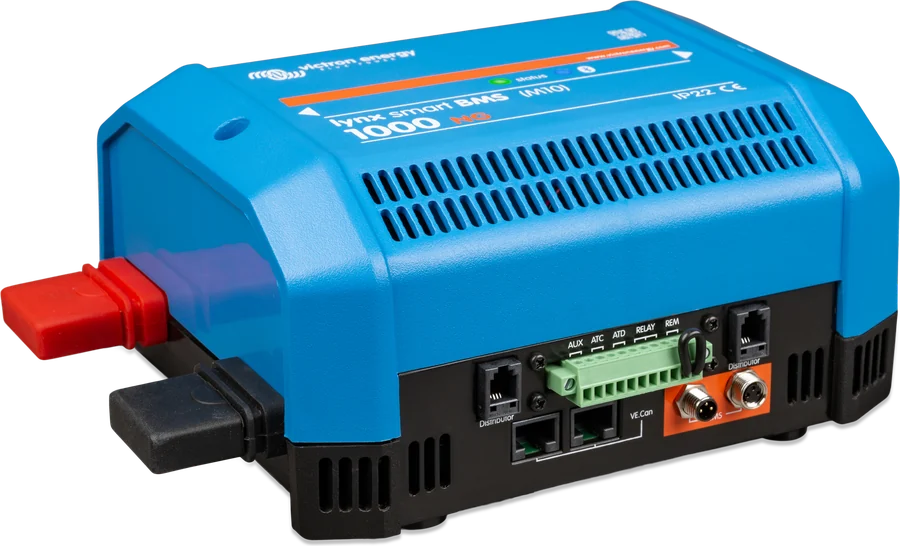
Yes — the datasheet states compatibility with lithium-ion batteries, and the two analogue/digital ports can communicate with a BMS. The BMS must be able to stop charging and discharging when necessary — for example Lynx Smart BMS or VE.Bus BMS V2 with Victron batteries. Set charging voltages according to the battery manufacturer.
How many units can be connected?
According to the manual, up to six identical units in parallel, and three units form a three-phase star configuration. Larger systems use several three-phase sets connected in parallel — the datasheet gives four sets for 15 kVA (144 kW / 180 kVA), and the 5–15 kVA manual gives six; it is worth confirming the details with the distributor. Delta is not supported.
Why does the system shut down when the generator stops?
With synchronous generators with an AVR regulator (most from 10 kVA up), the regulator tries to maintain 230 V as the generator slows down, and with the factory 180 V threshold this may shut the system down. The manual recommends raising the lower input voltage threshold to 210 V or disconnecting Quattro with a contactor on the generator stop signal. Separate case: when Quattro cannot synchronise with a small generator or keeps reverting to inverter, the manual recommends disabling the UPS function.
Is the temperature sensor included?
The manual says it is included, while the datasheet says 48 V models do not have one (order number ASS000001000). The sensor is isolated and mounted on the battery negative terminal; with several units, the sensor reporting the highest temperature is used.
Manufacturer documentation
- Quattro 3kVA–15kVA — datasheetvictronenergy.com · PDF · EN
- Quattro manual 5k–15k 100|100 A 230 V (firmware xxxx4xx)victronenergy.com · PDF · EN
- Quattro manual 3k 50|50 A 230 V (firmware xxxx4xx)victronenergy.com · PDF · EN
- Connecting third-party lithium batteries to Multi and Quattrovictronenergy.com · PDF · EN
- Quattro — product pagevictronenergy.com · EN
Content checked against Victron Energy documentation (datasheets and manuals) — as of 22 September 2026. Report a content error · Revision log