
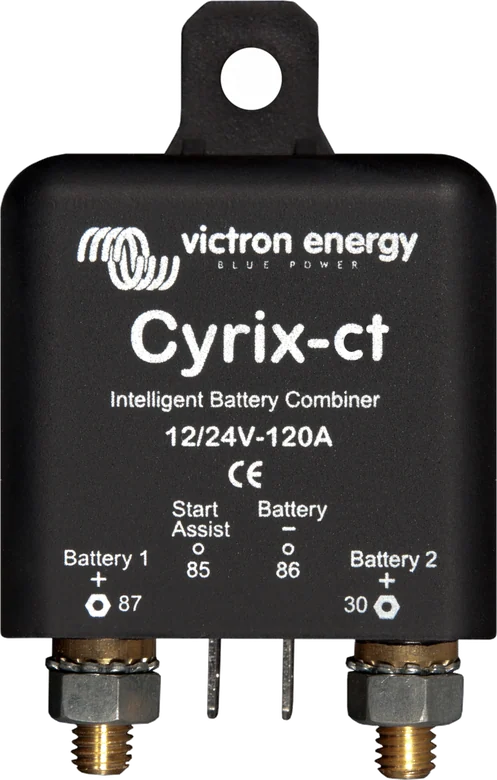
Cyrix-ct 12/24 V-120 A — battery combiner with terminal labels Battery 1, Battery 2 and Start Assist
Cyrix-ct
A voltage-controlled relay that connects the starter battery to the house battery while charging is in progress, and separates them when charging ends — so you do not lose engine starting ability. It replaces diode isolators and causes practically no voltage drop. It works both ways: it will also connect the batteries when the charger is charging the house battery.
- 12 / 24 V (automatic)
- 120 A or 230 A
- 30 s emergency start
- IP54
Thresholds and delays (12 V)
Cyrix measures the voltage of both batteries and analyses its trend — it changes state only when the trend reverses and persists for a certain time. The delay depends on how far the voltage is from the threshold:
| Voltage | Connect after | Voltage | Disconnect after |
|---|---|---|---|
| 13.0–13.2 V | 10 min | below 11.0 V | immediately |
| 13.2–13.4 V | 5 min | 11.0–12.0 V | 1 s |
| 13.4–13.6 V | 1 min | 12.0–12.2 V | 10 s |
| 13.6–13.8 V | 4 s | 12.2–12.4 V | 30 s |
| below 13 V | remains disconnected | 12.4–12.8 V | 3 min |
| above 12.8 V | remains connected |
According to the datasheet table. In a 24 V system the voltages are twice as high. Above 16 V (32 V) Cyrix disconnects because of overvoltage. The kit manual gives the thresholds in simplified form (e.g. connect at 13 V after approx. 10 min and at 13.8 V after approx. 4 s, disconnect at 12.8 V after approx. 10 min and at 11.8 V after approx. 4 s) — the disconnect delays there differ from the datasheet table.
- It disconnects if the contacts overheat (for example, due to prolonged overload) and reconnects after cooling down.
- It will not connect if the voltage at either terminal is below 2 V (4 V at 24 V) — even after disconnecting one battery.
- Emergency start: briefly applying positive to the start assist terminal (85) connects the Cyrix for 30 s — when the starter battery is discharged or damaged. A switch instead of a button keeps it connected while the switch is closed.
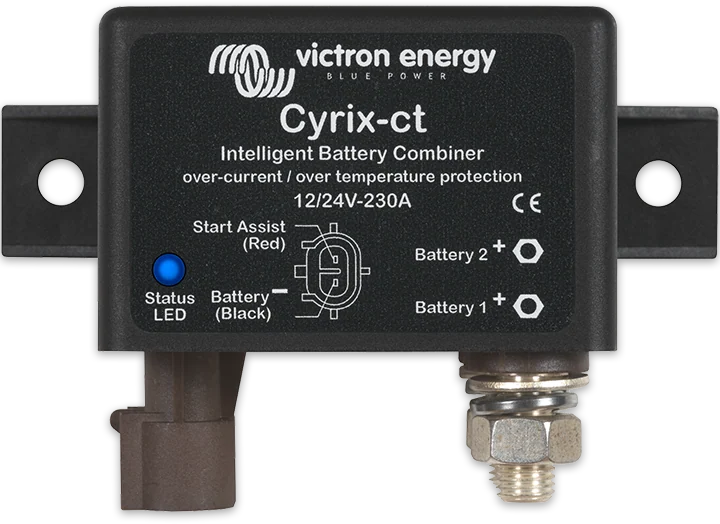
120 A or 230 A
| Cyrix-ct 12/24-120 | Cyrix-ct 12/24-230 | |
|---|---|---|
| Continuous / starting current (5 s) | 120 / 180 A | 230 / 500 A |
| Consumption when connected (12 V / 24 V) | 220 / 120 mA | 320 / 180 mA |
| Status LED | no | yes |
| 1 m control cable included | no | yes |
| Connection bolts | M6, 13 mm | M8, 16 mm |
| Dimensions (h × w × d), weight | 46 × 46 × 80 mm, 0.11 kg | 65 × 100 × 50 mm, 0.27 kg |
Common: automatic 12/24 V detection, disconnected-state consumption below 4 mA, −40…+60 °C, IP54. 120 A kit version: max alternator current 150 A.
How to connect Cyrix-ct
Mount Cyrix as close as possible to the smaller battery — usually the starter battery — in a dry place, away from hot components. The installation must have a common negative. Schematic diagram.
- Disconnect negativesBefore installation, disconnect the negative terminal of both batteries; reconnect them at the end.
- Positives to terminals 30 and 8710 mm² cables with crimped lugs, fuse in series (max. 120 A).
- Negative (86) to the common negativeThin 1.5 mm² cable — the installation must have a common negative.
- Optional start assist (85)A button or switch energises the Cyrix for 30 s during emergency starting.
Installing the Cyrix Battery Combiner Kit
Only for 12 V or 24 V installations with a common negative. The kit lets you add a second or third battery bank without cutting into the vehicle or boat’s factory wiring harness, which could void the manufacturer’s warranty.
- Disconnect the negative terminal of both batteries.
- Place the Cyrix as close as possible to the smaller battery, usually the starter battery, on a dry surface, away from hot components.
- Use the black 10 mm² cable to connect the negative of the new battery to the common negative.
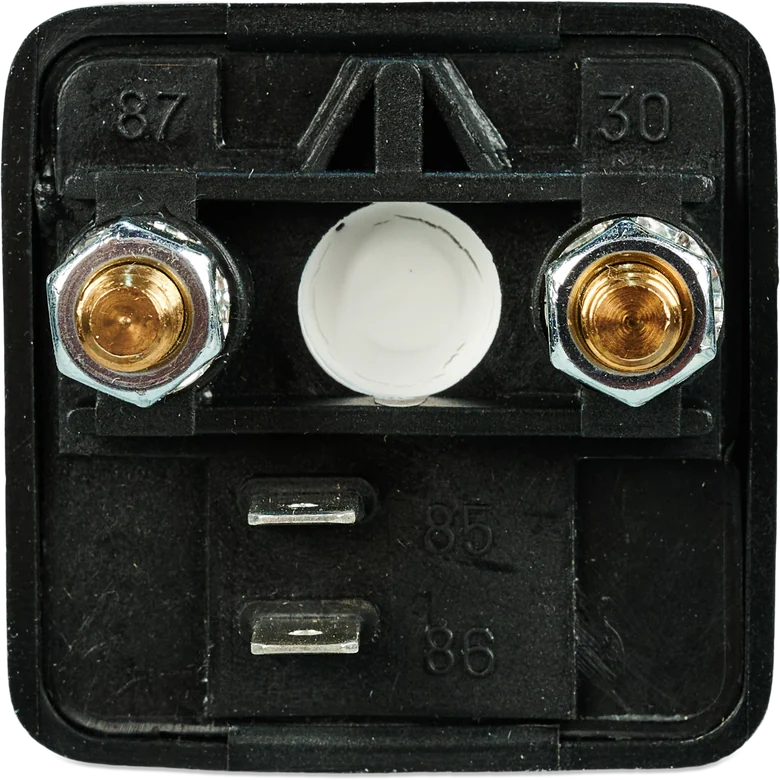
- Cut the red 10 mm² cables to length, crimp or solder the lugs, and connect the battery positives to the brass Cyrix studs marked 30 and 87. Where possible, add a fuse in series — sized to the cable cross-section, no greater than 120 A.
- Connect the Cyrix negative (86) to the common negative with a thin black 1.5 mm² cable. Optionally connect an emergency start button or switch to terminal 85.
- Finally, reconnect the negative terminal of both batteries.
The kit includes, among other things, 6 m of red and 0.5 m of black 10 mm² cable, 0.2 m of 1.5 mm² cable, and M8 and M6 terminals. The long studs allow more than one cable to be connected.
LED states
| on | on |
| flash every 10 s | off |
| flash every 2 s | switching on |
| flashing every 2 s | switching off |
| flashing every 0.25 s | alarm: overheating, voltage above 16 V, both batteries below 10 V, or one below 2 V (for 24 V, thresholds ×2) |
Cyrix-ct, Cyrix-Li or DC-DC charger
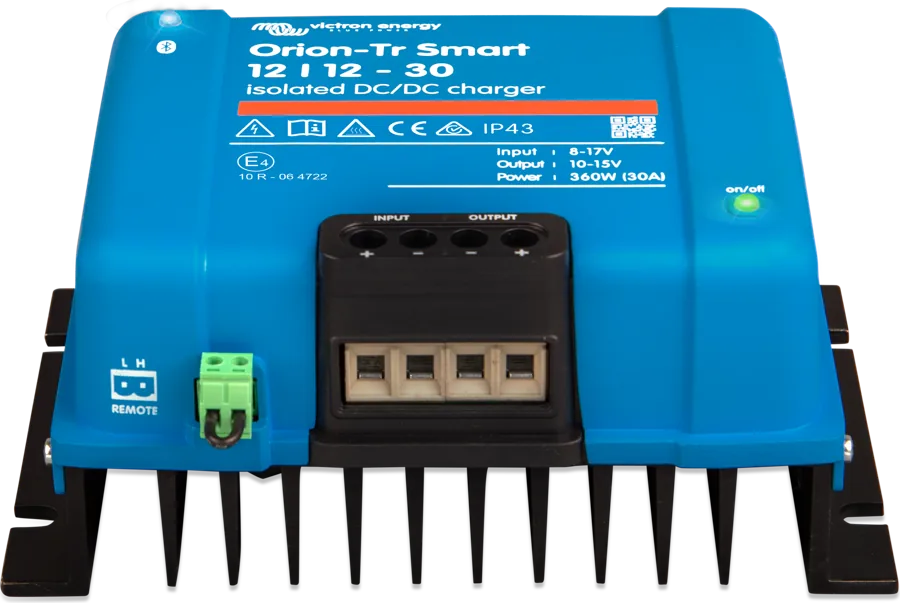
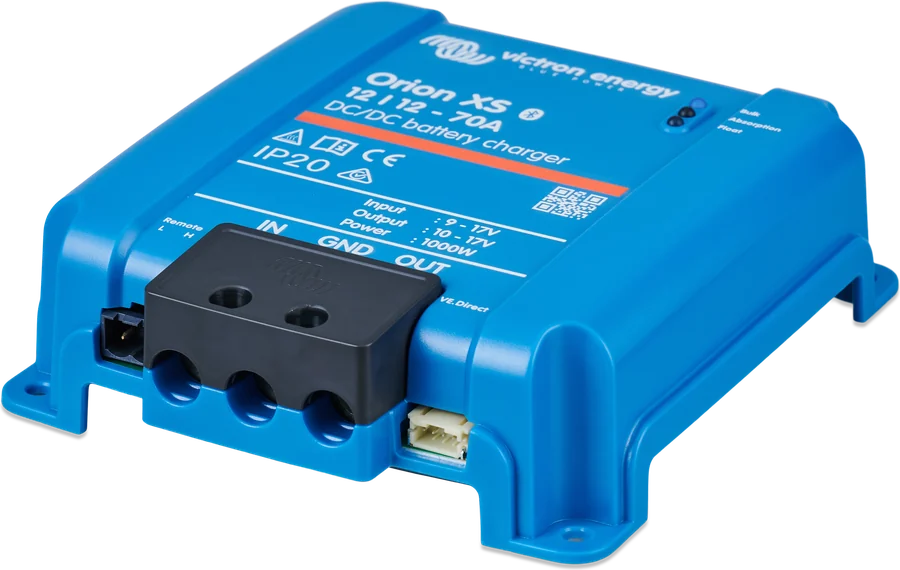
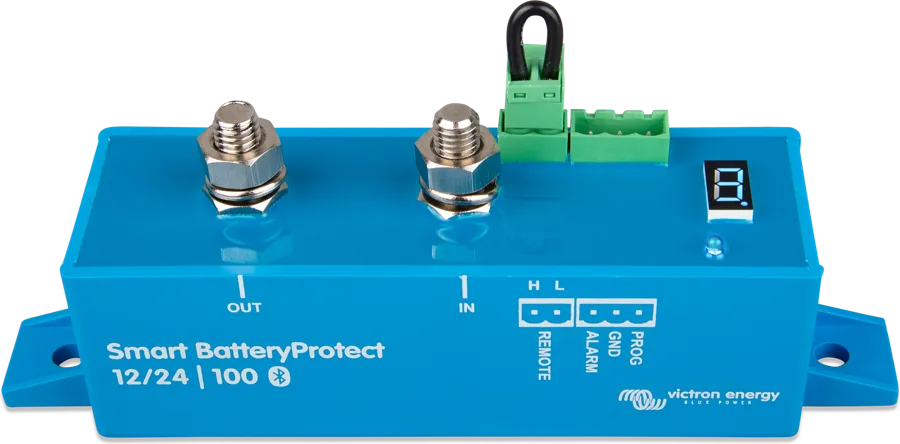
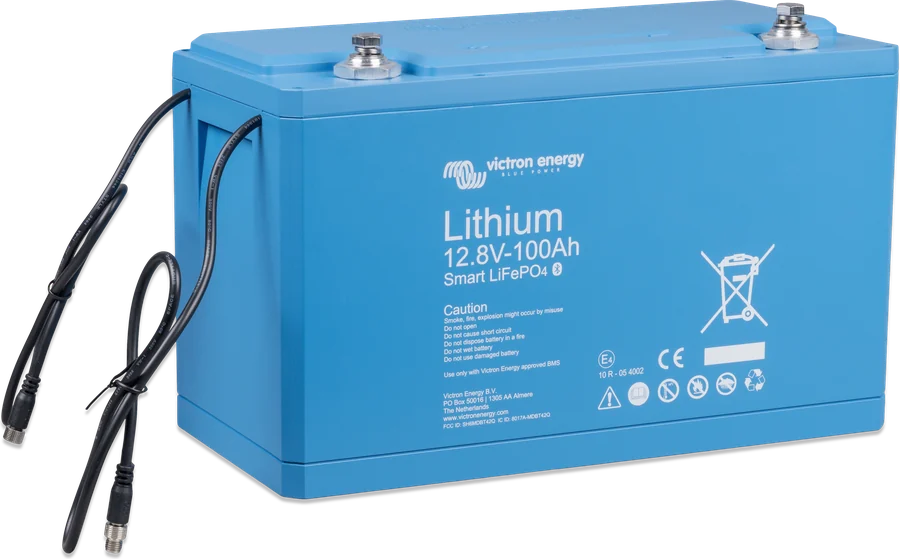
Cyrix-ct connects the batteries directly — the house battery charging voltage is whatever the alternator supplies. For Victron lithium batteries, separate combiners are provided: Cyrix-Li-ct (with a Li-ion profile and a control terminal driven from the Charge disconnect BMS output) and Cyrix-Li-Charge (one-way, between the charger and the LFP battery) — according to the smallBMS NG manual. The Orion-Tr Smart manual stresses that in vehicles with an “intelligent” alternator, controlled charging is essential — in that case, you choose a DC-DC charger: Orion XS or Orion-Tr Smart.
Cyrix-ct frequently asked questions
How is Cyrix better than a diode isolator?
It connects the batteries directly through contacts, so it practically causes no voltage drop — a diode isolator loses part of the charging voltage in the diodes.
Can Cyrix charge a lithium battery?
Cyrix-ct connects the batteries directly: the charging voltage is whatever the alternator supplies, and that is not enough to look after a lithium battery. Victron provides separate combiners for this — Cyrix-Li-ct and Cyrix-Li-Charge — and, with an “intelligent” alternator, a DC-DC charger (Orion XS or Orion-Tr Smart).
Why does Cyrix connect the batteries only after a delay?
It measures the voltage of both batteries and analyses the trend — it changes state only when the trend reverses and remains reversed. The further the voltage is from the threshold, the shorter the delay: at 13.6–13.8 V it connects after 4 seconds, and at 13.0–13.2 V only after 10 minutes.
What should you do when the starter battery is flat?
Use emergency starting: briefly applying positive voltage to the start assist terminal (85) energises the Cyrix for 30 seconds, so the engine can be started from the house battery. A switch rather than a push-button keeps the connection closed for as long as it is closed.
Which fuse should you choose?
Where possible, add a fuse in series with the cable, sized to the cable cross-section, but no greater than 120 A. The Cyrix negative (86) is connected to the common negative with a thin 1.5 mm² cable.
Manufacturer documentation
Content checked against Victron Energy documentation (datasheets and manuals) — as of 19 September 2026. Report a content error · Revision log