
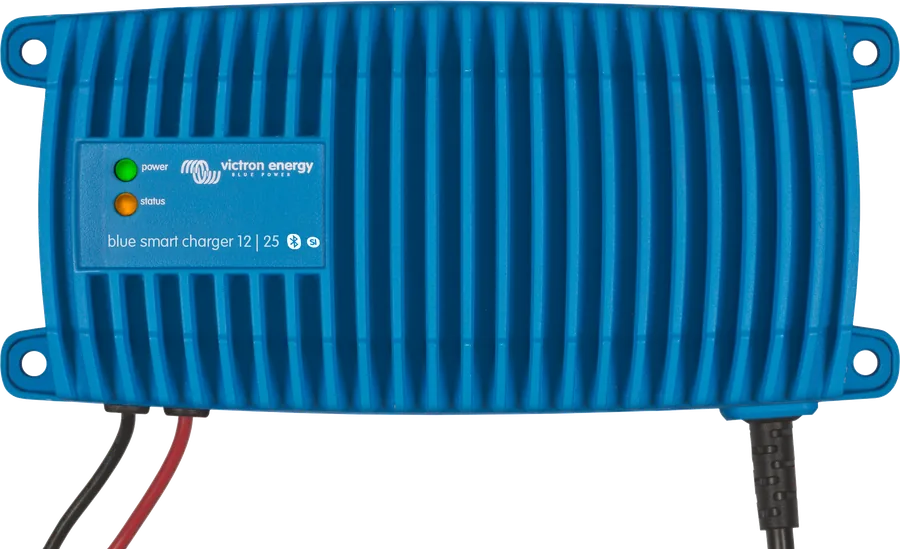
Blue Smart IP67 Charger 12/25 from above — finned aluminium case, POWER and STATUS LEDs, cables exiting from below
Blue Smart IP67 Charger
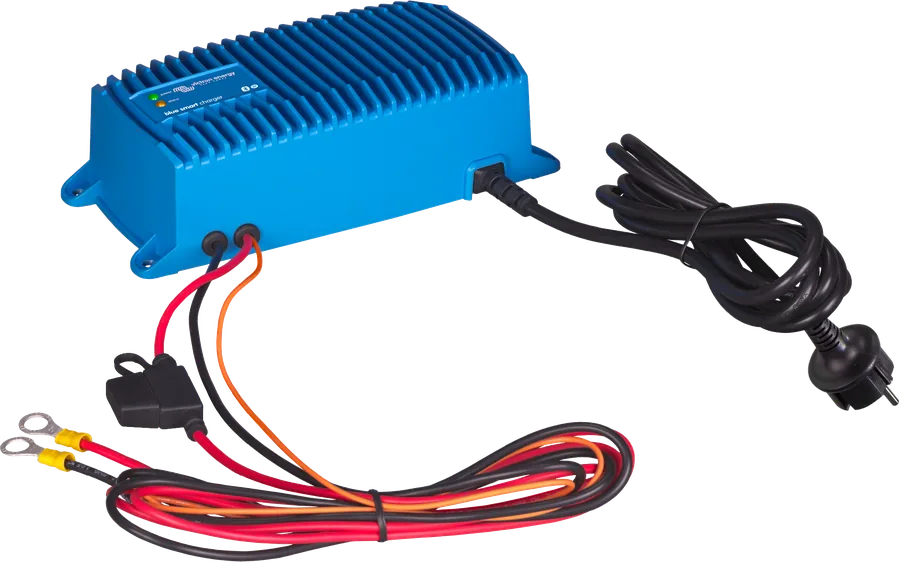
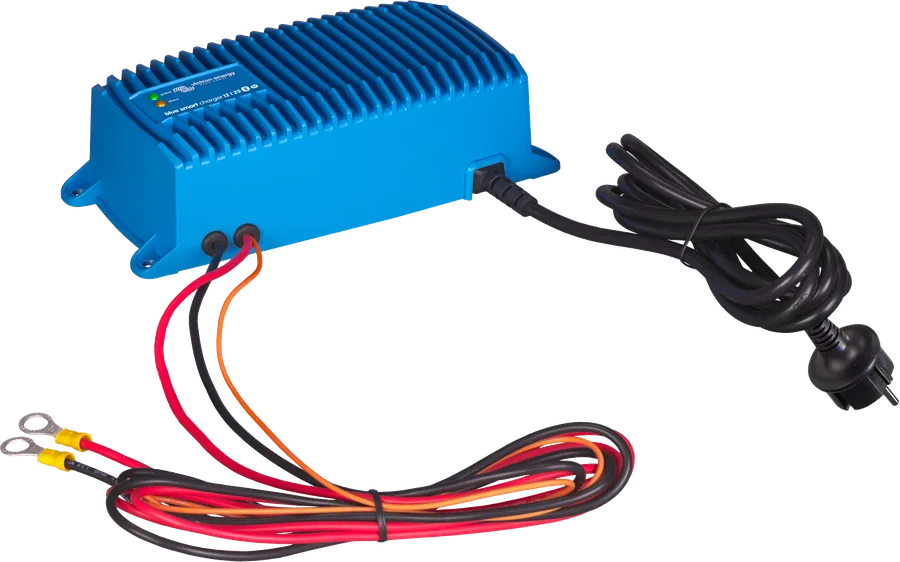
230 V charger for 12 and 24 V batteries, fully sealed: aluminium enclosure, electronics potted in resin. Water, oil and dirt do not harm it, it is shock-resistant and ignition protected. Charging mode, current and functions are set via Bluetooth and the VictronConnect app — just like in the IP65 and IP22 chargers. It is permanently mounted.
- 12 V: 7 / 13 / 17 / 25 A
- 24 V: 5 / 8 / 12 A
- IP67
- Bluetooth
- LiFePO4, power supply
Charger for wet and dirty places
Engine room of a boat, vehicle engine bay, special vehicle chassis, workshop — anywhere a conventional charger would be damaged by water, oil or shocks. The Blue Smart IP67 has a cast aluminium enclosure and the electronics are potted in resin. It is fanless; it delivers full current up to 40 °C, and above that it reduces current, but does not fail.
Models marked (1+si) have an additional “start interrupt” output that indicates connection to mains — you can use it to prevent the engine from starting while the vehicle is still connected to power. The manual says this is usually used in ambulances and fire engines.
- efficiency up to 96%, idle consumption 0.5 W,
- also charges a battery discharged to zero; it connects to a lithium battery that has disconnected itself at low voltage,
- reverse polarity protection (fuse), output short-circuit and overtemperature protection,
- Bluetooth: settings, monitoring, history, updates and VE.Smart networking.
Normal, High, Li-ion and Recondition
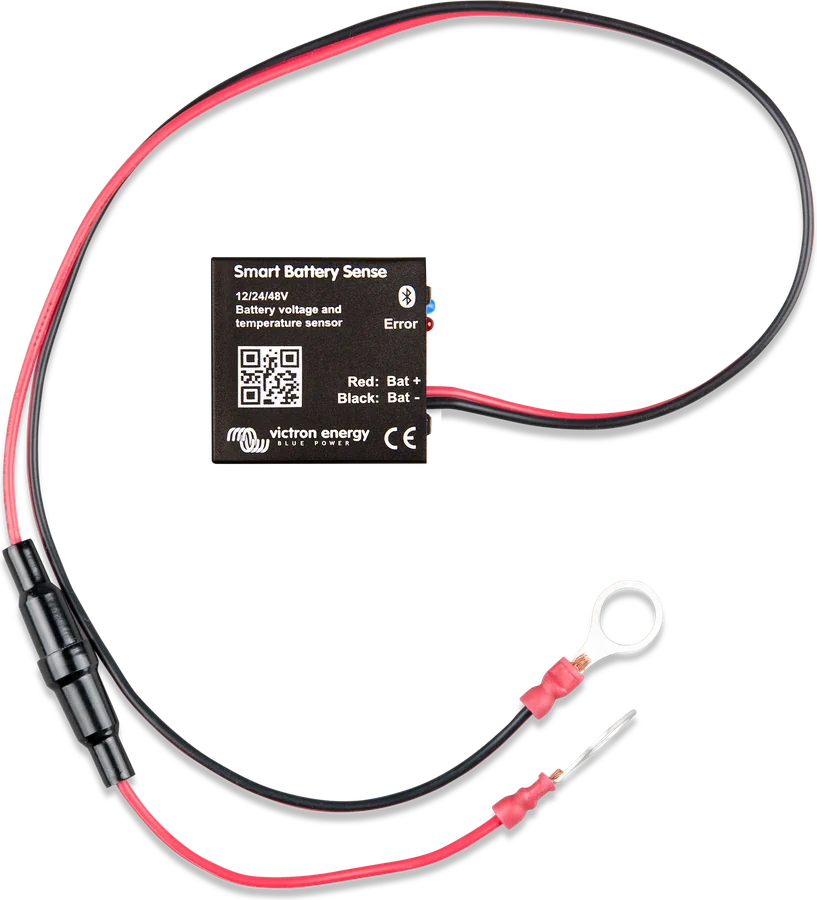
The mode is selected in the VictronConnect app. Settings are saved even after disconnecting from mains and battery. For lead-acid batteries, temperature compensation works (−16.2 mV/°C for 12 V, −32.4 mV/°C for 24 V, in the 6–50 °C range); the charger can receive a more accurate battery temperature via VE.Smart from a BMV, SmartShunt, Smart Battery Sense or VE.Bus Smart dongle.
| Mode | Absorption 12 / 24 V | Float 12 / 24 V | Storage 12 / 24 V | Recondition 12 / 24 V |
|---|---|---|---|---|
| Normal | 14.4 / 28.8 V | 13.8 / 27.6 V | 13.2 / 26.4 V | — |
| Normal + Recondition | 14.4 / 28.8 V | 13.8 / 27.6 V | 13.2 / 26.4 V | 16.2 / 32.4 V |
| High | 14.7 / 29.4 V | 13.8 / 27.6 V | 13.2 / 26.4 V | — |
| High + Recondition | 14.7 / 29.4 V | 13.8 / 27.6 V | 13.2 / 26.4 V | 16.5 / 33.0 V |
| Li-ion (LiFePO4) | 14.2 / 28.4 V | — | 13.5 / 27.0 V | — |
Recondition is only for lead-acid batteries and only when needed — frequent use shortens battery life through gassing. Storage mode switches on when the battery has not been discharged for 24 h; once a week the voltage briefly returns to absorption level. A new charging cycle starts after a mode change, power disconnection, or when the charger delivers full current for 4 s (heavy load). The datasheet describes the algorithm as 5-stage, the manual as 6-stage (3-stage for Li-ion).
For small batteries: lead-acid current should not exceed about 0.3C, and LiFePO4 about 0.5C. LOW mode limits current to 2–10 A (depending on the model). Do not charge lithium batteries below 0 °C.
Seven models, two enclosures
| Model | Current / LOW | Battery (lead-acid, min.–max.) | Li-ion battery min. | Efficiency | DC cable | Battery fuse | Enclosure |
|---|---|---|---|---|---|---|---|
| 12/7 | 7 / 2 A | 23–70 Ah | 14 Ah | 93% | 4 mm² | 10–40 A | 85 × 211 × 60 mm, 1.8 kg |
| 12/13 | 13 / 4 A | 43–130 Ah | 26 Ah | 93% | 4 mm² | 20–40 A | 85 × 211 × 60 mm, 1.8 kg |
| 12/17 | 17 / 6 A | 57–170 Ah | 34 Ah | 95% | 6 mm² | 25–50 A | 99 × 219 × 65 mm, 2.4 kg |
| 12/25 | 25 / 10 A | 83–250 Ah | 50 Ah | 95% | 6 mm² | 40–50 A | 99 × 219 × 65 mm, 2.4 kg |
| 24/5 | 5 / 2 A | 17–50 Ah | 10 Ah | 94–95% | 4 mm² | 7.5–40 A | 85 × 211 × 60 mm, 1.8 kg |
| 24/8 | 8 / 3 A | 27–80 Ah | 16 Ah | 96% | 6 mm² | 15–50 A | 99 × 219 × 65 mm, 2.4 kg |
| 24/12 | 12 / 4 A | 40–120 Ah | 24 Ah | 96% | 6 mm² | 20–50 A | 99 × 219 × 65 mm, 2.4 kg |
The maximum battery is about 10 × the charger current (≥ 0.1C), the minimum is at full current (0.3C for lead-acid, 0.5C for Li-ion; lower in LOW mode). Common: 220–240 V AC (180–265 V), 50–60 Hz (45–65 Hz), power factor > 0.6, 0.5 W idle, −20…+60 °C (full current up to 40 °C, above that −3% per °C), humidity up to 100%, aluminium RAL 5012. Efficiency 24/5: 94% in the datasheet, 95% in the manual. The start interrupt output is available on the 12/25 (1+si) and 24/12 (1+si) models: max. 0.5 A, voltage up to 1 V lower than the output, active whenever the charger is connected to mains.
Battery fuse and permanent installation
Models other than 12/25 have a fuse in the DC cable near the charger (12/7, 12/13, 24/5: 20 A in the cable; 12/17: 30 A in the cable and 35 A internal; 24/8: 20 A and 25 A; 24/12: 25 A and 30 A; 12/25: 30 A internal only). However, it only protects the section near the charger — a short circuit in the cable near the battery can overheat it and cause a fire. Therefore add a fuse or circuit breaker near the battery, according to the model table.
- Position: vertically, cables downwards, on a non-combustible surface; 100 mm free space above and below the charger. Do not place it above the battery, do not install it in a sealed compartment with the battery, and do not put anything on top of the charger.
- Screws: flat-head or flange-head (not countersunk), thread diameter about 5 mm. Hang it first on the two top screws (heads about 3 mm from the wall), then fit the bottom screws and tighten all of them.
- Permanent installation: switch off the DC installation, connect the red wire to positive and the black wire to negative, tighten to the terminal manufacturer’s torque specification. The wires can be shortened and re-crimped.
- Battery in a vehicle (temporary, negative to chassis): first red to the battery positive, then black to the body ground point — not directly to the battery negative. Disconnect in the reverse order.
- Mains: grounded socket, in accordance with local regulations. Several chargers in parallel on one bank — each with its own fuse near the busbar and the same settings.
What else it can do
Power supply mode
The “Power supply” function disables the charging logic and provides a constant, adjustable voltage — for powering loads with or without a battery. Both LEDs then stay on continuously.
VictronConnect app
Status, graph, charging history, advanced and expert settings, firmware updates, changing and resetting the PIN, disabling Bluetooth. The default PIN is on the sticker on the back (or 000000).
VE.Smart Networking
Battery temperature from BMV, SmartShunt, Smart Battery Sense or VE.Bus Smart dongle — more accurate compensation than from the charger’s internal sensor.
Fully discharged
Starts charging even at 0 V and reconnects to a lithium battery that its own BMS has disconnected.
How long charging takes
Lead-acid 100 Ah with a 10 A charger from empty: approx. 8 h bulk + up to 8 h absorption = approx. 16 h. LiFePO4 100 Ah: approx. 9.5 h bulk + 0.5 h = approx. 10 h.
Start interrupt
Models (1+si): the orange wire controls a relay (max. 0.5 A) that warns the driver or prevents starting when the vehicle is connected to mains power.
POWER and STATUS
| State | POWER (green) | STATUS (orange) |
|---|---|---|
| No power | off | off |
| Bulk | on | flashing rapidly |
| Absorption / reconditioning | on | flashing slowly |
| Float | on | on |
| Storage | on | off |
| Power supply mode | on | on |
| Error | flashing rapidly | flashing rapidly |
After bulk ends (STATUS flashes slowly), a lead-acid battery is at about 80%, a lithium battery above 95% — you can already use it. VictronConnect shows the error number; we describe the codes on the charger and MPPT codes page.
Most common questions about Blue Smart IP67
IP67, IP65 or IP22?
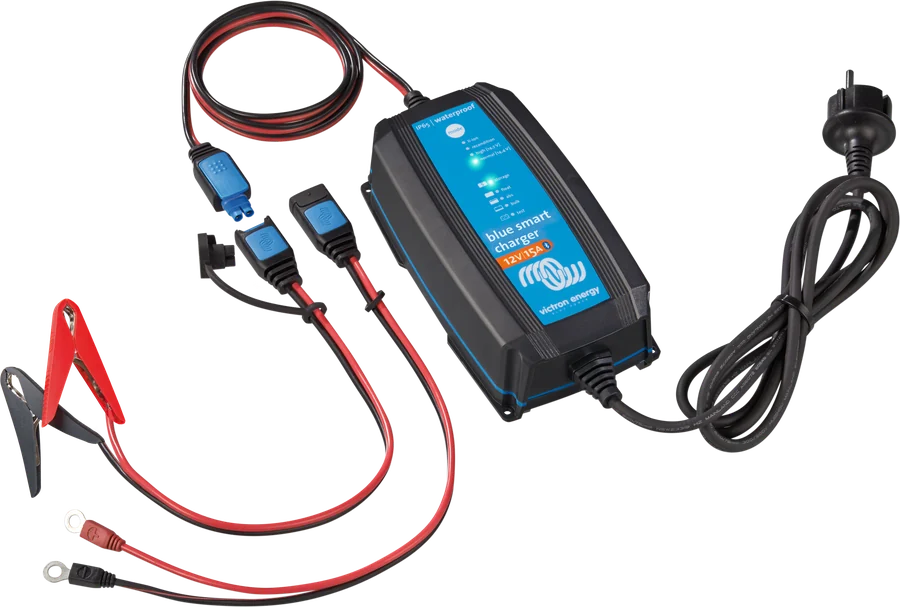
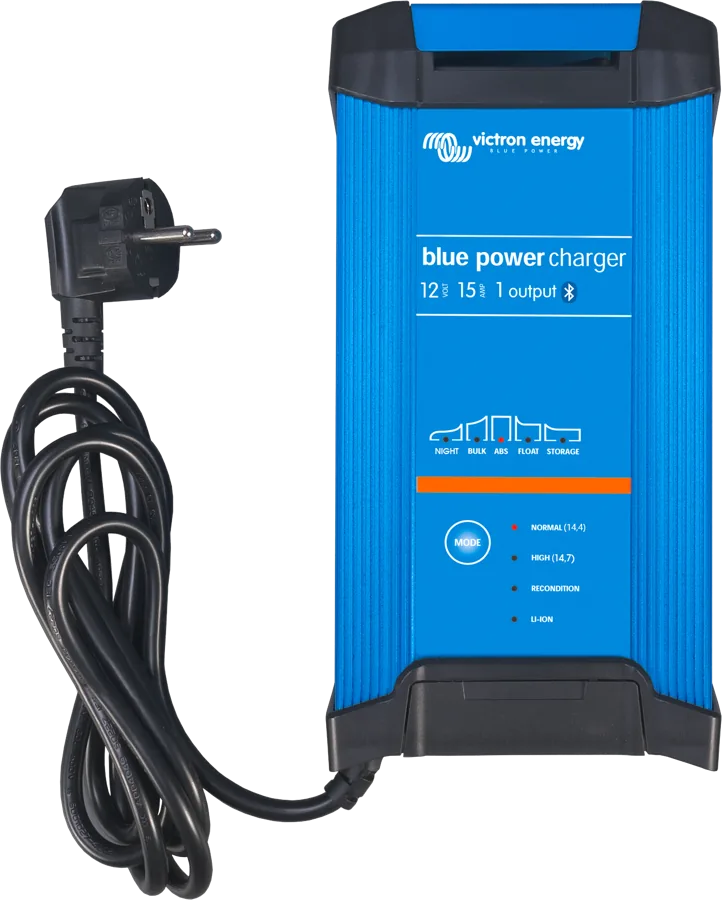
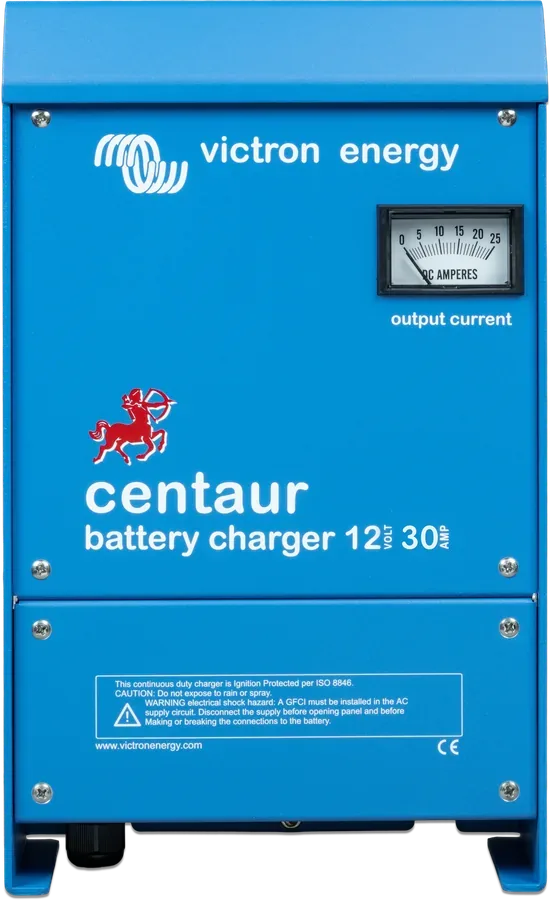
IP67 is fully sealed (resin-potted, aluminium) and intended for permanent installation in harsh conditions, up to 25 A. IP65 has a lighter IP65 housing, and IP22 is for indoor use, up to 30 A, also with three outputs. All have Bluetooth and VictronConnect.
Will it charge a LiFePO4 battery?
Yes — in Li-ion mode (14.2 V / 28.4 V, no float). Do not charge a lithium battery below 0 °C and do not exceed about 0.5C current — for a small battery, use LOW mode.
Is an additional fuse needed?
Yes, right at the battery. The fuse in the cable (or the internal one in the 12/25) is close to the charger and does not protect the cable against a short circuit at the battery. The value range for each model is given in the table.
Can it work as a power supply without a battery?
Yes — in Power supply mode the charger provides a constant, set voltage to power loads, with or without a battery.
How do you read the error number?
When both LEDs flash rapidly, connect to the charger in VictronConnect — the app will show the error code.
Content checked against Victron Energy documentation (datasheets and manuals) — status as of 23 September 2026. Report an error in the content · Correction log