

Energy balance: battery and panels
List the loads and how long they run. We will calculate daily consumption, required battery capacity and panel power for each month — using PVGIS solar data for 16 voivodeship cities.
Assumptions
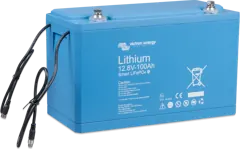 LiFePO4 Smart2500 cycles at 80% DoD
 MultiPlus-IImax. efficiency 93–96%
 Phoenix Inverter SmartECO mode: 0.6–3.2 W
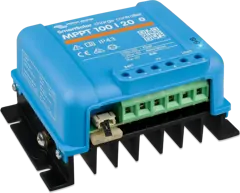 SmartSolar MPPTsolar charge controller
Consumption: power × hours × quantity. We divide 230 V loads by inverter efficiency (by default 90% for headroom — datasheets give maximum efficiency, for example MultiPlus-II 93–96%). We calculate the inverter’s no-load consumption over the full day. The value is taken from the inverter datasheet (for example, ECO mode in Inverter Smart limits consumption to 0.6–3.2 W depending on the model).
Battery: capacity (Ah) = daily consumption × days ÷ (voltage × usage). For lead-acid batteries, Victron’s “Energy Unlimited” recommends not discharging below 50%. For LiFePO4 Smart batteries, the manufacturer gives durability at 80% depth of discharge (2500 cycles), and the battery monitor recommends a discharge threshold of 10–20% — hence the default 80%.
Panels: PVGIS data (Joint Research Centre, European Commission), version 5.3, PVGIS-SARAH3 irradiation database from 2005–2023, 1 kWp installation, 14% system losses. For each month, the average daily output is given. The result is the panel power at which an average day in that month will cover consumption — on cloudy days output will be lower, so a battery and a second charging source are needed.
We describe battery and panel selection for a specific system in the guide Campervan installation from scratch.
Sources
Content checked against Victron Energy documentation (datasheets and manuals) — as of 19 September 2026. Report a content error · Revision log