
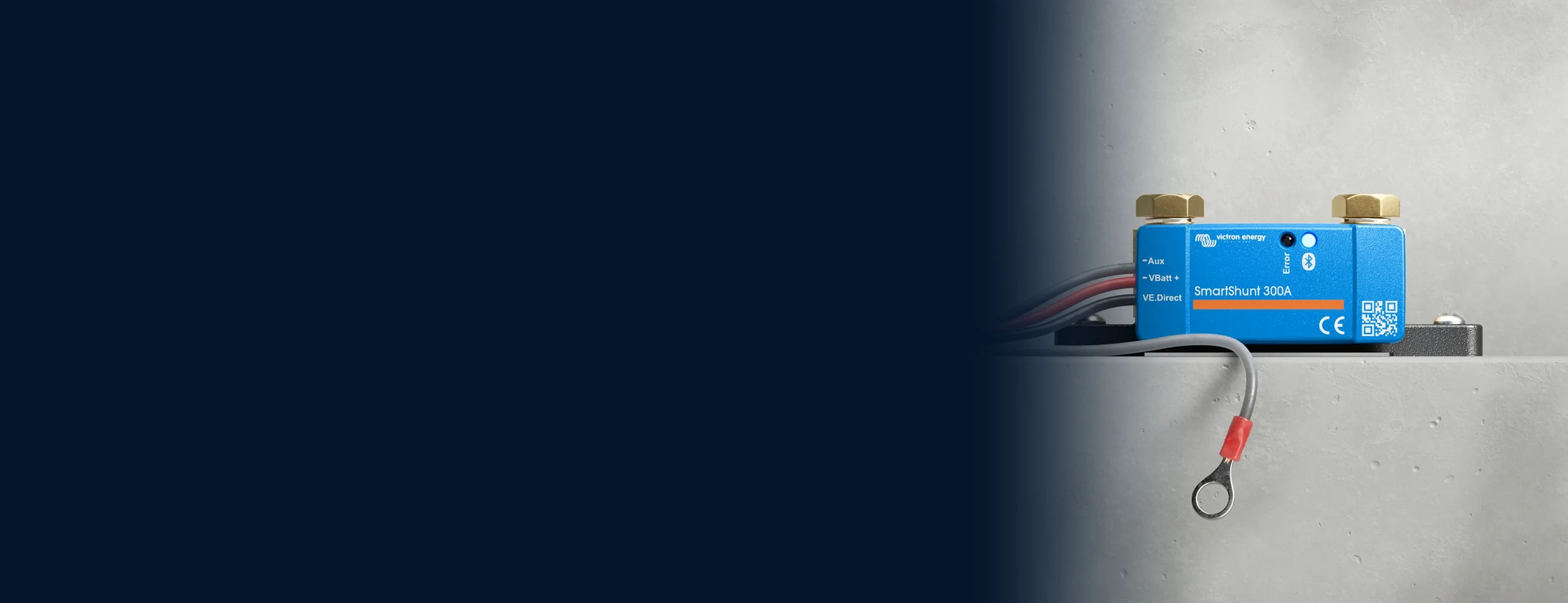
DC cable cross-section and fuse
Enter the voltage, current or power, and cable length — we will calculate the cross-section at which the voltage drop will not exceed the recommended value. Beside it: fuse sizing rules from Victron’s “Wiring Unlimited” book.
Voltage drop on the cable
 Lynx DistributorDC busbars with MEGA fuses
 SmartShunt300–2000 A shunt in the negative line
 MultiPlus-IIcross-section and fuse in the manual
 Orion XS50/70 A DC-DC charger
Cable resistance: R = ρ × l / A, where copper ρ = 1.7 × 10⁻⁸ Ω·m (0.017 Ω·mm²/m), l is the total cable length (positive and negative), and A is the cross-section. Voltage drop: U = I × R. Book example: 1.5 m of 16 mm² cable has about 1.6 mΩ, so at 200 A the drop is about 0.32 V.
Victron recommends that the voltage drop on DC cables does not exceed 2.5% (12 V: 0.3 V, 24 V: 0.6 V, 48 V: 1.2 V). Too much drop means slower charging, too low a battery voltage, power losses and cable heating. The result does not include the resistance of terminals, fuses and connections — so leave a margin.
Victron rule of thumb for cables up to 5 m (total length): cross-section in mm² ≈ current ÷ 3 (e.g. 200 A → about 66 mm²).
First, check the device manual. Victron manuals specify the recommended cable cross-section and fuse for each model (e.g. MultiPlus-II, MPPT controllers, Orion XS) — these values take priority over the calculator.
How to choose a fuse
“Wiring Unlimited” lists the criteria: rated current, rated voltage, breaking capacity, speed and type.
- Current: for a single load, choose the fuse to match the current of that load or the cable’s current-carrying capacity — whichever is lower. For several loads on one circuit, size it to the cable’s current-carrying capacity.
- Voltage: equal to or higher than the maximum voltage in the system, and for direct current (DC). Most DC fuses are suitable for 12 and 24 V, but not necessarily for 48 V. DC circuit breakers may be one-way — how they are connected matters.
- Speed: in DC circuits with motors or devices with capacitors (e.g. an inverter), time-delay fuses are usually used to withstand a short starting current.
- Breaking capacity (lithium batteries): lithium batteries can deliver a very high short-circuit current. In any installation with a lithium battery, at least one fuse in the DC line must have a breaking capacity equal to or greater than the maximum expected short-circuit current of the battery bank — this is a mandatory safety requirement.
| Fuse (according to “Wiring Unlimited”) | Max. DC voltage | Interrupting capacity |
|---|---|---|
| Class T (Eaton Bussmann) | 160 V | 200 kA |
| Class T (various manufacturers) | 125–300 V | 20 kA |
| NH (various manufacturers) | 250 V | 25 kA |
| ANL (Blue Sea) | 80 V | 6000 A |
| AMX(L) (Eaton Bussmann) | 125 V | 3000 A |
| MEGA (Littelfuse, 70 V) | 70 V | 2500 A |
| MRBF (Blue Sea) | 58 V | 2000 A |
| MEGA (Littelfuse, 58 V) | 58 V | 1000 A |
Values copied from the table in “Wiring Unlimited”; before buying, check the datasheet for the specific fuse. More in the guide Cable cross-sections and DC fuses.
Sources
Content checked against Victron Energy documentation (datasheets and manuals) — as of 19 September 2026. Report a content error · Revision log