

01What the controller name means
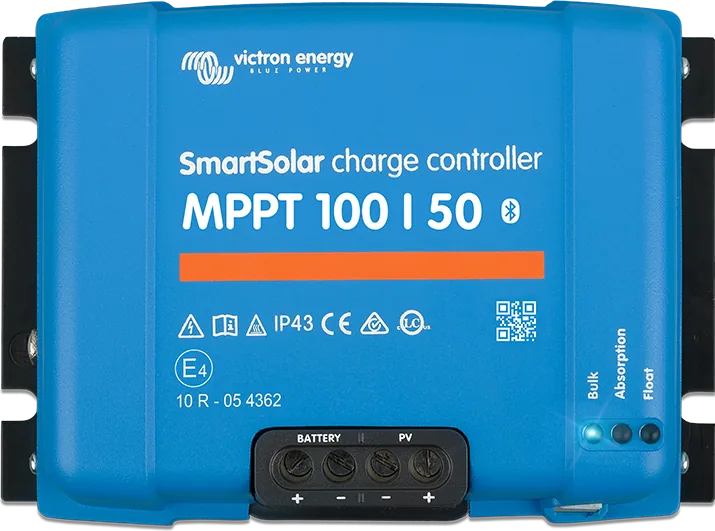
In the SmartSolar MPPT 100/50 name, the first number is the maximum panel voltage (100 V), the second is the maximum battery charge current (50 A). An MPPT controller can charge a lower-voltage battery from higher-voltage panels and automatically adapts to the battery voltage.
02Four checks
- Voltage in frost. Add the Voc of panels connected in series and recalculate for the lowest temperature that may occur (for example a frosty, sunny morning): Voc(T) = Voc × number of panels in series × (1 + Voc coefficient / 100 × (T − 25 °C)). The result must be below the controller’s maximum voltage. Victron recommends leaving at least a 10% voltage margin and, in a cool climate, recalculating Voc for the lowest expected temperature. Exceeding the voltage can permanently damage the controller and is not covered by the warranty.
- Short-circuit current. With parallel strings, the currents add up: Isc(T) = Isc × number of strings × (1 + Isc coefficient / 100 × (T − 25 °C)), calculated for the highest panel temperature. The total must not exceed the PV short-circuit current limit in the controller datasheet.
- Voltage in heat. Panel operating voltage (Vmp) drops at high temperature. The controller starts charging when panel voltage is 5 V above battery voltage, and keeps charging as long as panel voltage is at least 1 V higher — at 24 V, one “12-volt” panel in the heat may not be enough.
- Power. Every controller has a nominal power rating that depends on battery voltage (for example, 100/50: 700 W at 12 V, 1,400 W at 24 V). More panel power is allowed only if the configuration still meets the Voc and maximum PV short-circuit current limits; then the controller will limit input power. The official Victron calculator marks an array above 130% of nominal power as oversized.
Open-circuit panel voltage (Voc) rises as temperature falls below 25 °C — by the percentage per degree given by the Voc temperature coefficient in the panel datasheet. With Victron BlueSolar panels (−0.35%/°C), at −20 °C this is about 16% more than the catalogue value.
03Quick rule from the manual
| Setup | Minimum cells in series | Recommended | Maximum |
|---|---|---|---|
| 12 V battery, 75 V controller | 36 (1 × “12 V” panel) | 72 (2 × 12 V panel or 1 × 24 V panel) — controller’s highest efficiency | 108 (3 × 12 V panel) |
| 24 V battery, 100 V controller | 72 (2 × 12 V panel or 1 × 24 V panel) | — | 144 (4 × 12 V panel) |
According to the SmartSolar MPPT 75/10–100/20 manual. The manual notes that when calculating panels in series you must still take Voc and its temperature coefficient into account — below 25 °C, Voc rises.
04Example 1: 12 V campervan, two 400 W panels
Panel: 400 W, Voc 37 V, Isc 13.5 A, Vmp 31 V, Voc coefficient −0.35%/°C, Isc +0.05%/°C (example data — use your own from the nameplate). Connection: 2 in series. Temperatures: −20 °C in frost, 60 °C heated panel.
| Check | Calculation | Result |
|---|---|---|
| Voc at −20 °C | 2 × 37 V × (1 + (−0.35/100) × (−45)) = 74 × 1.1575 | 85.7 V — the 75 V controller is out; 100 V fits with a 14% margin |
| Isc at 60 °C | 13.5 A × (1 + (0.05/100) × 35) | 13.7 A |
| Vmp at 60 °C | 2 × 31 V × (1 + (−0.35/100) × 35) | 54.4 V — well above 12 V + 5 V |
| Power | 2 × 400 W | 800 W |
Choice at 12 V: 100/20 (290 W nominal power) would use only about 36% of the power. 100/30 (440 W) is 182% of nominal power — well above the 130% threshold. SmartSolar 100/50 (700 W at 12 V, Isc up to 60 A) is 114% — at peak it will barely limit the power. This is the same conclusion as in the SmartSolar MPPT datasheet.
05Example 2: 24 V cabin, six 400 W panels
The same panels, connected 3 in series × 2 parallel strings, 24 V battery.
| Check | Calculation | Result |
|---|---|---|
| Voc at −20 °C | 3 × 37 V × 1.1575 | 128.5 V — a 150 V controller is needed (below its 145 V max start and operating voltage) |
| Isc at 60 °C | 2 × 13.5 A × 1.0175 | 27.5 A |
| Vmp at 60 °C | 3 × 31 V × 0.8775 | 81.6 V |
| Power | 6 × 400 W | 2400 W |
Choice at 24 V: 150/60 (1,720 W at 24 V) is 140% — oversizing according to the Victron calculator. SmartSolar 150/70 (2,000 W) is 120%, and 150/85 VE.Can (2,400 W) is 100%. The 27.5 A short-circuit current is within the 50 A limit for the 150/70.
Why not 2 × 3 the other way round (2 in series × 3 parallel)? Voc in frost would drop to 85.7 V (a 100 V controller would be enough), but short-circuit current would rise to about 41 A, and 100 V controllers at 24 V have a maximum nominal power of 1,400 W (100/50). A higher string voltage also means lower current and thinner cables from the panels.
06What else to watch for
- PV and battery circuits are dangerous: the DC (PV) input is not isolated from the battery circuit, so the PV, battery and control circuits should not be accessible to the user; do not mount the controller where the user can access it.
- Do not use panels with optimisers — according to the manual, they may permanently damage the controller.
- Do not earth the positive or negative of the panel array; the panel frame may be earthed. Only one system earth — at the battery.
- PV isolator: it must be possible to disconnect all conductors of the panel array from the rest of the installation. On start-up, connect the battery first and wait 10 s, then connect DC loads and PV. You may connect PV first only when the system voltage has been set manually before connecting the battery — otherwise you can switch off or damage the controller or the installation.
- MPPT RS and Multi RS Solar: an extra condition — array Voc must be less than 8 × battery voltage at float (at 54 V float: 432 V). See off-grid cabin.
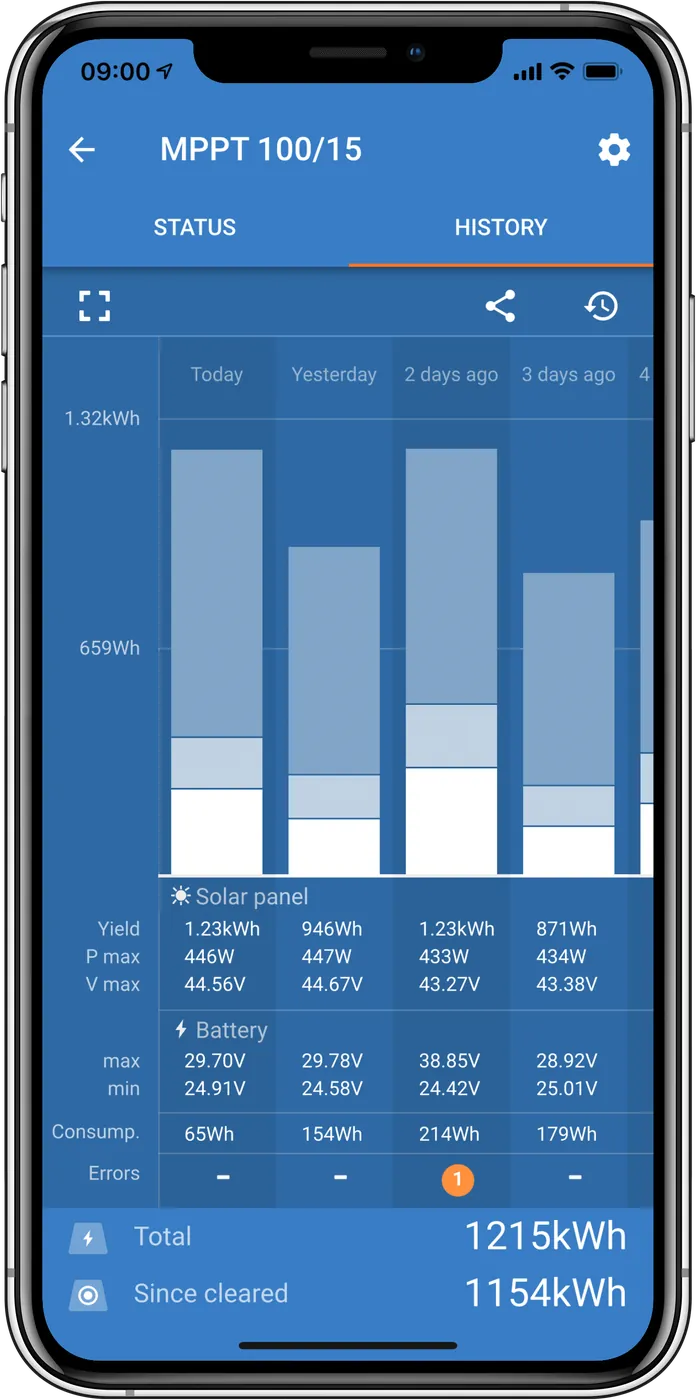
- Not enough sun? The history in VictronConnect will show whether the controller reaches float stage — if it never does, the array may be too small or the loads too large. How much energy panels will produce in Poland in a given month: energy balance.
Devices in this guide
 SmartSolar MPPT 75/10–100/20Small solar controllers with Bluetooth for campervans, boats and cabins.
 SmartSolar MPPT 100/30 and 100/5030 and 50 A controllers for up to 100 V from panels — at 12 V for about 440 and 700 W of panels.
 SmartSolar MPPT 150 and 250 V35–100 A controllers for higher panel voltages: 150 V and 250 V, Tr, MC4 and VE.Can versions.
 SmartSolar MPPT RS 450Isolated controller for up to 450 V from panels for 48 V battery banks.
 Multi RS SolarInverter/charger 48 V, 6 kVA, with two 450 V MPPT trackers — a hybrid for an off-grid cabin and 48 V systems.