
01First check
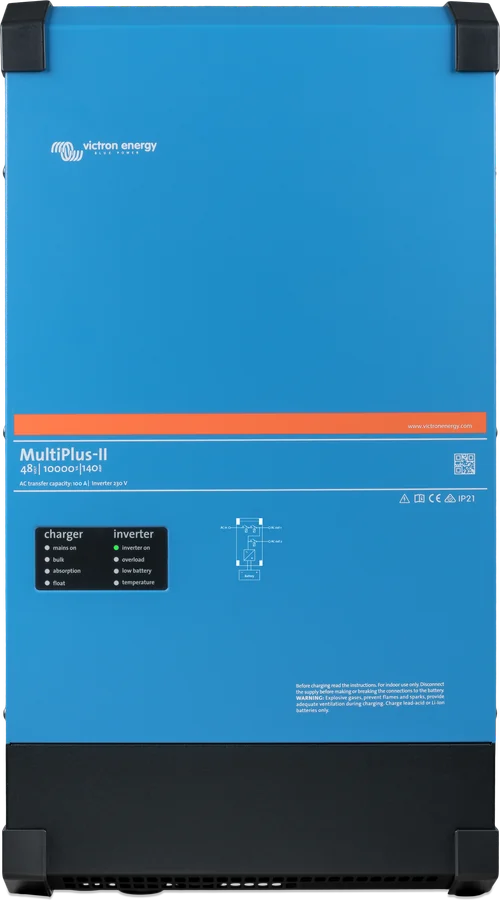
- Which LEDs are on or flashing — compare with the LED decoder. An inverter LED on means the inverter is supplying the load.
- PowerAssist is not an overload. Mains on LED on and inverter LED flashing: the inverter is switched on to add the missing current from the battery because the AC source is not enough.
- PowerControl is not an overload. Mains on LED flashing: AC output current equals the set limit, charge current has dropped to 0 A.
- No voltage at AC-out-2 when running on battery is normal. AC-out-1 is uninterrupted. AC-out-2 disconnects the load immediately after switching to battery and reconnects about 2 minutes after AC appears on AC-in-1.
- Compare loads with continuous power in watts at the given temperature, not only with VA. In the MultiPlus-II 3 kVA at 25 °C, continuous power is 3000 VA and 2400 W.
The inverter’s rated output is given separately in VA and W. At 40 °C and 65 °C, continuous power in watts is lower — see the table below.
02Diagnostic steps
1Is the overload LED flashing and low battery off?
According to the MultiPlus-II manual, a flashing overload LED is an early warning: the inverter’s rated output has been exceeded. The inverter is still operating.
Reduce the load. Check whether the total of the loads exceeds the continuous power in watts at the device’s ambient temperature (at 40 °C and 65 °C it is lower than at 25 °C). Peak power is higher than continuous power, but the manual does not state how long it may be drawn.
If the overload LED is on steadily or together with low battery, move on to the next steps.
2Is the overload LED on steadily and low battery off?
A steady overload LED means the inverter has shut down due to overload or short circuit. The load is above the rated value.
Reduce the load. Remove the overload or short circuit on AC-out-1 or AC-out-2 and reset the fuse or circuit breaker. Internal fuses are not user-replaceable.
Go to step 3 — battery terminal ripple gives a different LED combination.
3Are overload and low battery flashing alternately or together, or both on?
Distinguish the flashing pattern: overload and low battery flashing alternately — the battery is nearly empty and the inverter’s rated output has been exceeded; flashing together — battery terminal voltage ripple too high; both on steadily — shutdown due to excessive ripple. Separately: low battery flashing on its own is an early low-battery warning (the battery is nearly empty).
Alternating flashes: the battery is nearly empty and the inverter’s rated output has been exceeded — charge the battery, disconnect or reduce the load, or use batteries with greater capacity and shorter or thicker cables. Flashing together: battery terminal voltage ripple too high — check the battery cables and connections and whether the battery capacity is sufficient; increase it if needed. Both on steadily: the inverter has shut down due to excessive ripple — use batteries with greater capacity, shorter or thicker cables, and reset the inverter by switching it off and on again. The inverter will not start when battery voltage is outside the range — in the MultiPlus-II: 9.5–17 V (12 V), 19–33 V (24 V), 38–66 V (48 V).
Before working on the connections: switch off AC power and disconnect the battery. Work must be carried out by qualified personnel. Use a torque wrench with an insulated socket so you do not short the battery; avoid short-circuiting the battery cables. The recommended torque for M8 nuts is 12 Nm. Route the battery cables as close to the battery as possible; do not run them in a closed conduit. For the MultiPlus-II 3 kVA, the manual gives the DC fuse and cross-section for 0–5 m: 12/3000/120 — 400 A and 2 × 50 mm²; 24/3000/70 — 300 A and 50 mm²; 48/3000/35 — 125 A and 35 mm².
If the overload + low battery pair does not occur, check the temperature LED (step 4).
4Is the temperature LED flashing or on?
A flashing temperature LED means an early warning: the internal temperature is nearing the critical level. A steady temperature LED means the inverter has shut down because the temperature is too high.
Install the device in a cool, well-ventilated place or reduce the load. The place should be dry and as close to the battery as possible. At 40 °C and 65 °C, continuous power is lower than at 25 °C — see the table.
If the alarm LEDs are off and the problem is no changeover to mains, go to step 5.
5Does it not switch to mains or generator?
Failure to switch to the AC source can be caused by overload or a short circuit on the output, not just by the inverter limit itself.
Remove the overload or short circuit on AC-out-1 or AC-out-2 and reset the fuse or circuit breaker. Broader mains acceptance diagnostics: MultiPlus does not accept mains.
Read the other LEDs in the LED decoder. If the GX device shows a VE.Bus code, check it in the VE.Bus error codes.
03Continuous and peak power
The figures below come from the MultiPlus-II 230 V manual (Rev 14). In the 3 kVA and 5 kVA classes, the power is the same for 12 V, 24 V and 48 V. The 8 kVA, 10 kVA and 15 kVA models in this manual are 48 V units.
| Class | Continuous 25 °C | Continuous 40 °C | Continuous 65 °C | Peak |
|---|---|---|---|---|
| 3 kVA | 3000 VA / 2400 W | 2200 W | 1700 W | 5500 W |
| 5 kVA | 5000 VA / 4000 W | 3700 W | 3000 W | 9000 W |
| 8 kVA | 8000 VA / 6400 W | 5500 W | 4000 W | 15000 W |
| 10 kVA | 10000 VA / 8000 W | 7000 W | 6000 W | 18000 W |
| 15 kVA | 15000 VA / 12000 W | 10000 W | 7000 W | 27000 W |
MultiPlus (Version 31) is a separate series: for the 3 kVA models, peak power is 6000 W, IP20 rating. MultiPlus-II 3 kVA: 5500 W and IP22. Use the values from your model’s manual.
Devices this applies to
 MultiPlus-IIInverter/charger with UPS function: pure 230 V sine wave, PowerAssist supports a weak shore connection.
 MultiPlusInverter/charger 800 VA–20 kW: PowerAssist, UPS under 20 ms, parallel and three-phase operation.
 Quattro-IIInverter/charger with two AC inputs — mains and generator without an external changeover switch.
 EasySolar-II GXMultiPlus-II, 250 V MPPT controller and GX device factory-connected in one enclosure — 3 or 5 kVA.
What next
LED meaning: LED decoder. VE.Bus codes: VE.Bus error codes. Model specifications: MultiPlus-II and MultiPlus (800 VA–3 kVA).