
Battery bank
Enter the system voltage, battery and the required capacity or energy. We will calculate how many batteries to connect in series and parallel, check the limits from the Victron manual and give the connection rules.
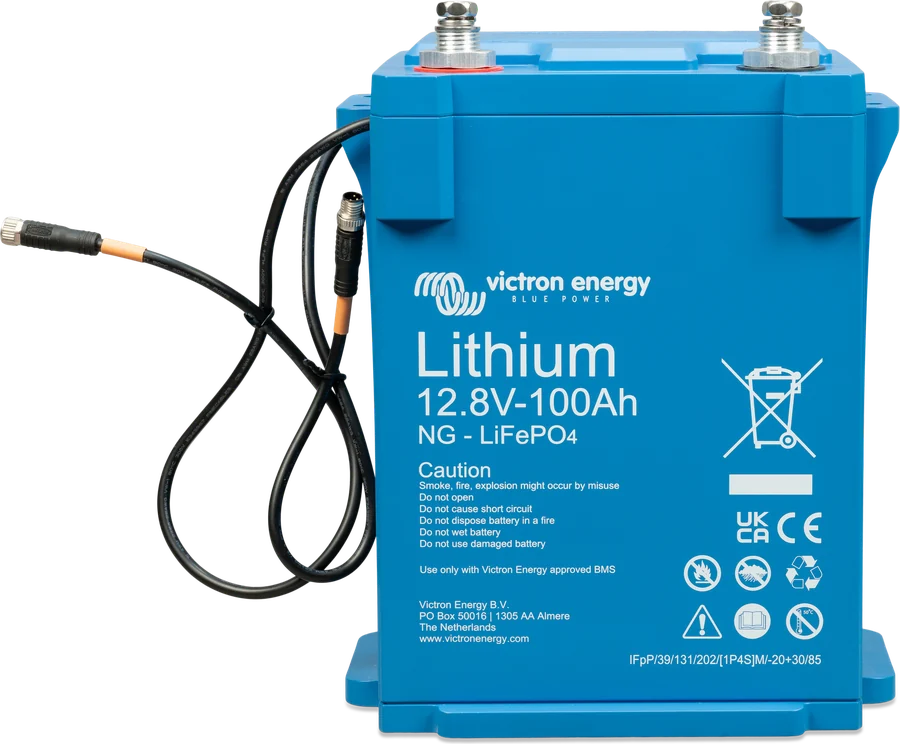
Assumptions
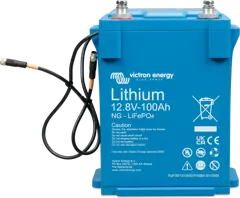 Lithium NG12.8 / 25.6 / 51.2 V
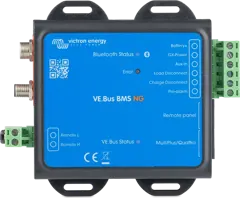 VE.Bus BMS NGwith MultiPlus or Quattro
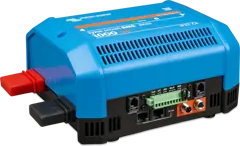 Lynx Smart BMS / NGlarger systems, contactor
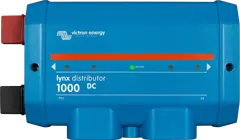 Lynx Distributorfuse on each battery
System: according to “Wiring Unlimited”, a series connection increases voltage, while a parallel connection increases capacity. The number of batteries in series = installation voltage ÷ battery voltage (12.8 V for every 12 V of installation voltage in lithium batteries). The number of parallel branches = required capacity ÷ battery capacity, rounded up. We convert energy in kWh to Ah at the nominal bank voltage (for example, 25.6 V).
Manual limits: Lithium NG 12.8 and 25.6 V — up to 50 batteries in a system, Lithium NG 51.2 V — up to 25 and parallel only, Lithium Smart — up to 20 batteries. In series, a maximum of 4 × 12.8 V or 2 × 25.6 V. The VE.Bus BMS V2 manual recommends as few batteries in series as possible, meaning a 24 V bank made from 25.6 V batteries, and 48 V from two 25.6 V batteries.
Cables and fuses: a fuse on the positive terminal of each battery (branch), a main fuse, system cables laid diagonally, and their cross-section equal to the battery cable cross-section multiplied by the number of batteries (branches). We discuss fuse ratings and Victron diagrams in the guide Connecting batteries into a bank.
What the calculator does not check: the battery’s continuous current against the inverter and chargers (see inverter selection), permitted discharge, or temperature. You can calculate how much energy you need per day in the energy balance.
Sources
Content checked against Victron Energy documentation (datasheets and manuals) — status as of 23 September 2026. Report an error in the content · Correction log