
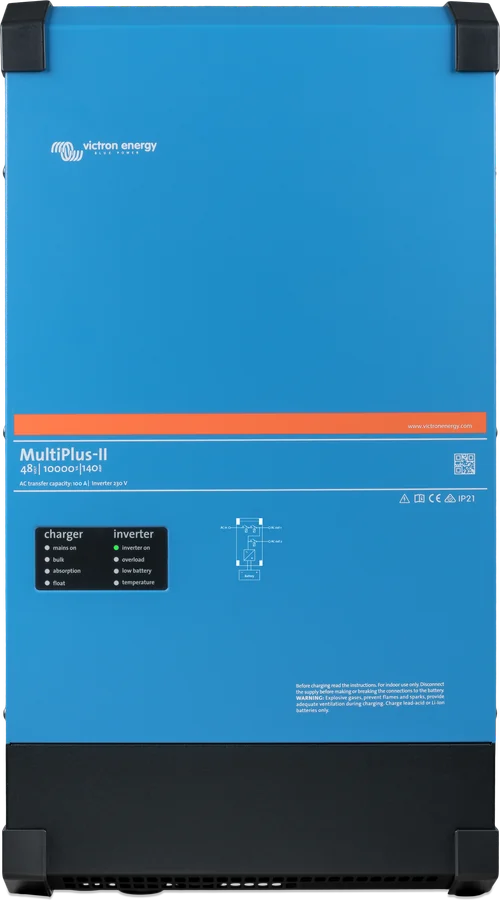
01Inverter or inverter/charger
An inverter (for example Phoenix Inverter Smart) only converts battery power to 230 V. An inverter/charger, such as MultiPlus-II, combines a pure sine wave inverter, a battery charger and a transfer switch in one housing: when mains or a generator is present at the input, it supplies the loads from that source and charges the battery, and when the supply disappears, it takes over the loads so quickly that computers and other electronics do not notice the break. If the installation will ever work with a campsite hook-up, marina shore power or a generator, choose an inverter/charger.
02Continuous power: VA, watts and temperature
In the name MultiPlus-II 12/3000/120-32, the second number is the power in volt-amperes (3000 VA), not watts. The manual gives continuous power separately in watts and depending on ambient temperature:
| Model | Continuous power | at 25 °C | at 40 °C | at 65 °C | Peak power |
|---|---|---|---|---|---|
| MultiPlus-II 3 kVA (12, 24 and 48 V) | 3000 VA | 2400 W | 2200 W | 1700 W | 5500 W |
| MultiPlus-II 5 kVA (12, 24 and 48 V) | 5000 VA | 4000 W | 3700 W | 3000 W | 9000 W |
For comparison with loads, use the power in watts, and at the temperature at which the inverter really operates: in summer in a closed campervan cabinet it is closer to 40 °C than to 25 °C. The power in VA is higher because it refers to apparent power.
03Peak power and starting
Motor loads — fridge compressors, pumps, power tools — draw briefly more at start-up than during normal operation. These short peaks are covered by peak power: 5500 W in the 3 kVA model and 9000 W in the 5 kVA model. Long operation above continuous power is overload — the inverter will report it with the “overload” LED and will eventually switch off (see “MultiPlus reports overload”).
Peak power is also the highest DC-side current. “Wiring Unlimited” gives an example: a 3000 VA inverter with a 6000 W peak power at 12 V draws 500 A — the battery monitor shunt is sized for that current, and the cables and fuse are selected according to the inverter manual.
04How to calculate the load
You calculate the total power of the loads that may run at the same time, not of everything you have in the house or vehicle. The ESS manual gives an example of a grid-connected house: a 3000 VA inverter/charger will supply most household appliances, as long as no more than one runs at once. If the inverter is to supply backup circuits or runs off-grid, size it for the loads that need to operate at the same time.
Example with sample values — use the ratings from your own nameplates:
| Step | Calculation | Result |
|---|---|---|
| Loads running together | 1500 W + 400 W + 200 W | 2100 W |
| MultiPlus-II 3 kVA at 25 °C / 40 °C | 2400 W / 2200 W | fits, but in hot weather the margin is only 100 W |
| Battery current at 12 V | 2100 W ÷ (12 V × 0.93) | approx. 188 A — at the maximum efficiency of 93% from the manual; in practice, more |
How much energy these loads will use in a day, and how large a bank will cover it, can be calculated in the energy balance calculator. Examples with complete installations: camper van, work van and home with energy storage.
05System voltage: 12, 24 or 48 V
“Wiring Unlimited” gives the recommended maximum inverter power for each voltage: 12 V — up to 3000 VA, 24 V — up to 5000 VA, 48 V — from 5000 VA upwards. The reason is current: the same 2400 W load draws 200 A at 12 V, 100 A at 24 V, and 50 A at 48 V. Lower current means smaller cables and less voltage drop. If some loads or chargers run only on 12 V, the manual recommends a DC-DC converter instead of lowering the voltage of the whole installation.
06Bank, fuse and cables for the model
The MultiPlus-II manual gives the recommended battery capacity, DC fuse and cable cross-section for each model (per pole, for battery-to-inverter distance):
| Model | Charger | Bank | DC fuse | 0–5 m cables | 5–10 m cables |
|---|---|---|---|---|---|
| 12/3000/120-32 | 120 A | 400–1200 Ah | 400 A | 2 × 50 mm² | 2 × 70 mm² |
| 24/3000/70-32 | 70 A | 200–700 Ah | 300 A | 50 mm² | 95 mm² |
| 48/3000/35-32 | 35 A | 100–400 Ah | 125 A | 35 mm² | 70 mm² |
| 12/5000/220-50 | 220 A (rated) | 600–2400 Ah | 600 A | 2 × 95 mm² | 2 × 150 mm² |
| 24/5000/120-50 | 120 A | 400–1400 Ah | 400 A | 2 × 50 mm² | 2 × 70 mm² |
| 48/5000/70-50 | 70 A | 200–800 Ah | 200 A | 70 mm² | 120 mm² |
Discrepancy in the manual: in the technical data table for model 12/5000/220-50, the charge current is listed as 50 A, although the third number in the model name (220) indicates the charger current, and for the other models the table matches the name. Do not run cables in enclosed ducts; for the cross-sections of the other circuits, see the guide cable cross-sections and DC fuses.
The rule is simple: the larger the inverter at the same voltage, the larger the minimum bank. A MultiPlus-II 12/3000 needs at least 400 Ah at 12 V, while the 48/3000 model with the same power needs 100 Ah at 48 V.
07PowerControl and PowerAssist
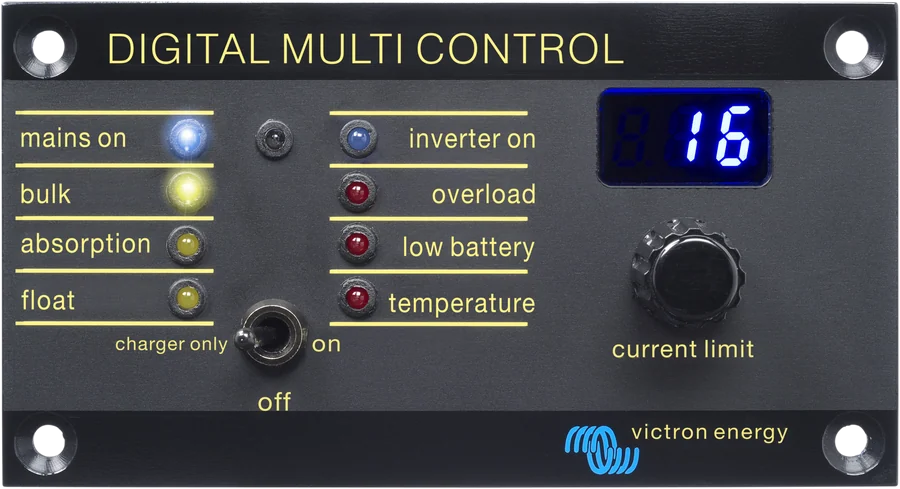
The MultiPlus charger can draw a high current from the grid, and a campsite hook-up or a small generator has its limits. That is why the inverter has an input current limit — set with the knob on the Digital Multi Control panel or in the configuration. For the 3 kVA model the range is 4–32 A, for the 5 kVA model 6–50 A.
- PowerControl — the charger takes account of the loads and charges the battery only with the current left over, so as not to exceed the limit.
- PowerAssist — when the loads want more than the source can provide, the inverter immediately adds the missing power from the battery. When the load drops, the surplus returns to charging. Example from the manual for the 3 kVA model: the inverter adds up to 3 kVA, i.e. 13 A, so with a 32 A limit the output can deliver 32 + 13 = 45 A — the output cables and protection are selected for that total.
- Inverter generator — such generators slow down at low load, and with a sudden increase in power their voltage drops sharply. The “dynamic current limiter” setting makes the MultiPlus add power itself first, and lets the generator take over gradually, up to the set limit.
- Input limitOn the Digital Multi Control panel you set how much current may be drawn from the hook-up or generator — on the 3 kVA model, 4–32 A.
- PowerControlThe charger takes only the current left over after the loads.
- PowerAssistWhen the loads want more than the limit, the inverter adds power from the battery: with a 32 A mains input, the output will deliver 32 + 13 = 45 A.
- AC-out-2Circuits that operate only on mains — disconnected immediately when running from the battery.
08Two outputs and source switching
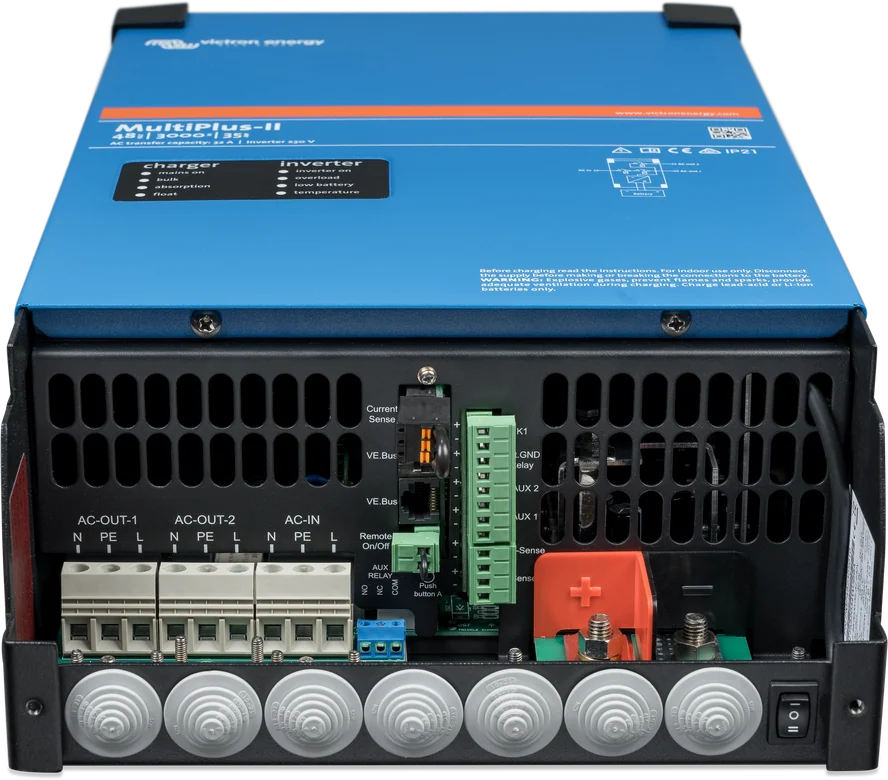
- AC-out-1 always works — from mains or from the inverter. On the output, the manual requires an RCD and protection matched to the load; type A is sufficient, because the transformer in the inverter prevents DC on the AC terminals.
- AC-out-2 (32 A in the 3 and 5 kVA models) disconnects immediately when the inverter switches to battery, and reconnects about 2 minutes after voltage appears at the input — so that the generator has time to stabilise. This is the place for a water heater or air conditioner that makes no sense on battery.
- AC input is protected by a fuse or circuit breaker rated at up to 32 A (3 kVA) or 50 A (5 kVA), lower with a weaker source. That is also the maximum pass-through current.
- UPS function switches to inverter operation with practically no interruption. With generators with unstable voltage, the MultiPlus may keep switching to battery — the manual then recommends turning off the UPS function.
09No-load consumption: AES and Search modes
An inverter that is on draws current even with no loads. In a battery-only installation this is a real item in the balance. For the MultiPlus-II 3 kVA, the manual gives:
| Mode | 12 V | 24 V | 48 V | How it works |
|---|---|---|---|---|
| Normal operation with no load | 13 W | 13 W | 11 W | — |
| AES | 9 W | 9 W | 7 W | about 20% less by slightly “narrowing” the sine wave; only when running a single device |
| Search | 3 W | 3 W | 2 W | about 70% less: with no load the inverter switches off and checks every 2 s whether something has switched on; by default it switches off below 40 W, and switches on from 100 W |
13 W around the clock is about 0.3 kWh. Search is not suitable for small loads running continuously, such as a phone charger — below the threshold the inverter simply will not supply them.
10When one inverter is not enough
- Larger model — the MultiPlus-II 5 kVA provides 4000 W continuous power at 25 °C, but at 12 V it requires a 600–2400 Ah bank and a 600 A fuse. According to the “Wiring Unlimited” recommendation, that power is already more suitable for a 24 V or 48 V installation.
- Parallel operation — up to six identical units on a common battery, with DC cables of the same length and cross-section, side by side with at least 10 cm of free space. The 8, 10 and 15 kVA models are not connected in parallel without an external switch.
- Three phases — three devices are configured as a three-phase star connection; they are not suitable for delta connection. Example of such an installation: three-phase home battery storage system.
Devices in this guide
 MultiPlus-IIInverter/charger with UPS function: pure 230 V sine wave, PowerAssist supports a weak shore connection.
 MultiPlusInverter/charger 800 VA–20 kW: PowerAssist, UPS under 20 ms, parallel and three-phase operation.
 MultiPlus-II GXMultiPlus-II with built-in GX device, display and Wi-Fi — VRM without a separate Cerbo.
 Quattro-IIInverter/charger with two AC inputs — mains and generator without an external changeover switch.
 Inverter Smart (Phoenix)Stand-alone 1600–5000 VA inverter with Bluetooth and ECO mode — without a charger.
 Digital Multi ControlWall panel for MultiPlus and Quattro: switch, shore or generator current-limit knob, LEDs and error codes.
Sources
- MultiPlus-II 230V manual — function description, DC cables and fuses, AC wiring, settings (PowerAssist, AES, Search, UPS), technical datavictronenergy.com · PDF · EN
- Wiring Unlimited (rev 04) — system voltage versus inverter power, voltage drop, peak currentvictronenergy.com · PDF · EN
- ESS design and installation manual, section 2.3 — inverter/charger sizevictronenergy.com · EN