
Charging from the alternator
Enter the installation voltage, alternator current and house battery. We will calculate how much current you can safely take from the alternator, what current the battery will accept, which Victron DC-DC charger model fits and how many Ah you will top up while driving.
Assumptions
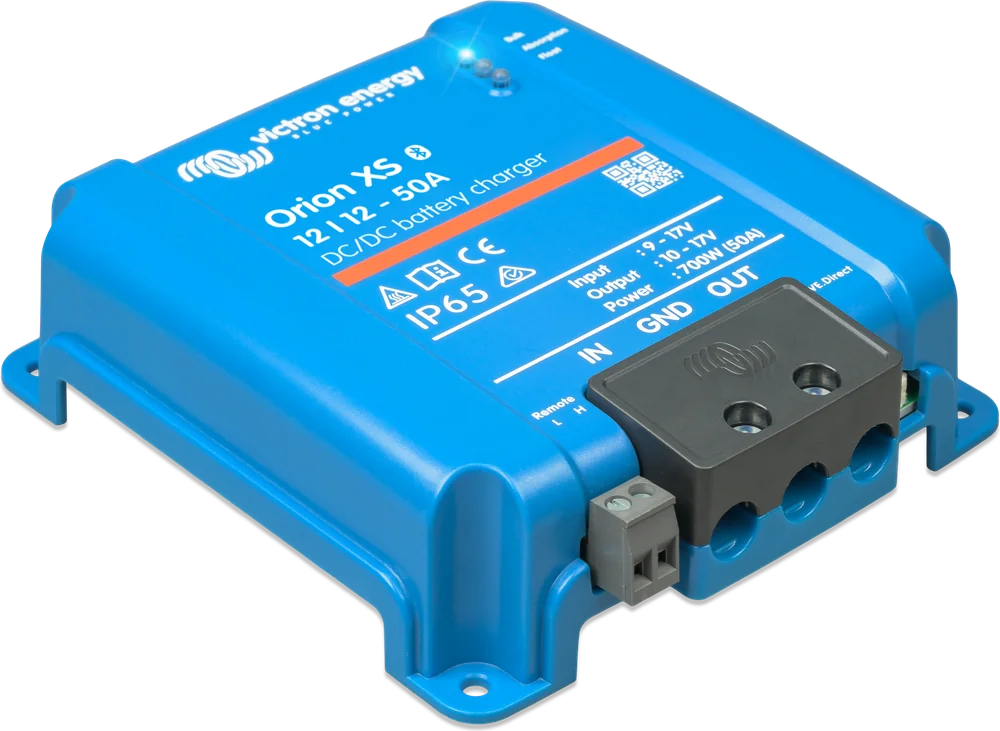
 Orion XS50 and 70 A, XS 1400 · Bluetooth
 Orion-Tr Smartisolated and non-isolated
 Buck-Boost25, 50 and 100 A · TSConfig
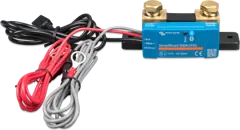 SmartShuntbattery state of charge
How much from the alternator: the Buck-Boost converter manual recommends setting the charger’s maximum current to no more than 60% of the vehicle alternator current — the alternator also powers the vehicle itself. We apply this rule to the current the charger draws from the alternator. When the voltage changes (for example 12 V → 24 V), we calculate input current from power: charge current × charge voltage (14.4 / 28.8 / 57.6 V) ÷ (alternator voltage 14 / 28 V × 90% efficiency).
How much the battery accepts: typically up to about 0.5C for LiFePO4 and about 0.3C for lead-acid batteries (Victron Blue Smart charger manual). The datasheet for the specific battery takes priority.
Models: output currents from the Orion XS datasheets (12/12-50A, 12/12-70A, XS 1400), Orion-Tr Smart (isolated and non-isolated) and Buck-Boost 25/50/100 A for the given voltage pair. Orion XS and Orion-Tr Smart can be connected in parallel — the calculator suggests this when several smaller units will provide more current than one. Orion XS and Orion-Tr Smart also let you set a lower current in VictronConnect.
Charging time: as in the charging time calculator — bulk phase to about 95% (LiFePO4) or 80% (lead-acid) = missing Ah ÷ charge current. At idle the alternator may deliver only about 50% of its power (Orion XS support page), so charging can be slower when stationary.
What the calculator does not check: cables and fuses (tables for each model are on the Orion XS, Orion-Tr Smart and Buck-Boost datasheets; you can also calculate cable cross-section in the cable calculator), engine running detection or battery temperature. With a LiFePO4 battery, Buck-Boost requires a CAN-bus Temp. Sensor sensor.
Sources
Content checked against Victron Energy documentation (datasheets and manuals) — status as of 23 September 2026. Report an error in the content · Correction log