
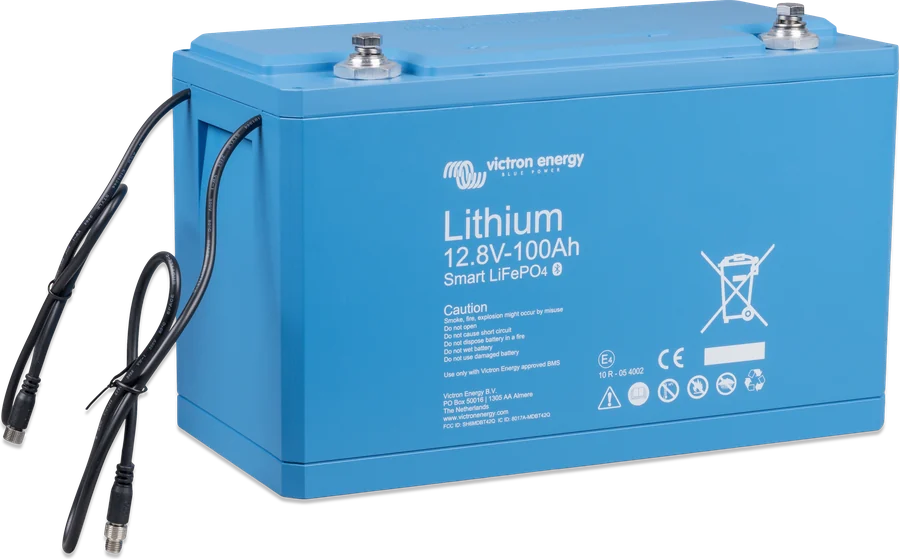
01Temperature ranges
| Lithium Smart and Lithium NG | |
|---|---|
| Charging | from +5 °C to +50 °C |
| Discharge | from −20 °C to +50 °C |
| Storage | from −45 °C to +70 °C |
The key point: in frost the battery can power loads, but it must not be charged. Charging outside the temperature range can damage the battery, and charging a Lithium Smart battery below 5 °C voids the warranty.
The Lithium NG manual adds current limits: at 0 °C and below, discharge current must be limited to 0.5C (for 200 Ah — 100 A), and below 15 °C charge current must be limited to no more than 0.3C (for 200 Ah — 60 A). Above 35 °C both currents must also be reduced.
02Capacity in frost
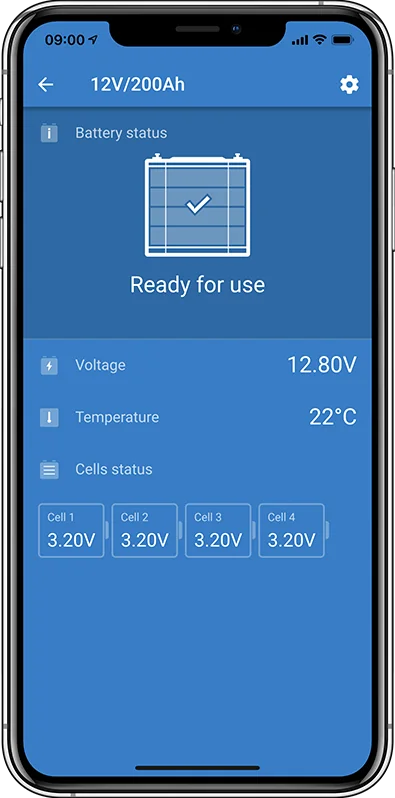
Nominal capacity is given at 25 °C. According to the Lithium NG manual it falls by about 20% at 0 °C and to about 50% at −20 °C. Lithium Smart 12.8 V/100 Ah table: 100 Ah at 25 °C, 80 Ah at 0 °C, 50 Ah at −20 °C.
SoC is calculated by the battery monitor, not by the battery itself — in frost the monitor may therefore show more than is actually available. The manual recommends that when discharging at low temperature you should mainly watch battery and cell voltage. More about SoC: SoC does not match.
03Who will block charging in frost
| Setup | How the block works |
|---|---|
| Lithium Smart / Lithium NG with Victron BMS | The battery measures temperature and reports an alarm to the BMS. At too low a temperature (for Lithium NG: below 5 °C; for Lithium Smart, the “Allowed to charge minimum temperature” threshold in VictronConnect) the BMS switches off the chargers. It works only when every charger is controlled by the BMS — via the charge disconnect contact or via GX (DVCC). |
| SmartSolar MPPT solar charge controller | “Low temperature cut-off” setting (factory disabled, default threshold 5 °C). It works only in the VE.Smart network, when the controller receives battery temperature from Smart Battery Sense or from a battery monitor with a temperature sensor. Charging resumes when the temperature rises by 0.5 °C above the threshold. In Lithium Smart this MPPT function does not replace the BMS: the battery measures temperature and reports an alarm, and only an external BMS switches off the chargers. Not needed for SuperPack from serial number HQ2040 — they block charging themselves. |
| Orion XS | Similar setting in the battery profile; it works only when battery temperature is made available by another device (for example BMV-712 or SmartShunt in the VE.Smart network) and does not work when the charger is controlled by the BMS. Triggering is indicated as Warning 151. |
Conclusion: for a lithium battery without its own frost-charge protection you need temperature measurement of the battery itself (Smart Battery Sense or a monitor with a sensor) and the protection enabled in every charger. The only way to charge in winter is to keep the battery above +5 °C — for example by installing it in a heated part of the vehicle.
In chargers for lithium batteries, temperature compensation of charge voltage is not needed — turn it off or set it to 0 mV/°C.
04Winter storage of a camper or boat
- Before storage, charge the batteries fully. Lithium Smart can be stored for up to a year at 25 °C if fully charged. Lithium NG self-discharge is at most 3% of capacity per month (at 25 °C).
- Switch off the inverter/charger and the main switch. Leave the battery monitor powered as recommended in the manual: ideally from the BMS load disconnect output. Direct power from the battery is only allowed for low-consumption monitors such as the BMV-712 or SmartShunt, with a battery bank larger than 200 Ah; such a monitor is not controlled by the BMS and may continue discharging the battery until it is damaged.
- Every 4–6 weeks, check that the batteries are not losing too much energy (Victron recommends this in the camper installation diagram).
- Remember the reserve after BMS cut-off: at the “Allowed to Discharge” threshold of 2.8 V per cell in a Lithium Smart battery, about 3% capacity remains; at 2.6 V, about 1%. After such a cut-off, the battery must be recharged quickly, because self-discharge can damage the cells. What to do after a deep discharge: lithium battery discharged.
- Victron recommends a small 230 V maintenance charger (e.g. Blue Smart IP65) instead of a running inverter/charger — but charging must still be blocked below +5 °C if the battery is standing in frost.
Devices in this guide
 LiFePO4 Smart 12,8/25,6 VLithium iron phosphate batteries with Bluetooth — work only with an external BMS.
 Lithium NGVictron’s new generation of LiFePO4 batteries: 12.8/25.6/51.2 V, IP65, built-in current measurement — only with BMS NG.
 SmartSolar MPPT 75/10–100/20Small solar controllers with Bluetooth for campervans, boats and cabins.
 Orion XSDC-DC charger 50/70 A from the alternator, including with a smart alternator.
 Smart Battery SenseWireless battery voltage and temperature sensor for controllers and chargers via VE.Smart.
 BMV-712 SmartBattery monitor with display, alarm and programmable relay.
 SmartShuntBattery monitor with 300–2000 A shunt, read on your phone or on a GX device.
 Blue Smart IP65Mains charger for 12/24 V with Bluetooth and Li-ion mode, IP65 enclosure.
Related
- LiFePO4 Smart — battery datasheet.
- BMS has disconnected charging — including a low-temperature alarm.
- A-SL22 — low-temperature alarm.